Category Archives: National Audit Office

Some of this state-sanctioned conduct would not be out of place in China or North Korea… the Horizon scandal in summary

By Tony Collins

  1. A knock on your mother-in-law’s front door at 3am. A state-sanctioned investigations team wants to interview you over stolen money you know nothing about.
  2. Your hands are bound and you are also handcuffed to one police officer on your left and another on your right. A state-owned institution says thousands of pounds is missing. It is confident you have taken it.
  3. You haven’t taken a penny but your protests count for nothing. The institution has the evidence from its computer system.
  4. You are not allowed to see your family. You are put in a vehicle and not told where you are going.
  5. You are taken to prison, kept in a cell all day and fed through a hatch. You see another prisoner who has committed suicide.
  6.  Before sending you to prison, a judge says you’ve stolen from pensioners. You are asked if you’ve used the stolen money for your recent holiday.
  7. In fact you are in prison because you had the misfortune to be a user of the institution’s computer system – called “Horizon” – at a time when it was showing discrepancies.
  8. Once a large and inexplicable shortfall appears on Horizon, more follow.  It’s the usual pattern.
  9. You are required to make good every shortfall now and in the future.  It is no excuse to say you haven’t stolen any money or made any mistakes. Evidence from Horizon is sacrosanct.
  10. If you cannot pay for the shortfalls, the institution, the Post Office, will make monthly deductions from your income, make you sell your home or make you bankrupt.
  11. You were given an impossible choice: a) accept the computer’s evidence at face value and agree to give to the Post Office any amount of money it requires you to pay now and in the future, or b) challenge the computer’s evidence and be prosecuted as dishonest.
  12. You challenged Horizon and ended up in court. Here, the denials of a branch counter clerk were unlikely to be believed against the evidence from a large and much-respected publicly-owned institution.
  13. The jury accepted that the computer was correct.  The computer seemed to work well for thousands of people every day. Why would it go wrong just in your case? But you didn’t realise then that, to everyone who complained about Horizon, the Post Office said they were the only one.
  14. You lose your job, cannot pay the mortgage and lose your home. You are traumatised, have an electronic tag, go on medication and try twice to commit suicide.
  15. Why have the courts and jury preferred the evidence from a computer system to your denials?
  16. Many years after prison has left an indelible mark on your mental well-being, it will emerge that thousands of reports on Horizon-related problems have been kept secret.
  17. The system’s problems are kept a secret for more than a decade while the Post Office, with apparent impunity, prosecutes and persecutes.
  18. To clear your name, the onus was on you and other accused to prove the system was flawed.
  19. But you had no right to see the system’s audit data. You had no way of proving whether the computer was showing non-existent shortfalls.
  20. Some families try to avoid the prosecution of a family member by raising tens of thousands of pounds to pay the Post Office for shortfalls they suspect are not real but cannot prove it. The Post Office still prosecutes.
  21. In one of the world’s most advanced nations, governments and civil service leaders turn a blind eye to a scandal that has been obvious for years to those not employed directly by the Post Office.
  22. Far from holding anyone accountable, the UK state appoints those ultimately responsible for running the Post Office and  Fujitsu, supplier of the Horizon system, to top jobs in the public sector.
  23. The Post Office has no close oversight because it is an “arm’s length body”. The state owns more than 100 ALBs. What is to stop any number of them turning on the public as the Post Office has turned on hundreds of Horizon users? In 2015, a committee of MPs found there was little understanding across government of how arm’s length bodies ought to work.
  24. It’s the job of state-funded auditors, non-executive directors, ministers and civil servants to challenge what they are told by the boards of arm’s length bodies.  If they accept assurances at face value, the governmental system of oversight breaks down. But in 2020 business minister Martin Callanan suggests that civil servants were unknowingly misled by the Post Office. Was this confirmation that the system of oversight has failed with appalling consequences?
  25. Since 2010, the media and Parliamentarians, particularly former defence minister James Arbuthnot (now Lord Arbuthnot) have tried to draw the attention of ministers to the Horizon scandal. But civil servants and postal services ministers have preferred the word of the Post Office to the pleadings of constituency sub-postmasters.
  26. After setting up a costly mediation scheme and hiring forensic accountants Second Sight to address the concerns about Horizon among MPs, particularly Arbuthnot, the Post Office ends the mediation scheme and summarily dismisses Second Sight whose report criticises Horizon.
  27. In totalitarian states, it may not be unusual for innocent people to be handcuffed and taken to prison because they questioned the output of a state-owned institution’s computer system. But in the UK?

  28. BBC Panorama reveals in 2015 that it is possible for engineers working for Fujitsu, Horizon’s supplier,  to access Post Office branch accounting systems and alter lines of code, to fix bugs, without the local Horizon users knowing.
  29. These changes could affect the branch’s financial records as shown on Horizon.
  30. Panorama is correct. Fujitsu staff can alter branch Horizon systems remotely but the Post Office issues a lengthy public denial of Panorama’s correct disclosures. Ministers and civil servants accept the Post Office’s denial.
  31. In at least two families,  the misfortune of being a Horizon user at the time of a glitch or training-related issue becomes a factor in  suicide. In other families there are attempted suicides. A  sub-postmaster suffers a stroke shortly after the Post Office wrongly suspends him, claiming incorrectly that he owes £65,000.
  32. The Post Office had the power to enrol state resources in prosecuting sub-postmasters on the basis of “robust” evidence from Horizon.
  33. Even after the extent of Horizon’s problems has come to light during High Court trials, the UK government continues to hold nobody to account.
  34. That the scandal was obvious to outsiders helped Alan Bates, a former sub-postmaster who was one of Horizon’s earliest victims, to obtain venture funding, via solicitors Freeths, of tens of millions of pounds for a High Court case against the Post Office.
  35. The Post Office tried to oppose Bates’ group litigation by claiming every individual case was different. The judge disagreed and the group litigation went ahead in 2017.
  36. Even after the first of a series of planned High Court trials started, the full extent of Horizon’s problems were kept hidden.
  37. Thousands of internal reports on Horizon’s problems were not given to the High Court until late 2019 – after several hearings and judgements in the case.
  38. In 2020, Kelly Tolhurst, the then Post Office minister, refused a request to pay a fair sum in compensation to former sub-postmasters.  She suggested in her letter that the compensation being paid by the Post Office (about £58m) was enough. Last week business minister Martin Callanan also refused state compensation. His words were almost identical to Tolhurst’s, implying that their words were drafted by civil servants at the Post Office’s parent organisation, the Department for Business, Energy and Industrial Strategy, which appears to see its role as defending the Post Office against outside criticism.
  39. To those who sold homes and lost businesses because of the Post Office’s demands for payment, under threat of criminal and civil action, the compensation being offered is no compensation at all  It will not, in the end, come close to covering their losses.
  40. Today, 10 years after a pregnant sub-postmistress fainted in the dock as she was sentenced to 15 months for stealing money she knew nothing about, and woke up in hospital in handcuffs she tried to hide, her criminal conviction has not yet been quashed. She considered taking her own life.  The state’s overriding duty to protect its citizens seems not to have applied to her.
  41. Another ordinary law-abiding Horizon user went to prison in handcuffs but her criminal conviction is still in place nearly 20 years later.
  42. Her conviction is likely to be quashed this year or next but she will have endured for much of her adult life being branded a criminal by the state. No amount of compensation can replace 20 lost years of being presumed guilty.
  43. Boris Johnson last week promised an inquiry into the Horizon IT scandal but it is likely to be resisted by civil servants. Officials may see anything other than a narrow inquiry into procedures, contracts and technical matters as not being in their interest.
  44. Last week BEIS confirmed it will not hold anyone accountable. Instead, the new business minister Lord Callanan offered Parliament a series of promises from Sir Humphrey’s phrasebook: a new framework … a working group … ministerial meetings …. cultural and organisational changes … learning lessons …  a major overhaul … strengthened relationships … productive conversations … close monitoring of progress … constant reviews … genuine commercial partnerships … direct addressing of past events … the delivery of support on the ground… accelerating a programme of improvement … engaging with stakeholders … seek evidence of real positive change. .. further accountability mechanisms.
  45. It is likely that some or most the above stock phrases will be used by every BEIS minister when giving a formal response to the Horizon IT scandal in letters, statements and Parliamentary debates.
  46. But those seeking justice will continue to campaign for fair compensation at a minimum.
  47. The campaigners in Parliament include Lord Arbuthnot, Lord Berkeley, Gill Furniss MP, Kate Osborne MP, Kevan Jones MP and Lucy Allan MP. For campaigners, the High Court rulings in favour of the sub-postmasters mark only the end of the beginning.
  48.  Some of the points below may add to grounds for the state to pay fair compensation.
Comment

A scandal perpetuated?

To be fair to the Post Office, it has acted as if it were answerable to nobody because it was indeed not answerable.

It had the very occasional polite tap on the knuckles by officials at its parent organisation, the Department for Business, Energy and Industrial Strategy [BEIS]. But nothing more.

In effect the Post Office was untouchable. It received hundreds of millions of pounds from BEIS in state aid but not even the National Audit Office was able to investigate how the money was spent.

Again, to be fair to the Post Office, it was partly in the hands of Horizon’s supplier Fujitsu when it came to understanding faults in Horizon. Fujitsu kept its own central error logs and the reports of Horizon problems. It could charge the Post Office for access to data beyond a certain point.

Given the circumstances, the Post Office did what large institutions tend to do when things go badly wrong: they  blame the weakest links in the corporate chain, the human operators.

Fatal crashes of the Boeing 737 Max were, at first, blamed on the weakest inks – pilots – instead of on a poorly-designed onboard computer system.

Again, after the Chernobyl nuclear reactor explosion, the plant’s human operators, the weakest links, were blamed, which initially helped to cover up the reactor’s design and construction deficiencies.

And after the crash of a military Chinook killed 25 VIPs on the Mull of Kintyre, the two dead pilots, the weakest links, were blamed while deficiencies with the helicopter’s computer systems were hidden.

In the case of the Horizon scandal, the weakest links when the system went wrong were the sub-postmasters. About 550 sub-postmasters took part in subsequent litigation but the Horizon shortfall scandal might have claimed another 500 or so victims who hadn’t realised at first that they weren’t alone.

That the Post Office’s parent department BEIS appears to have no interest in paying compensation or holding accountable anyone for the Horizon scandal is not a surprise given that it is part of the problem.

Indeed, it’ll be no surprise if its civil servants resist making good on Boris Johnson’s promise of an inquiry. There are already signs of this, according to Computer Weekly.

For years, BEIS and its successive postal services ministers have accepted the Post Office’s word when it was obvious to Computer Weekly and Parliamentarians that a scandal was taking place under the noses of those running the department.

The Post Office’s party line continues?

In their carefully-worded reactions to the Horizon IT scandal, the current Post Office CEO Nick Read, Post Office chairman Tim Parker, former Postal Services minister Kelly Tolhurst and a current business minister Lord Callanan, have all referred to wrongs as being “in the past”.

Perhaps unwittingly, they appear collectively to be following a party line – although Sir Peter Fraser QC, the High Court judge in the Horizon case, was particularly critical of Post Office witnesses who appeared to follow a party line.

Perhaps Read, Parker, the Post Office press office and Lord Callanan wish to consign the Horizon scandal to history.

-In its corporate apology the Post Office’s statement said,

“We accept that, in the past, we got things wrong …”

In his apology, Tim Parker, Post Office chairman, said that the December 2019 High Court judgement,

“makes findings about previous versions of the [Horizon] system and past behaviours …”

In January 2020, the then postal services minister Kelly Tolhurst said in a letter to Justice for Sub-Postmasters Alliance that the Post Office accepted and recognised that,

“… in the past they had got things wrong…”

Last week, business minister Lord Callanan said at the end of a short debate in Parliament on the Horizon IT scandal,

“Post Office Ltd has accepted that, in the past, it got things badly wrong … ”

“We accept that, in the past, we got things wrong …”

“the Post Office is also continuing to directly address past events for affected postmasters …”

Nick Read, the current Post Office CEO said there was a need to

“… learn lessons from the past.”

[My emphases]

But the scandal is not in the past. Far from it.

In February 2020, Mark Baker, a sub-postmaster and spokesman for the communications union CWU, told a BBC File on 4 documentary that he knows of Horizon shortfall incidents of nearly one a week continuing in one UK region alone this year.

File on 4 also raised the question of whether it is easier to blame “user error” than the Post Office’s having to fine Fujitsu for not fixing a bug within a pre-defined time limit.

Another reason the apologies of the Post Office and ministers for “past” wrongs are disingenuous is that they avoid any apology for the Post Office’s conduct in the litigation.

In his High Court rulings, Sir Peter Fraser was prolific in his  criticisms of the Post Office’s dealings with sub-postmasters but he also attacked its conduct in the much more recent litigation.

It is this conduct that demeans the reputation of UK government and public sector institutions as a whole.

When ministers and the Post Office refer to such conduct as historic they are, in essence,  excusing it. By apologising for past events only, business ministers appear to have become apologists for the Post Office’s conduct in the litigation … conduct such as this:

  • Several Post Office witnesses did not give accurate or impartial evidence to the High Court in 2018 and 2019.  That wasn’t in a past era.
  • A current Post Office director tried to mislead the High Court, as did a witness from IT supplier Fujitsu. This wasn’t in a past era.
  • The Post Office opposed the setting up of a group litigation order, sought to have no substantive trial listed at all and, when this failed, tried to strike out much of the evidence of sub-postmasters before the trials started.
  • During the first trial the Post Office, said the judge, seemed to try and put the court “in terrorem”  – which means serving or intended to threaten or intimidate.” None of this was in a past era.
  • The  judge said some Post Office costs were “extraordinarily high, unreasonable and disproportionate”.
  • In addition to the above costs, the Post Office hired four QCs and two firms on solicitors. It also fielded 14 witnesses against the six lead claimants for the sub-postmasters.
  • The publicly-funded Post Office appeared to be trying to rack up costs, perhaps to drain the funding of the former sub-postmasters and force them into submission.
  • The Post Office sought to have the judge removed – a highly unusual and costly approach to the litigation.  The judge expressed surprise that the Post Office applied to remove him near the end of a lengthy trial. If the judge had stood down, a re-trial would have happened, adding greatly to costs that were already tens of millions of pounds by this stage. It was only last year that the Post Office sought to have the judge removed –  not in a past era.

How many more business ministers will try to consign the Horizon scandal to the past?

That the scandal is one of the most serious group miscarriages of justice in decades is not in doubt.

But by not paying fair compensation, the state is, in essence, sending a signal to the public sector that if another group of innocent people are handcuffed, bundled into a van and taken into prison for doing nothing more than questioning the system, the state will care even less than it does today.

Holding nobody to account and not paying fair compensation also sends a message to the public and Parliament: that it is acceptable for a state-owned institution to conduct itself as if it were answerable to nobody.

One question that still remains unanswered is how a state-owed institution was able – perhaps is still able – to maintain a control and influence similar in status to that of a cult.

For more than two decades, the civil service and ministers accepted the Post Office’s criticisms of sub-postmasters. The courts and judges too.

The Post Office was also able to enlist the support of some the UK’s top QCs in litigation to fight sub-postmasters.

And the Post Office’s most senior witness in the case, whom the judge described as a very clever person,  seemed “entirely incapable of accepting any other view of the issues other than her own”, said the judge. She exercised her judgement to “paint the Post Office in the most favourable light possible, regardless of the facts”.

Other Post Office witnesses in the case were expected to give impartial evidence to the court but followed its party line. Even the Post Office’s expert witness who was professionally required to give impartial evidence to the court was, according to the judge, “partisan” in favour of the Post Office’s case.

The Post Office’s control extended to the sub-postmasters’ supposed trades union, the National Federation of Sub-postmasters: the Post Office secretly gave the Federation millions of pounds that could be clawed back if the Post Office disapproved of the Federation’s public criticisms.

Are BEIS civil servants and ministers, therefore, under the influence of a cult-like institution when they tell MPs the Horizon scandal is in the past and they refuse to apologise for conduct in the litigation, refuse compensation and refuse to hold anyone accountable?

Are the BEIS civil servants and ministers also remarkably naïve when they ask MPs and peers to accept a series of Sir Humphryisms instead of fair compensation for hundreds of damaged or ruined lives?  …  a new framework, ministerial meetings, a monitoring of progress… phrases that could be the output of platitude-generating software?

Do ministers really believe that the Post Office, after decades of control  and influence is able to change suddenly now that it has a new CEO and the Horizon scandal is acknowledged at the top of government?

If ministers want to convince us that the Post Office, BEIS and the government are genuinely contrite, they will pay fair compensation to former sub-postmasters  and hold to account those responsible for the scandal and the failure to put an early stop to its all-too-obvious traumatic consequences.

Acknowledgements:

Alan Bates

Karl FindersNick Wallis, Tim McCormack, Mark Baker, James Arbuthnot, Eleanor Shaikh,  Private Eye, File on 4, Panorama, Christopher Head

Is the Post Office to blame for Horizon IT dispute – or is it really ministers and civil servants?

By Tony Collins

How does a public institution behave when it has little effective oversight?

Mr Justice Peter Fraser is expected to rule shortly on a critical question that is at the heart of a long-running IT dispute between the Post Office and hundreds of former sub-postmasters.

His ruling may answer the question of whether the Post Office’s “Horizon” IT or sub-postmasters were likely to have been to blame for unexplained shortfalls of sometimes tens of thousands of pounds shown on local branch systems.

If the Post Office loses the High Court case, it could end up paying damages of hundreds of millions of pounds – which could fall to the taxpayer. The state owns 100% of the Post Office. Public funding of the Post Office amounted to £2bn between 2010 and 2017 and a further funding package of £370m is agreed until 2021. Any damages could be on top of this.

If the case ends up with the Post Office’s needing a taxpayer bail-out, this would raise some obvious questions:

  1. Who in government and the civil service provided oversight when the Post Office decided controversially to trust what was shown on a proprietary computer system rather than the word of hundreds of local branch sub-postmasters?
  2. Who in government and the civil service endorsed the Post Office’s decision to defend litigation that could end up costing taxpayers hundreds of millions of pounds?
  3. Who in government and civil service endorsed the decision to continue defending the litigation – and indeed deepening it – despite excoriating criticisms of the Post Office by two High Court judges?

It is still possible for the Post Office to win the case in which event its actions and decisions may be vindicated. But it has lost every interim ruling so far, in a case which has lasted two years to date.

When asked about their oversight of the Post Office, ministers have distanced themselves.

In August 2019, the then Minister for Postal Services, Kelly Tolhurst, said in a letter that Post Office Limited “operates as an independent, commercial business and the matters encompassed by this litigation fall under its operational responsibility”.

But thanks to extensive research by Eleanor Shaikh, a reader of the blog of journalist Nick Wallis, who is crowd-funded to cover the High Court hearings, we know that civil servants reporting to ministers have extensive responsibilities for oversight of the Post Office.

The state categorises the Post Office as an “Arm’s Length Body”]. Shaikh learned that the Department for Business Energy and Industrial Strategy is required to “exercise meaningful and commensurate oversight of ALB [Arm’s Length Body] strategy, financial management, performance and risk management”.

A 2014 Civil Service document, Introduction to Sponsorship, adds that,

“the Secretary of State is ultimately accountable to Parliament for the overall effectiveness and efficiency of each ALB of which their department is responsible.”

It’s not only about oversight. Civil servants are,

“… expected to play an active role in the governance, financial management, risk management and performance monitoring of ALBs and are responsible for managing the relationship with an ALB on behalf of the Minister and the AO [accounting officer].”

Wallis reports in full on Shaikh’s findings.

How effective has civil service oversight been so far?

The judge’s comments in his ruling of March 2019, which the Post Office is seeking leave to appeal, suggest that there has been little effective civil service challenge to Post Office’s decisions. Indeed, one of the judge’s findings was that,

“The Post Office appears, at least at times, to conduct itself as though it is answerable only to itself.”

The judge also criticised,

  • untrue statements by the Post Office
  • threatening and oppressive behaviour by the Post Office.
  • the Post Office’s appearing “determined to make this litigation, and therefore resolution of this intractable dispute, as difficult and expensive as it can”.
  • the Post Office house style for some senior management personnel giving evidence which was to “glide away from pertinent questions, or questions to which the witness realised a frank answer would not be helpful to the Post Office’s cause”.
  • a culture of secrecy and excessive confidentiality generally within the Post Office but particularly focused on Horizon
  • Post Office witnesses in general who have become “so entrenched over the years, that they appear absolutely convinced that there is simply nothing wrong with the Horizon system at all …”
  • attempts by the Post Office to prevent some evidence from emerging into the public domain by applying to have it struck out as irrelevant
  • attacks by the Post Office on the credibility of sub-postmasters whom the judge found credible as witnesses in the case.
  • some Post Office procedures that went from the sublime to the ridiculous,
  • some Post Office submissions that were “bold, pay no attention to the actual evidence, and seem to have their origin in a parallel world”.
  • the Post Office’s asking a sub-postmistress to extend the local branch’s opening hours a day after her husband, who ran the branch, had died.

Of the Post Office’s most senior witness, a director, the judge described her as highly intelligent. She on occasions gave clear and cogent evidence. She helped to improve the Horizon system and had provided some useful evidence.

But in describing parts of her evidence he also referred to a “degree of obstinacy”, extraordinarily partisan”, “sought to obfuscate matters…”, “disingenuous” and a “disregard for factual accuracy”. He said at one point in his ruling, “I find that she was simply trying to mislead me.”

He concluded, “I find that it is necessary to scrutinise everything she said as a witness, both in her witness statement and in cross-examination, and treat it with the very greatest of caution in all respects.”

Comment

If the judge is right in his criticisms – and it is too early in the appeals process to say conclusively that he is right – is he simply describing the behaviour of a state institution that is, in essence, without higher control?

Civil servants from, among others, the Department for Work and Pensions, HM Revenue and Customs, the Ministry of Defence, Home Office and DEFRA appear regularly before the Public Accounts Committee and are the subject of value-for-money investigations by the National Audit Office. The Post Office has little of this scrutiny.

A large private company has many shareholders and the threat of going bust to keep it in check. But the Post Office is too big and important to the community to be allowed to fail.

When Boeing’s aircraft technology is the subject of independent, detailed and widespread criticism, its planes are grounded indefinitely while regulators investigate.

The Post Office has no fear of any regulators shutting down its Horizon system.

In an accountability vacuum, how can a state institution be expected to behave?

Individuals within a large organisation will have a sense of right and wrong. But collectively, can people within state institutions be expected to do much more than meet the requirements of the culture and law as they perceive it?

That is why effective and rigorous oversight of state institutions is critical, if only to protect the interests of taxpayers.

When the widow of a sub-postmaster who’d died the previous day took over his branch, the Post Office asked her to extend the opening hours, which seems to have surprised the judge. Wouldn’t that behaviour surprise anyone?

When shortfalls were shown on the computer system, how easy was it for the Post Office to demand that sub-postmasters made good the losses sometimes without full investigations? It was easier, perhaps, without effective oversight.

Can the Post Office be held entirely responsible for the Horizon IT debacle? It is a state institution. Responsibility for the debacle lies, therefore, with ministers and civil servants, whatever the outcome of the Horizon dispute.

Nick Wallis’ trial coverage including Eleanor Shaikh’s research on the oversight that ought to be provided by ministers and the civil service.

Computer Weekly’s useful summary of the latest position


Civil servant in charge of £9.3bn IT project is not shown internal review report on scheme’s failings.

By Tony Collins

“If people don’t know what you’re doing, they don’t know what you’re doing wrong” – Sir Arnold Robinson, Cabinet Secretary, Yes Minister, episode 1, Open Government.

Home Office officials kept secret from the man in charge of a £9.3bn project a report that showed the scheme in serious trouble.

The Emergency Services Network is being designed to give police, ambulance crew and firemen voice and data communications to replace existing “Airwave” radios.  The Home Office’s permanent secretary Philip Rutnam describes the network under development as a “mission-critical, safety-critical, safety-of-life service”.

But Home Office officials working on the programme did not show an internal review report on the scheme’s problems to either Rutnam or Stephen Webb, the senior responsible owner. They are the two civil servants accountable to Parliament for the project.

Their unawareness of the report made an early rescue of the Emergency Services Network IT programme less likely. The scheme is now several years behind its original schedule, at least £3.1bn over budget and may never work satisfactorily.

The report’s non circulation raises the question of whether Whitehall’s preoccupation with good news and its suppression of the other side of the story is killing off major government IT-based schemes.

With the Emergency Services Network delayed – it was due to start working in 2017 – police, ambulance and fire services are having to make do with the ageing Airwave system which is poor at handling data.

Meanwhile Motorola – which is Airwave’s monopoly supplier and also a main supplier of the Emergency Services Network – is picking up billions of pounds in extra payments to keep Airwave going.

Motorola may continue to receive large extra payments indefinitely if the Emergency Services Network is never implemented to the satisfaction of he emergency services.

EE is due to deliver the network component of the Emergency Services Network. Motorola is due to supply software and systems and Kellogg Brown & Root is the Home Office’s delivery partner in implementing the scheme.

Has Whitehall secrecy over IT reports become a self-parody?

The hidden report in the case of the Emergency Services Network was written in 2016, a year after the scheme started. It said that dialogue between suppliers, notably EE and Motorola, did not start until after the effective delivery dates. Integration is still the main programme risk.

MP SIr Geoffrey Clifton Brown has told the Public Accounts Committee that the report highlighted an absence of clarity regarding dependency on the interface providers, which caused something of an impasse.

He said the report “alluded to the fact that that [a lack of clarity around integration] remains one of the most serious issues and is not showing any signs of resolution”.

Stephen Webb has been in charge of the project since its start but he is the business owner, the so-called “senior responsible owner” rather than the programme’s IT head.

In the private sector, the IT team would be expected to report routinely to a scheme’s business owner.

But in central government, secrecy over internal assurance reports on the progress or otherwise of major IT-related projects is a Whitehall convention that dates back decades.

Such reports are not published or shared internally except on a “need-to-know” basis. It emerged during legal proceedings over the Universal Credit IT programme that IT project teams kept reports secret because they were “paranoid” and “suspicious” of colleagues who might leak documents that indicated the programme was in trouble.

As a result, IT programme papers were no longer sent electronically and were delivered by hand. Those that were sent were “double-enveloped” and any that needed to be retained were “signed back in”; and Universal Credit programme papers were watermarked.

The secrecy had no positive effect on the Universal Credit programme which is currently running 11 years behind its original schedule.

Webb has told MPs he was “surprised” not to have seen review report on the Emergency Services Network. He discovered the report’s existence almost by accident when he read about it in a different report written a year later by Simon Ricketts, former Rolls Royce CIO.

This month the Public Accounts Committee criticised the “unhealthy good news” culture at the Home Office. The Committee blamed this culture for the report’s not being shown to Webb.

The Home Office says it doesn’t know why Webb was not shown the “Peter Edwards” report. The following was an exchange at the Public Accounts Committee between MP Sir Geoffrey Clifton-Brown, Webb and Rutnam.

Clifton-Brown: When you did that due diligence, were you aware of the Peter Edwards report prepared in the fourth quarter of 2016?

Rutnam: No, I’m afraid I was not. The Peter Edwards report on what exactly, sorry?

Clifton-Brown: Into the problems with ESN [Emergency Services Network], in particular in relation to suppliers.

Rutnam: I do not recall it. It may have been drawn to my attention, but I’m afraid I do not recall it.

Webb: It was an internal report done on the programme. I have not seen it either.

Clifton-Brown: You have not seen it either, Mr Webb—the documents tell us that. Why have you not seen such an important report? As somebody who was in charge of the team—a senior responsible officer—why had you not seen that report?

Webb: I don’t know. I was surprised to read it in Simon’s report. [Simon Ricketts.]

Chair: Who commissioned it?

Webb: The programme leadership at the time.

Chair: That is the board?

Webb: The programme director. It was a report to him about how he should best improve the governance. I think he probably saw it as a bit of an external assurance. It probably would have been better to share it with me, but that was not done at the time.

Clifton-Brown: “Probably would have been better to share it”? That report said that dialogue between suppliers, notably EE and Motorola, only started after the effective delivery dates. The report highlighted that there was not clarity regarding dependency on the interface providers, and that caused something of an impasse. It also alluded to the fact that that remains one of the most serious issues and is not showing any signs of resolution. That was in 2016, in that report. Had that report been disseminated, would we still be in the position that we are today?

Webb: I think that we would have wanted to bring forward the sort of [independent] review that the Home Secretary commissioned, and we would have done it at an earlier date.

Clifton-Brown: Why did you need to? You would not have needed to commission another review. You could have started getting to the root of the problem there and then if you had seen that report.

Webb: Yes.

Comment:

Webb and Rutman seem highly competent civil servants to judge from the open way they answered the questions of MPs on the Public Accounts Committee.

But they did not design the Emergency Services Network scheme which, clearly, had flawed integration plans even before contracts were awarded.

With no effective challenge internally and everything decided in secret, officials involved in the design did what they thought best and nobody knew then whether they were right or wrong. With hindsight it’s easy to see they were wrong.

But doing everything in secret and with no effective challenge is Whitehall’s  systemically flawed way of working on nearly all major government IT contracts and it explains why they fail routinely.

Extraordinary?

It’s extraordinary – and not extraordinary at all – that the two people accountable to Parliament for the £9.3bn Emergency Services Network were not shown a review report that would have provided an early warning the project was in serious trouble.

Now it’s possible, perhaps even likely, the Emergency Services Network will end up being added to the long list of failures of government IT-based programmes over the last 30 years.

Every project on that list has two things in common: Whitehall’s obsession with good news and the simultaneous suppression of all review reports that could sully the good news picture.

But you cannot run a big IT-based project successfully unless you discuss problems openly. IT projects are about solving problems. If you cannot admit that problems exist you cannot solve them.

When officials keep the problems to themselves, they ensure that ministers can be told all is well. Hence, ministers kept telling Parliament all was well with the £10bn National Programme for IT in the NHS  – until the scheme was eventually dismantled in 2011.

Parliament, the media and the public usually discover the truth only when a project is cancelled, ends up in the High Court or is the subject of a National Audit Office report.

With creative flair, senior civil servants will give Parliament, the National Audit Office and information tribunals a host of reasons why review reports on major projects must be kept confidential.

But they know it’s nonsense. The truth is that civil servants want their good news stories to remain uncontradicted by the disclosure of any internal review reports.

Take the smart meters roll-out. Internal review reports are being kept secret while officials give ministers and the Department for Business, Energy and Industrial Strategy the good news only. Thus, the latest Whitehall report on smart meters says,

“Millions of households and small businesses have made the smart choice to get a smart meter with over 12.8 million1 operating in smart mode across Great Britain. This world leading roll out puts consumers firmly in control of their energy use and will bring an end to estimated bills.”

Nothing is said about millions of homes having had “smart” meters installed that are neither smart nor compatible for the second generation of smart meters which have a set of problems of their own.

The answer?

For more than 30 years the National Audit Office and the Public Accounts Committee have published seemingly unique reports that each highlight a different set of problems. But nobody joins the dots.

Sir Arnold, the Cabinet Secretary said in “Yes Minister“, that open government is a contradiction in terms. “You can be open, or you can have government.

This is more than a line in a TV satire.  It is applied thinking in every layer of the top echelons of civil service.

Collective responsibility means civil servants have little to fear from programme failures. But they care about departmental embarrassment. If reviews into the progress or otherwise of IT-enabled programmes are published, civil servants are likely to be motivated to avoid repeating obvious mistakes of the past. They may be motivated to join the dots.

But continue to keep the review reports secret and new sets of civil servants will, unknowingly each time, treat every project as unique. They will repeat the same mistakes of old and be surprised every time the project collapses.

That the civil service will never allow review reports of IT programmes to be published routinely is a given. If the reports were released, their disclosure of problems and risks could undermine the good news stories ministers, supported by the civil service, want to feel free to publish.

For it’s a Whitehall convention that the civil service will support ministerial statements whether they are accurate or not, balanced or not.

Therefore, with review reports being kept secret and the obsession with good news being wholly supported by the civil service, government’s reputation for delivering successful IT-based programmes is likely to remain tarnished.

And taxpayers, no doubt, will continue to lose billions of pounds on failed schemes.  All because governments and the civil service cannot bring themselves to give Parliament and the media – or even those in charge of multi-billion pound programmes –  the other side of the story.

Home Office’s “unhealthy good news culture” blamed for Emergency Services Network Delays – Civil Service World

Emergency Services Network is an emergency now – The Register

Home Office not on top of emergency services programme – Public Accounts Committee report, July 2019

Will Post Office need state bail-out if it loses Horizon IT trial?

By Tony Collins

The Government is now aware, if it wasn’t before, that Horizon IT trials could end up costing the publicly-owned Post Office hundreds of millions of pounds.

Is continuing the case a gamble with public money?

Tom Cooper, the Government’s shareholder on Post Office board

Journalist Nick Wallis has questioned a minister and a senior official on the possible cost implications if the Post Office loses a High Court case over the Horizon IT system.

His questions to the Post Office minister Kelly Tolhurst and civil servant Tom Cooper, who is the government’s representative on the Post Office board, could help to ensure that the Government is aware that the Horizon IT trial may end up costing the Post Office hundreds of millions of pounds if it loses.

This awareness could raise questions among ministers and civil servants about whether the Post Office will face financial problems or even insolvency if it loses the Horizon trials.

The litigation began in 2017 and the Post Office has lost all of the several rulings so far. Judgements have been strongly critical of the Post Office, its approach to the litigation and its behaviour.

Hundreds of millions of pounds?

Tom Cooper joined the Post Office’s board as non-executive director last year. On the board he represents, on behalf of the Department for Business, Energy and Industrial Strategy,  the Government’s 100% shareholding in the Post Office.

He is a director of UK Government Investments, which is wholly-owned by HM Treasury and represents government interests on the boards of arm’s length bodies including the Post Office.

Wallis asked Cooper about the government’s strategy if the claimants win the case. Claimants are about 550 former sub-postmasters who are suing the Post Office – potentially for hundreds of millions of pounds – because they say they were unjustly forced to make good non-genuine losses shown on the Horizon system.

The Post Office is strongly defending the case, arguing that Horizon is robust and that the sub-postmasters were to blame for actual losses.

In his reply to Wallis, Cooper explained that claimants have not declared the size of the damages they seek. Wallis cited Freeths solicitors, which represents the former sub-postmasters, as saying the litigation could cost the Post Office hundreds of millions of pounds.

Cooper replied that no sums of that nature had been mentioned in court. At this point, one of Cooper’s colleagues politely terminated the interview.

Bail-out?

Wallis also questioned Post Office minister Kelly Tolhurst on the possible cost implications if the Post Office loses the case. She politely declined to answer directly saying, “I can’t really go into the litigation stuff… I’m not being evasive. I can’t speak to you about it.”

Wallis asked whether, if the Post Office loses, the government could end up bailing out the Post Office. Tolhurst said she wouldn’t “get into theoretical-based outcomes of the litigation.”

But Tolhurst disclosed that there were conversations going on between the Post Office, civil servants and the ministry [Department for Business, Energy and Industrial Strategy which is the Post Office’s parent ministry].

HM Treasury’s UK Government Investments is responsible for ensuring the Post Office has enough investment and subsidy funding to ensue it is commercially sustainable in the longer term, whilst meeting its social obligations, particularly around minimum network coverages requirements.

UK Government Investments also advises ministers on Post Office commercial and policy issues.

Comment

Wallis’s interviews with Cooper and Tolhurst are important developments: they mean that officials and ministers cannot credibly deny in future that, if they end up bailing out the Post Office, it has come as a shock.

In Wallis’ questions, he made it clear that solicitors Freeths had said the litigation could end up costing the Post Office hundreds of millions of pounds.

Cooper tacitly acknowledged in his reply that he had heard what Wallis said. Indeed, Cooper’s impressive financial background indicates that he will have a good understanding of the possible cost implications for the Post Office if it loses the case.

Cooper was global co-chairman of mergers and acquisitions at Deutsche Bank. He was at UBS Investment Bank for 21 years where his various roles included head of European merger and acquisitions.

Of course, ministers and officials could argue internally – at the moment – that taxpayers are not funding the litigation.

Indeed, Whitehall officials have obtained a written assurance from the Post Office that it will fund the Horizon litigation from its own money, not public money that is allocated to modernisation and new investment in the Post Office’s network.

But it’s a different story if the Post Office runs into financial trouble.

The Government would have no choice but to use public money for a bail out. It could not allow the Post Office to go bust.

And thanks to Wallis’ questions yesterday,  ministers could not argue they were unaware of the full possible cost implications of losing the case.

Indeed, it is incumbent on civil servants now to make sure ministers are aware of what could happen if the Post Office loses the case and cannot afford to pay damages and costs from its own money.

When fully aware of the risks – the gamble with public money – will ministers and officials allow the Post Office to continue spending large sums on the High Court case – or will they urge it to settle now before many more millions of pounds are spent on legal costs?

The judge in the trials, Mr Justice Fraser, has said the case will continue for “years”. Ministers and officials could therefore take the attitude that they may be long gone by the end of the trials and therefore costs are a matter for their successors.

Or they could do the right thing and urge the Post Office to limit its potential liabilities by settling now.

Wallis has a full account of his conversations with Cooper and Tolhurst on his postofficetrial blog.

Post Office Ltd and the money tree – Tim McCormack’s blog

Post Office ordered to pay £5m towards claimants’ costs – part of Computer Weekly’s coverage of Horizon trials

How is Post Office paying for increasing costs of Horizon IT litigation – MP asks questions

The Post Office has lost all four High Court rulings  (so far) in a series of hearings over its Horizon IT system. There are still three trials to go. With appeals, the number of hearings and judgements, and  the duration of the case, are indeterminate.

How is the publicly-funded Post Office paying for litigation that is, in essence, its defence of the Horizon system?

By Tony Collins

Labour MP Kevan Jones has this week asked a series of pertinent questions about costs and the Post Office’s dispute with former sub-postmasters over the Horizon branch accounting system.

His Parliamentary questions are likely to draw the attention of business secretary Greg Clark to the increasing costs of a High Court trial in which more than 550 former sub-postmasters seek compensation and damages from the Post Office. They say they were made to pay for unexplained shortfalls shown on Horizon that could have been caused by bugs or other system weaknesses.

The Post Office says Horizon is robust and the shortfalls were the result of dishonesty or mistakes by sub-postmasters or their staff. The Post Office has pursued sub-postmasters for “debts” shown on the Horizon system of millions of pounds in total.

Kevin Jones’ questions follow a judgement last month in which a High Court judge, Mr Justice Peter Fraser, referred to the Post Office’s approach to the costs of the litigation.

“The Post Office has appeared determined to make this litigation, and therefore resolution of this intractable dispute, as difficult and expensive as it can,” said the judge.

Since that judgement, costs have risen further because the Post Office has decided to appeal last month’s judgement. The Post Office has also applied for the judge to remove himself from three remaining trials over the Horizon system. which caused the second trial to be suspended.

This week it has emerged that costs, which could run into tens millions of pounds, are set to rise again. Although the judge has refused permission for the Post Office to appeal his refusal to remove – “recuse”  himself, the Post Office can ask the Court of Appeal to grant that permission.  BBC legal commentator Joshua Rozenberg has tweeted,


Kevan Jones has asked the business secretary Greg Clark:

  • what steps he is taking to ensure the Government is held accountable for the decisions and actions of Post Office Limited in the handling of postmasters’ problems with Horizon.
  • whether public money has been used to pay costs involved in the ongoing dispute with postmasters since 2000.
  • whether the Lord Chancellor will determine the extent of any conflict of interest on the part of Tim Parker by reason of his dual roles of (a) the Chairman of Post Office Limited; and (b) the Independent Chair of the HM Courts and Tribunal Service Board.
  • what the anticipated increased cost implications are for Post Office Limited in its dealing with serving Subpostmasters following the High Court decision handed down on 15 March 2019.
  • whether the Post Office has ever taken into profit from its suspense accounts any unreconciled sums recovered from Subpostmasters.

Former sub-postmaster Alan Bates, founder of Justice for Subpostmasters Alliance and lead claimant in the case, told Computer Weekly, 

“This move by Post Office Ltd to have the judge recused was just another act by an organisation abusing the use of public money to litigate a valid case into the ground in order to protect the reputations of just a few individuals and a dysfunctional business.”

The Post Office said, “We will be seeking to appeal the judgment on the recusal application and to continue to vigorously defend this litigation. We believe the overall litigation remains the best opportunity to resolve long-standing issues in order to ensure a stable and sustainable Post Office network for the benefit of the communities who rely on our services every single day.”

Freeths, solicitors for the sub-postmasters,  has submitted an application for the Post Office to pay the legal costs in the first trial, likely to be for several million pounds.

Comment:

Kevan Jones is right to ask questions about the publicly-funded Post Office and costs. The Post Office appears to have no cap on how much it is prepared to spend on the litigation; and it has shown little or no concern about how many years the case will continue.

Institutions, particularly public ones,  have a duty to spend money wisely. Not cutting your losses when you are losing a series of High Court hearings is poor judgement.

The Post Office has a choice: continue to pour money into a case that looks, on the basis of evidence so far, to be unwinnable.  Or pay the millions it is giving lawyers to its former sub-postmasters instead.

It’s a decision the Post Office will not make on its own – in which case Kevan Jones and his Parliamentary colleagues must continue their campaign for justice.

Thank you to sub-postmaster “Mrs Goggins”  and former sub-postmaster Jo Hamilton whose tweets alerted me to Kevan Jones’ questions.

Computer Weekly’s coverage

Journalist Nick Wallis’ coverage

Former sub-postmaster and campaigner Tim McCormack’s blog


Will more campaigners die as they await justice in extended Post Office IT dispute?

A High Court dispute over the Post Office Horizon IT system is expected to cost tens of millions of pounds. But what is the human cost of delaying the outcome?

Tomorrow a High Court judge will consider an application by the Post Office to recuse – remove – himself from a series of trials that relate to the Post Office’s Horizon IT system. The Post Office accuses him of bias.

The Post Office’s application means that the second of four trials is currently suspended. A final outcome of the various hearings, after appeals,  could be years away.

Will any delayed final outcome have an effect on the 600 or so sub-postmasters who are part of the litigation?

It is a concern expressed by the judge in the case, Sir Peter Fraser, QC who is head of the High Court’s Technology and Construction Court. In his 1,100-paragraph judgement delivered last month after the first trial, he said,

“Even on that intended timetable, some Claimants [sub-postmasters] may be waiting far longer than is ideal to have their claims fully resolved either in their favour, or against them.

“Some of the Claimants are retired; some are elderly; some have  criminal convictions under review by the Criminal Cases Review Commission.

“Nobody involved in this litigation is getting any younger as time passes. The Post Office itself is under a cloud in respect of these unresolved allegations and I consider it to be an obvious point that resolution of this litigation as soon as possible is in the interests of all the parties – all the Claimants and the Post Office – in the interests of justice and the wider public interest.”

Is the Post Office trying its best to expedite an outcome? Mr Justice Fraser suggested the opposite. His judgement said,

“The Post Office has appeared determined to make this litigation, and therefore resolution of this intractable dispute, as difficult and expensive as it can.” [Par 544].

Separately, the judge said,

“It does appear to me that the Post Office in particular has resisted timely resolution of this Group Litigation whenever it can, and certainly throughout 2017 and well into 2018.” [Par 14]

The judgement referred to the Post Office’s “attritional approach of the Post Office to this litigation”. [Par 569]

If the judge is right and if the Post Office board is determined to make the litigation as difficult and expensive as it can, what of the human cost of any delays taking into account the age of some of those involved and the hopes of those with criminal convictions whose cases are under review?

Traumatised

Journalist Nick Wallis who is covering the High Court trials reports that he has been told that some sub-postmasters remain “traumatised” by their experience of losses shown on the Horizon system that they were required to make good.

Some of the sub-postmasters, says Wallis,  “are having to work long past retirement age” with all their life savings taken to pay for losses that are now in dispute as part of the sub-postmasters versus Post Office litigation.

The Post Office contends that Horizon is robust and that it was justified in holding sub-postmasters responsible for discrepancies and shortfalls shown on the system. The sub-postmasters claim damages saying the Post Office unjustly required payments for losses shown on an imperfect Horizon system. They argue the losses were not real shortfalls.

For one justice campaigner, Julian Wilson, a former sub-postmaster from Redditch in Worcestershire,  time ran out in 2016. Nick Wallis knew Wilson as a gentle, generous and good humoured man. The Post Office prosecuted Wilson for false accounting after unexplained shortfalls on the Horizon system.

The Criminal Cases Review Commission was reviewing his conviction when he died.

Wilson had been sentenced to 200 hours of community service and had to pay the Post Office £27,500 plus £3,000 costs. He told the Daily Telegraph in 2013,

“Initially, when there were discrepancies [on the Horizon system], my wife and I were putting the money in. As the discrepancies got larger and larger, we were no longer able to afford it.

“I told my line managers on several occasions that I was concerned about this, and the comment I got back from them was: ‘Don’t worry, the system will put itself right.’

“But it never did, so I was taken to court. I hadn’t taken a penny. Everything we’ve got has gone. In the last few weeks, we’ve been doing car boot sales to try to get some money to put some food on the table. My wife even had to sell her engagement ring.”

Comment

It is by no means certain that all of the 600 or so former sub-postmasters who are fighting for justice will live to know the final outcome of the trials.

If sympathetic to its former sub-postmasters, the Post Office could settle the litigation or seek expedited judgements. On the other hand, the Post Office could, given its deep pockets as a public institution,  seek to replace trial judges and appeal judgements. If so, a final outcome could be delayed with no end date in sight,

Business minister Kelly Tolhurst MP has responsibility for postal affairs. In deciding whether or not to intervene, will she weigh up the cost in human terms of a dispute that began more than 10 years before the start of the High Court Horizon trials?

MPs called the Post Office Horizon dispute a national scandal but to the family of Julian Wilson it is a tragedy. They live with the knowledge that he went to his grave a near-bankrupt convicted criminal whose wife ended up selling her engagement ring  because of events that followed losses shown on a branch accounting system.

Nick Wallis’ Post Office trial coverage

Post Office lacked humanity in treatment of sub-postmasters, says peer – Computer Weekly’s coverage of the Post Office’s trial

Blog of campaigning former sub-postmaster Tim McCormack

Could MPs hold Post Office directors to account for Horizon IT trial costs – after they have left?

By Tony Collins

The Public Accounts Committee and the National Audit Office have been alerted to the costs of the High Court trials over the Post Office Horizon IT system.

Parliamentary committees have the power to hold people to account after they have left an organisation.

Could this happen in the case of the publicly-owned Post Office whose directors have decided to spend, potentially, tens of millions of pounds on an avoidable High Court litigation?

Nearly 600 sub-postmasters are suing the Post Office because they say their lives were ruined when the Post Office required them to make good non-existent shortfalls shown on an imperfect Horizon system. The Post Office says Horizon has always been robust and that they were entitled to hold the sub-postmasters liable for losses shown on Horizon.

The Post Office appears resolved not to settle the case despite campaigns for justice in Parliament and by the Justice for Sub-postmasters Alliance. One unanswered question is whether the Post Office board is hardening its position in the face of the campaigns.

Campaign4Change emailed the Public Accounts Committee about costs of the litigation. As a result, the National Audit Office, which works closely with the accounts committee, contacted UK Government Investments, which represents the Government’s interest as sole shareholder of Post Office Limited.

The Committee told us,

“The NAO has now completed its enquiries and reviewed supporting evidence.

“Post Office Limited is a government owned company which is primarily funded through income from it is operations and is not audited by the Comptroller and Auditor General.

“The NAO has therefore limited its enquiries to understanding the role of UKGI [UK Government Investments] given it has no remit to audit the actions of Post Office Limited.

“The NAO discussed the case with UKGI to understand the governance in place between Post Office Limited and UKGI and to confirm there was appropriate oversight of Post Office Limited’s decision to defend the litigation.”

Regarding the accountability of individual Post Office Limited’s directors, the National Audit Office said,  “Since Post Office Limited’s inception in 2012, UKGI has had a representative on the Board as a Non-Executive Director. The same government representative is also a member of the subcommittee of the Board which specifically considers this issue. These committees are involved in decision making around the litigation case and the representative regularly reports to ministers on these matters.

“From the work performed by the NAO, they have concluded that the involvement of UKGI in decision making appears appropriate and the level of oversight proportionate.”

The Committee said the National Audit Office has not  directly considered the actions taken by the Post Office Board but the case is being kept under review.

Following the NAO’s investigation, the Department for Business Energy and Industrial Strategy, which is responsible for the Post Office, sought an assurance from the Post Office’s CEO Paula Vennells that departmental funds meant for transformation and business investment will not be used on the Horizon litigation.

Also the BEIS department now requires regular written assurances that BEIS funding will be used for the intended purposes only.

Summons?

When a Parliamentary committee decides to summon a witness formally, the witness is summoned to attend the committee by an order signed by the chairman.

Failure to attend a committee when formally summoned is a contempt and if a witness fails to appear, when summoned in this manner, his or her conduct is reported to the House of Commons which can deal with the matter as an act of disobedience.

MPs and peers are expected to look more closely at the actions of the Post Office in the light of its decision to try and remove Sir Peter Fraser, the judge in the Horizon IT case. The Post Office’s application to remove the judge could greatly increase costs of the case which are already expected to run into tens of millions of pounds.

Following the Post Office’s application for the judge’s removal, the second of four High Court trials has been suspended and will not resume until 3 April.

Journalist Nick Wallis reports that the application for the judge’s removal coincided with evidence being given, in part, by the chief architect for the Horizon system at Fujitsu. He was being questioned on the system and possible errors.

Thank you to campaigner Tim McCormack whose Freedom of Information requests unearthed the letter dated January 2019 to the Post Office from the Department for Business, Energy and Industrial Strategy that seeks assurances on funding for the Horizon IT litigation.

Postofficetrial– Nick Wallis

Post Office Horizon IT trial suspended after Post Office accuses judge of bias – Computer Weekly

The power to summon witnesses

The process for formally summoning a witness is outlined in a House of Commons paper: 

“When a committee decides to summon a witness formally, the witness is summoned to attend the committee by an order signed by the chairman. Failure to attend a committee when formally summoned is a contempt and if a witness fails to appear, when summoned in this manner, his conduct is reported to the House… If he still neglects to appear, he will be dealt with as in other cases of disobedience.

“It is the House which will ultimately decide how a case of disobedience should be dealt with.”

More public sector IT-related failures for which nobody will be accountable – a solution?

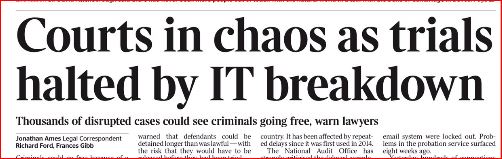
The Times front page – 23 January 2019

By Tony Collins

Criminal trials were delayed, jurors unable to enrol and witness statements inaccessible.

Quoting a tweet by the authoritative @BarristerSecret, the BBC said the “entire digital infrastructure” of courts was “broken for days”.

@BarristerSecret added,

“No accountability, no lessons learned.”

In the Spectator, Matthew Scott, a criminal barrister at Pump Court Chambers, said,

“Nobody seems to know exactly what has gone wrong or, if they do, they do not like to say.”

His Spectator blog was headlined,

The Spectator – 24 Jan 2019


“The most irritating fault has been for a few days the near total seizure (or ‘major service degradation’ to use the official non-explanation) of the secure email system (‘CJSM’) which for several years now has been the only authorised means of written communication between the Crown Prosecution Service and defence lawyers, probation, prisons, police and others.”

The Law Society Gazette said,

Law Society Gazette – 22 Jan 2019


The Law Society Gazette gave examples of how the problems had caused disruption and angst in the criminal justice system. It said,

“Major disruption that affected multiple Ministry of Justice IT systems last week continues to cause chaos.

“Lawyers on the front line have told the Gazette that trials have been delayed, jurors have been unable to enrol and practitioners have been prevented from confirming attendance that will enable them to get paid.

“Last week the ministry’s digital and technology team said most systems were improving. However, the Gazette has spoken to practitioners whose experiences suggest otherwise.”

A criminal barrister who spent the day in Leicester Crown Court said  none of the court’s computer systems was operational, jurors could not be enrolled, and no advocates could sign into the Ministry of Justice’s XHIBIT system, an online service that logs lawyers’ attendance so they can get paid.

A lawyer at Lincoln Crown Court said the XHIBIT system was down again. The Crown Court Digital Case System, on which all cases are accessed, was also down.

A criminal defence solicitor arrived at Highbury Magistrates’ Court in London at 9.15am, where there were several clients in the cells. But jailers did not know which courts the cases would be heard in and  because there was no wi-fi in the building magistrates had no access to any papers on their ipads before the hearings.

“The Gazette was told that several people attended Scarborough Magistrates’ Court last week to make statutory declarations in respect of driving matters. ‘Most of these people had come suited and booted, with all the anxiety that marks ordinary members of the public out as different from the frequent flyers who regularly come before the courts.

“These poor souls were left hanging around all morning, until 1pm, when they were advised that the systems were still not back up. Two of them agreed to come back on an adjourned date, 14 days later, but one of them explained that he couldn’t take further time off work. He was asked to come back in the afternoon, in the vain hope that the case management system might be back online.”

Former government chief technology officer Andy Beale quoted The Times in a tweet,


In another tweet, Beale said,


The Guardian reported yesterday (28 January 2019) that the Ministry of Justice knew its court computer systems were “obsolete” and “out of support” long before the network went into meltdown, internal documents have revealed.

The MoJ document, entitled Digital & Technology, said, “Historical under-investment in ageing IT systems has built our technical debt to unacceptable levels and we are carrying significant risk that will result in a large-scale data breach if the vulnerabilities are exploited.”

It added, “We have a Technology 2022 strategy, but it is not funded to help us address the long-term issues with current systems and allow us to make best use of new technologies to improve service delivery.”

It referred to a database used by 16 employment tribunal administrative offices in which the “scale of outage” accounted for 33% of incidents over the previous six months. Users were unable to access systems for a “significant number of hours”.

The report cited problems such as “risk of database corrupted leading to data loss; unable to restore service in a timely manner”, and added: “Judges say they will put tribunal activity on hold because of the poor running of the application.”

Government response

In the Commons, the government’s justice minister Lucy Frazer, responding to an urgent Labour request for a statement on the IT problems, was relaxed in her comments. She said the disruption was “intermittent” and the problems were merely “frustrating”. She added,

“The issue that has arisen relates mainly to email systems. There has been minimal disruption, I am told, to the courts system as a whole.”

She said there had been an “infrastructure failure in our supplier’s data centre”.

“The Prison Service has not been affected and—to correct inaccurate reporting—criminals have not gone free as a result of the problem. We have been working closely with our suppliers, Atos and Microsoft, to get our systems working again, and yesterday we had restored services to 180 court sites, including the largest ones.

“Today (23 January 2019), 90% of staff have working computer systems. Work continues to restore services and we expect the remainder of the court sites to be fully operational by the time they open tomorrow morning. We are very disappointed that our suppliers have not yet been able to resolve the network problems in full.

“This afternoon, the permanent secretary, Sir Richard Heaton, will meet the chief executive of Atos and write personally to all members of the judiciary. I am very grateful to all our staff who have been working tirelessly and around the clock, alongside our suppliers, to resolve the issues.”

Labour’s Yasmin Qureshi asked if Microsoft and Atos have paid any penalties to which Frazer gave a vague, non-committal reply,

“… the permanent secretary is meeting the supplier’s chief executive this afternoon and of course we will look carefully at the contracts, which include penalty clauses.”

Frazer later said the problem related to a “server” which raised questions about how the failure of a single server, or servers, could cause widespread chaos in the courts.

Labour’s Steve McCabe said the server problem was not a  single or unusual event.

“… her Department has been receiving reports of failures in the criminal justice secure email service for at least six months now”.

Police systems

The BBC reported last week that problems with a police IT system were causing some criminals to escape justice.

Nine forces in England and Wales use Athena from Northgate Public Services. They are Bedfordshire, Cambridgeshire, Essex, Hertfordshire, Kent, Norfolk, Suffolk, Warwickshire and West Mercia. The system is designed to help speed up the detection of crimes.

But officers told the BBC’s Victoria Derbyshire programme that it crashes regularly and is overly complicated, meaning some cases are not built in time or dropped.

Developers Northgate Public Services apologised for problems “in small areas”, which it said it was fixing.

A joint response from nine police forces said Athena – which has cost £35m over the past 10 years – had been “resilient and stable, although no system is perfect”.

The system was introduced following a government directive for forces to share intelligence after the Soham murders of Holly Wells and Jessica Chapman, in 2002.

Officers said the intelligence-sharing function works well but problems arise when they use the system to build cases for the Crown Prosecution Service.

The delays it causes means officers can struggle to get the information together in time to charge suspects or the cases are not up to a high-enough standard and are dropped.

Serving officers at Bedfordshire, Hertfordshire and Essex told the programme the process could now take up to twice as long.

The BBC did not name any officers who revealed details of the problems because they could face disciplinary action for speaking out. Their comments included:

  • “The first two weeks it (the system) was brought in were the worst two weeks of my entire career. It’s overly bureaucratic. It doesn’t understand the police investigative process at all. From day one, it malfunctioned. Four years on, it is still malfunctioning”
  • “It often requires information that is totally irrelevant and if you miss just one data entry point (like whether a solicitor is male or female), I have to reject the whole case and send it back to the officer”
  • “Even for a simple shoplift, I probably have to press about 50 buttons, with a 30-second minimum loading time between each task”
  • “There have been incidents where charges have been dropped because of the inadequacies of the system. There have been cases of assaults, albeit fairly minor assaults, but these are still people who should be facing criminal charges”
  • “It slows the whole criminal justice system down. At the moment, it is not fit for purpose. This is the most challenging time I have come across. We’re at breaking point already. This has pushed some officers over the edge”
  • “When you’ve got detainees in a custody block who’ve got various illnesses and ailments, medical conditions that are all recorded on there and they need medication at certain times – it became very dangerous because we were unable to access the records”

The nine forces – which also include those in Cambridgeshire, Kent, Norfolk, Suffolk, Warwickshire and West Mercia – said in a joint statement that they had been working with the supplier to identify and correct issues as they arose.

“Over the 12 months up to November 2018, there have only been 72 hours of total downtime and there are detailed plans in place of how to manage business when this occurs.”

Northgate Public Services, which created Athena, said 40,000 officers accessed the system and benefited from improved criminal intelligence.

It said it was working to make improvements to the “complex system”.

“We recognise there are a small number of areas of the solution where improvements can be made and we apologise for any difficulties this has caused.

“We are working hard with the customer and other parties to make these improvements as a priority.”

Comment:

As @BarristerSecret said,

“No accountability, no lessons learned.”

In central and local government, accountability means suppliers sometimes have to pay small penalties. Outsourcing supplier Capita last year paid Barnet Council about £4.2m in compensation for poor performance.

It was a fraction of the hundreds of millions Capita has received from Barnet Council.

Sometimes the opposite happens and it is the supplier that wins money from the government after a failure.

The Home Office sacked Raytheon over problems on an e-borders IT systems and ended up paying Raytheon £224m in compensation.

The Department of Heath ended up paying Fujitsu hundreds of millions of pounds after the supplier’s contract to deliver systems under the National Programme for IT [NPfIT] was ended.

A major failure in one area of the public sector will not  stop or deter officials from awarding the same supplier a major contract in the same or another part of the public sector.

Were a major failure or legal dispute to preclude a supplier from bidding for further UK public sector work, most if not all major suppliers would today have little UK government business.

A solution?

There is an effective way to encourage IT suppliers and the public sector to avoid public service failures. But the senior civil service isn’t interested.

That solution would be to publish – after every major public services failure – a full, independent third-party report into what went wrong and why.

Some senior officials seem unruffled by public criticism or even contempt after a services failure. But particularly in some of the major departments, there is a high-level fear of the full truth emerging after an administrative disaster.  Departments would do almost anything to avoid IT-related failures if reports on the causes were routinely published.

But unless there is a Parliamentary or public clamour for such internal analyses to be published, they will remain hidden or uncommissioned.

When the National Audit Office publishes a report on a departmental failure, the report has usually been agreed and signed off by the department; and it is usually a one-off report.

When public services descend into chaos, as happened in the court service last week, immense pressure falls on the IT teams to restore normal services urgently. But without the routine publication of reports on major IT-related public service failures, where is the motivation for senior officials to avoid chaos in the first place?

House of Commons debate on the courts’ IT failures

Thank you to Celina Bledowska for her tweet alerting me to the criminal justice IT problems.

Do some councils serve their own officials and councillors better than they serve the public?

By Tony Collins

Increasing numbers of local government and NHS officials are paying themselves salaries of £100,000 upwards, and some more than £500,000, but competence in handling public money appears to be diminishing.

Today, the outgoing head of the National Audit Office Amyas Morse expresses “shock”. He said,

“I am shocked by the persistent high level of qualified audit reports at local public bodies.

“A qualification is a judgement that something is seriously wrong, but despite these continued warnings, the number of bodies receiving qualifications is trending upwards.

“Let us hear no cries of ‘where were the auditors?’ when things go wrong. The answer will be ‘they did the job, but you weren’t listening’.

“This is not good enough; local bodies need to address their weaknesses, and departments across government should ensure they are challenging local bodies to demonstrate how they are responding.”

Today’s National Audit Office report “Local auditor reporting in England 2018″ says that the number of NHS and local government bodies with significant weaknesses in their arrangements for delivering value for money for taxpayers is “unacceptably high and increasing”.

The report makes no comparison between how well or badly NHS and council organisations are run in comparison with the salaries paid but it makes a point of saying that there are no consequences for councils and other public bodies of having a poor grip on how they spend public money.

Says the National Audit Office,

“There is no direct consequence of receiving a ‘non-standard’ report from a local auditor.

“While departments responsible for the oversight of local bodies may intervene in connection with an issue, such as failure to meet expenditure limits, there are no formal processes for reporting publicly whether bodies are tackling these issues.

“Departments use information from local auditors’ reports to differing extents to inform their understanding of the issues local bodies are facing, but they also need to be able to challenge local bodies to demonstrate that they are taking appropriate action where necessary.

“Given increasing financial and demand pressures on local bodies, they need to take prompt and effective action to strengthen their arrangements and improve their performance when issues are raised.

“The proportion of bodies with insufficient plans for keeping spending within budget or who have significant weaknesses in their governance, is too high.

“This is a risk to public money and undermines confidence in how well local services are managed. Local auditors need to exercise the full range of their additional reporting powers, especially where they consider that local bodies are not taking sufficient action.”

Comment

Anyone who reads the National Audit Office latest findings together with the numerous reports about poorly-run council IT-based outsourcing deals, including ones at Somerset County Council and Barnet Council, and an IT-related fraud involving Barnet council that was spotted by chance,  is entitled to ask: are some council officers and councillors serving themselves better than local communities?

Alongside amounting evidence of poor decision-making – or worse – in local government and the corporate NHS, there is a general lack of openness and, as the National Audit Office points out, widespread failures to act diligently on auditor findings.

Council taxes are rising, spending on important local services is diminishing yet the amounts paid to layers of senior management at councils and within the NHS and NHS England are rising without any link to competent decision-making.

For the most part, top officials cannot be fired. Their jobs are not appraised or at risk as they would be in the private sector.   Indeed some councils change senior job titles regularly and increase the salaries they pay themselves.

There is no sign of austerity when it comes to the pay of departmental leaders in local government.

Published figures indicate that at least 2,500 council officials were paid more than £100,000 each last year — and about 500 of them grossed in excess of £150,000, more than the prime minister earns.

The number whose total remuneration was in six figures has also risen. A report by the Taxpayers’ Alliance found that 16 local government CEOs received more than £300,000 and four grossed in excess of £500,000 in 2016-17.

All of which raises the question in the headline of this post: do some councils serve their own officials and councillors better than the public?

Local government officers defend their pay levels by saying that if you pay peanuts you get monkeys.

But some primates with large brains work remarkably well in their local communities. Do council departmental chiefs on unjustifiably large salaries always work well for their local communities? Or do they serve their own interests rather better than they serve the public?

Local auditor reporting in England – NAO report


£20bn for the NHS? – not spent like this please

Johnathan Lewis, CEO Capita (right) and Simon Stevens, Chief Executive, NHS England (left) at Monday’s Public Accounts Committee.

By Tony Collins

Capita apologies for working “blind” on NHS outsourcing contract – but no humility from NHS England

Capita’s CEO Johnathan Lewis was contrite and authoritative when he appeared before public accounts MPs in the House of Commons on Monday.

He apologised unreservedly for what the committee chairwoman Meg Hillier called “a shambles”, which was Capita’s £330 seven to ten-year contract to run a range of services for GPs, dentists and ophthalmologists, as well as handle invitations and test results for cervical screening.

Capita’s Primary Care Support Services contract began in 2015 and complaints about the service from medical practitioners began to flow months later.

Capita made mistakes, said Lewis who was supported by his colleague Stephen Sharp, who reports directly to Lewis on public sector contracts. One mistake was that Capita tried to save money too soon by folding the work of 47 local NHS offices with 1650 staff into three offices without fully understanding that each office had a different way of working and a different way of delivering NHS services.

[A similar mistake helped to floor the £10bn National Programme for IT in the NHS (NPfIT), where suppliers and Whitehall officials tried unsuccessfully to use computers to standardise working practices and services in hundreds of hospitals before they fully understood the widely-different approaches of each hospital.]

Lewis told the Public Accounts Committee on Monday,

“This was an extremely complex outsourcing of services that I think both parties would recognise were not fully understood when the work was outsourced – the volumes, the scope, the fact that the service was being delivered in different ways across the different regions that became NHS England. At the same time I recognise the pressure NHS England were under to reduce costs and hence the pressure on them to outsource.”

His colleague Stephen Sharp added,

“I think mistakes were made. During the bid stage, NHS England did say there were some inconsistencies and differences within the various operations. But once Capita got into all the offices and looked at it, the inconsistencies and differences were not inconsequential. It was more or less 45 different services being run from 45 different offices, so the closure programme, which we adhered to and carried on with, we maybe should have stopped. We just made the problem worse as we went along.”

Why didn’t you stop the office closures, asked Conservative MP Anne Marie Morris who added that “even the NHS said, ‘We think you need to stop’.”

Sharp replied,

“We were actually working blind for a period of time. It was only once the service had been running under our control for a few months that complaints started to come in and we started to see visibility that there were bigger issues than we thought there were.”

With hindsight he said he would not have closed offices “until we had got the procedures operating on a national basis”. He conceded that if NHS England and Capita had deferred closing offices, the first two years of savings of about £60m would not have been achieved.

Capita’s losses of £140m

Lewis said that Capita had invested £125m in the contract but, given the loss of profit margin, the losses would be closer to £140m. “We will not make money over the life of this contract,” said Lewis.

An MP asked: why not walk away?

Lewis replied, “Because we made a commitment to deliver this service and reputations depend on that commitment. We see the public sector as a segment of our market that helps us achieve a diversified revenue base. It is a segment where we have services and solutions, where we can create value for the taxpayer and that is why it is an attractive segment.”

Capita is now meeting 41 of the 45 KPIs and, though the company is making good progress against the remaining four KPIs, it doesn’t change the fact that “our initial execution on this contract was not good and for that we apologise unreservedly,” said Lewis.

There were failings on the part of NHS England too. Health officials were so anxious to achieve the savings from closing offices and replacing old IT that couldn’t be relied on that they failed to test new national, standardised working practices and services before they asked a supplier to implement this strategy.

The result was that officials at NHS England had no clear idea of how much work they were outsourcing. They left due diligence to Capita; and Capita admitted at the hearing it did not do enough due diligence at the bid stage. If it had understood how much work was involved it would have bid a higher price or not bid at all.

NHS England also failed to involve most of the potential end-users – GPs, dentists and ophthalmologists in the design and planning of new services that would directly affect them such as pensions and payments.

Lewis said.

“There are other stakeholders that have historically not been brought into this process to the extent that they should have been, such as the BMA [British Medical Association] in how we might implement the digitisation of pension payments and the management of its pensions, or the Confederation of Dental Employers with regard to ophthalmic payments.

“We want to bring them into the process in ways that they have not been historically because we think that that will ultimately lead to a more successful roll out of the technology… They rightly have influence over the process. If we are going to roll out a process for digitising the 20,000 paper documents that cover the process by which you get refunded for an ophthalmic prescription today, surely those people need to be involved in the final roll-out and configuration of that solution.”

Absence of humility?

When MPs questioned the top official at NHS England, Simon Stevens, there was little sign of humility, contrition or regret. He left an impression that the same problems could end up being repeated by a different supplier under a different contract. One Conservative MP Bim Afolami found himself “sticking up for Capita”.

Afolami said,

“Do you feel, Mr Stevens, that criticism of this contract is in any way unfair on Capita? The more I hear, the more I feel that Capita has taken the sharp end of this and NHS England, despite slight reputational difficulty, has saved £60 million. To what extent do you feel that you should take more of the blame here and Capita should take less of it?”

Stevens emphasised the £60m savings but made no mention any of the contract’s specific problems such as the thousands of patient records that went missing, dozens of women left off cancer-screening lists, the qualified GPs who were unable to work for months while the system delayed verifying their entitlement to go onto a “National Performers List”, the GPs who ran short of basic supplies or the GPs and ophthalmologists who suffered financial detriment because of delayed payments.

Said Stevens,

“First, let me say that this has clearly been a rocky road, and the National Audit Office accurately described the bumps along the way, which are regrettable. That should not obscure the fact that, notwithstanding the economic pain that Capita has experienced, the contract has saved taxpayers £60 million in lower administrative costs in the National Health Service over the first two years of its life … that £60 million of savings is not to be sniffed at; it is the equivalent of 30,000 operations.”

Comment:

Campaign4Change has repeatedly criticised Capita’s performance on Barnet’s outsourcing contract, in part because Capita and the council have been markedly defensive – thin-skinned.

It was refreshing, therefore, to hear Capita’s newish CEO Jonathan Lewis being openly contrite over highly-visible failings in the NHS contract. He gave the impression to public accounts MPs of being a CEO who is determined to put right the failings for the sake of Capita’s reputation. The cost of correcting the problems seemed a secondary consideration.

With Lewis at the helm, Capita’s share price has continued to rise in recent weeks.

Less impressive at Monday’s hearing was Simon Stevens, NHS England’s chief executive, who seemed to imply that NHS England had done nothing wrong.  It was a reaction we’ve come to expect from top civil servants after an IT-related programme disaster. It’s never the fault of officialdom.

The reality is that NHS England was almost as culpable as Capita. NHS England rushed the whole outsourcing exercise – which doomed it from the start. It didn’t listen to critics who warned that primary care support services were too locally diverse and inherently problematic to standardise as part of a national  outsourcing deal.

Instead of first piloting and agreeing with GPs, dentists and ophthalmologists fundamental changes in working practices that would be needed across the country, NHS England went ahead with signing a co-called transformation deal with Capita.

NHS England paid only lip service to engagement with the new system’s end-users in the medical professions. By its own admission Capita, because of its own internal shortcomings, went into the contract blind.

What’s worrying is the way civil servants blithely repeat mistakes of the past and later say they did everything right.

The National Programme for IT in the NHS – NPfIT – failed in part because it was rushed, the implications of “ruthless standardisation” were not fully understood at the outset and there was a lack of proper engagement with potential end-users in hospitals and GP practices. All these same mistakes were made by Capita and NHS England on the Primary Care Support Services contract.

When ordinary human beings become senior civil servants there seems to be a requirement that they lose at a cellular level the facility to express humility and contrition. That loss is replaced by an overly prominent complacency. Whatever goes wrong is not their fault.

Stevens said in essence that NHS England did everything right. Through its unpublished project reviews, the Major Projects Authority – now the Infrastructure and Projects Authority –  endorsed NHS England’ s plans. All the so-called experts gave the outsourcing deal what Stevens called a “thumbs-up”.

It would have been surprising if Stevens had said the public sector was in any way to blame.

At least Capita has learned the lessons. It has a financial interest in doing so.

Ministers can learn from Capita’s candid chief executive

NHS England’s management of Primary Care Support Services contract with Capita – National Audit Office report

Monday’s televised Public Accounts Committee hearing with Capita’s Jonathan Lewis and Simon Stevens of NHS England