
Category Archives: public services

Inside Universal Credit IT – analysis of document the DWP didn’t want published

dwpBy Tony Collins

Written evidence the Department for Work and Pensions submitted to an FOI tribunal – but did not want published (ever) – reveals that there was an internal “lack of candour and honesty throughout the [Universal Credit IT] Programme and publicly”.

It’s the first authoritative confirmation by the DWP that it has not always been open and honest when dealing with the media on the state of the Universal Credit IT programme.
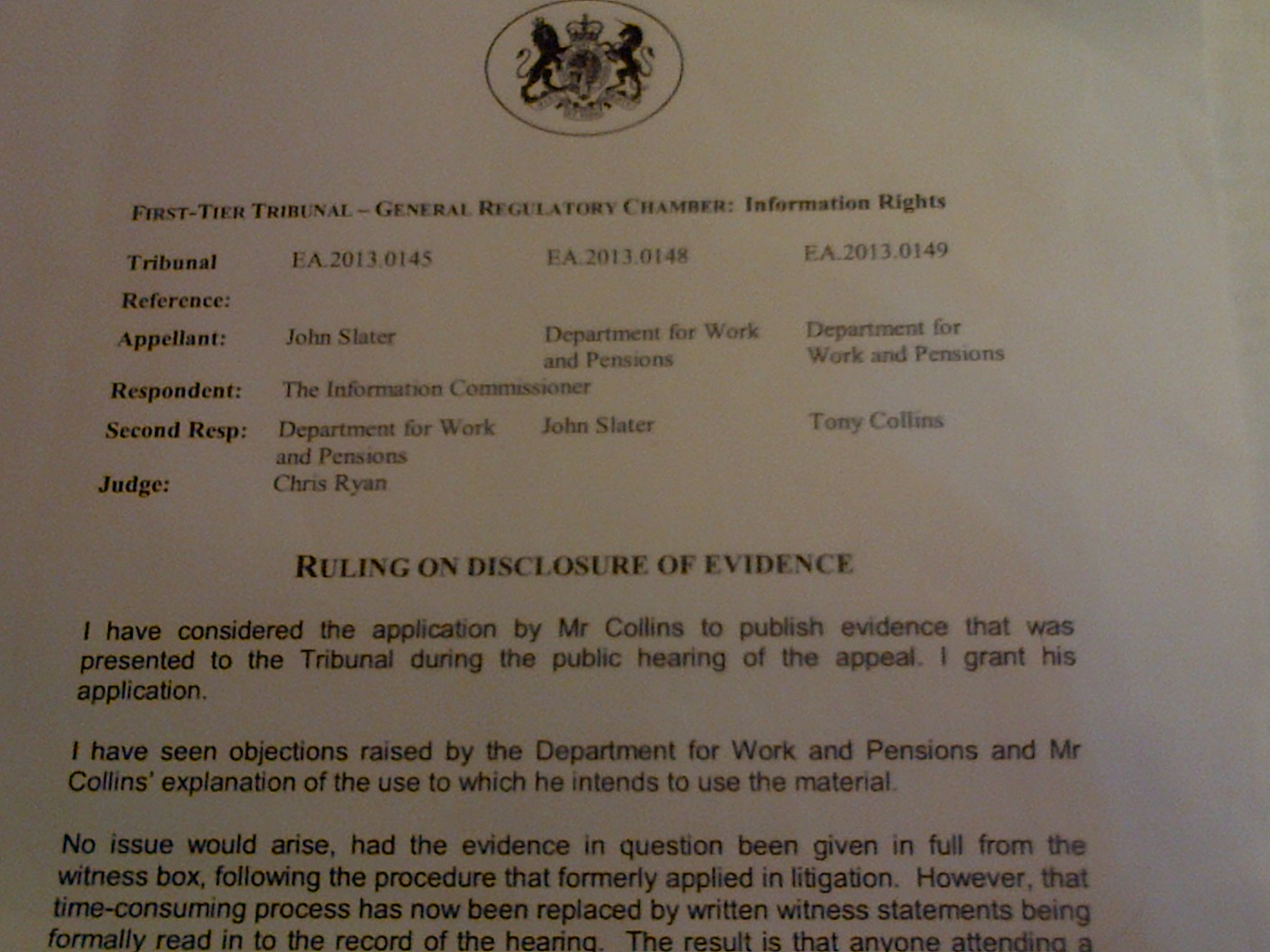
FOI tribunal grants request to publish DWP's written submission

FOI tribunal grants request to publish DWP’s written submission

According to the DWP submission, senior officials on the Programme became so concerned about leaks that a former member of the security services was brought in to lead an investigation. DWP staff and managers were the subjects of “detailed interviews”. Employee emails were “reviewed”, as were employee access rights to shared electronic areas.

Staff became “paranoid” about accidentally leaving information on a printer. Some of the high-security measures appear still to be in place.

Unpublished until now, the DWP’s written legal submission referred, in part, to the effects on employees of leak investigations.

The submission was among the DWP’s written evidence to an FOI Tribunal in February 2016.

The Government Legal Service argued that the DWP’s written evidence was for the purposes of the tribunal only. It should not be published or passed to an MP.

The Legal Service went further: it questioned the right of an FOI Tribunal to decide on whether the submission could be published. Even so a judge has ruled that the DWP’s written evidence to the tribunal can be published.

Excerpts from the submission are here.

Analysis and Comment

The DWP’s submission gives a unique glimpse into day-to-day life and corporate sensitivities at or near the top of the Universal credit IT programme.

It reveals the lengths to which senior officials were willing to go to stop any authoritative “bad news” on the Universal Credit IT programme leaking out. Media speculation DWP’s senior officials do not seem to mind. What appears to concern them is the disclosure of any credible internal information on how things are progressing on Universal Credit IT.

Confidential

Despite multiple requests from IT suppliers, former government CIOs and MPs, for Whitehall to publish its progress reports on big IT-based change programmes (some examples below), all central departments keep them confidential.

That sensitivity has little to do with protecting personal data.

It’s likely that reviews of projects are kept confidential largely because they could otherwise expose incompetence, mistakes, poor decisions, risks that are likely to materialise, large sums that have been wasted or, worst of all, a project that should have been cancelled long ago and possibly re-started, but which has been kept going in its original form because nobody wanted to own up to failure.

Ian watmore front cover How to fix government IROn this last point, former government CIO and permanent secretary Ian Watmore spoke to MPs in 2009 about how to fix government IT. He said,

“An innovative organisation tries a lot of things and sometimes things do not work. I think one of the valid criticisms in the past has been when things have not worked, government has carried on trying to make them work well beyond the point at which they should have been stopped.”

Individual accountability for failure?

Oblivious to MPs’ requests to publish IT progress reports, the DWP routinely refuses FOI requests to publish IT progress reports, even when they are several years old, even though by then officials and ministers involved will probably have moved on. Individual accountability for failure therefore continues to be non-existent.

Knowing this, MPs on two House of Commons select committees, Public Accounts and Work and Pensions, have called for the publication of reports such as “Gateway” reviews.

This campaign for more openness on government IT projects has lasted nearly three decades. And still Whitehall never publishes any contemporaneous progress reports on big IT programmes.

It took an FOI campaigner and IT projects professional John Slater [@AmateurFOI] three years of legal proceedings to persuade the DWP to release some old reports on the Universal Credit IT programme (a risk register, milestone schedule and issues log). And he had the support of the Information Commissioner’s legal team.

universal creditWhen the DWP reluctantly released the 2012 reports in 2016 – and only after an informal request by the then DWP secretary of state Stephen Crabb – pundits were surprised at how prosaic the documents were.

Yet we now know, thanks to the DWP’s submission, the lengths to which officials will go to stop such documents leaking out.

Understandable?

Some at the DWP are likely to see the submission as explaining some of understandable measures any government department would take to protect sensitive information on its largest project, Universal Credit. The DWP is the government largest department. It runs some of the world’s biggest IT systems. It possesses personal information on nearly everyone in Britain. It has to make the protection of its information a top priority.

Others will see the submission as proof that the DWP will do all it can to honour a decades-old Whitehall habit of keeping bad news to itself.

Need for openness

It’s generally accepted that success in running big IT-enabled change programmes requires openness – with staff and managers, and with external organisations and agencies.

IT-based change schemes are about solving problems. An introspective “good news only” culture may help to explain why the DWP has a poor record of managing big and successful IT-based projects and programmes. The last time officials attempted a major modernisation of benefit systems in the 1990s – called Operational Strategy – the costs rose from £713m to £2.6bn and the intended objective of joining up the IT as part of a “whole person” concept, did not happen.

Programme papers“watermarked”

The DWP’s power, mandate and funding come courtesy of the public. So do officials, in return, have the right to keep hidden mistakes and flawed IT strategies that may lead to a poor use – or wastage – of hundreds of millions of pounds, or billions?

The DWP’s submission reveals that recommendations from its assurance reports (low-level reports on the state of the IT programme including risks and problems) were not circulated and a register was kept of who had received them.

Concern over leaks

The submission said that surveys on staff morale ceased after concerns about leaks. IT programme papers were no longer sent electronically and were delivered by hand. Those that were sent were “double-enveloped” and any that needed to be retained were “signed back in”. For added security, Universal Credit programme papers were watermarked.

When a former member of the security services was brought in to conduct a leaks investigation, staff and mangers were invited by the DWP’s most senior civil servant to “speak to the independent investigator if they had any information”. This suggests that staff were expected to inform on any suspect colleagues.

People “stopped sharing comments which could be interpreted as criticism of the [Universal Credit IT] Programme,” said the submission. “People became suspicious of their colleagues – even those they worked closely with.

“There was a lack of trust and people were very careful about being honest with their colleagues…

“People felt they could no longer share things with colleagues that might have an honest assessment of difficulties or any negative criticism – many staff believed the official line was, ‘everything is fine’.

“People, even now, struggle to trust colleagues with sensitive information and are still fearful that anything that is sent out via email will be misused.

“For all governance meetings, all documents are sent out as password protected, with official security markings included, whether or not they contain sensitive information.”

“Defensive”

dwpLines to take with the media were added to a “Rolling Brief”, an internal update document, that was circulated to senior leaders of the Universal Credit IT programme, the DWP press office and special advisors.

These “lines to take” were a “defensive approach to media requests”. They emphasised the “positive in terms of progress with the Programme without acknowledging the issues identified in the leaked stories”.

This positive approach to briefing and media management “led to a lack of candour and honesty through the Programme and publically …”

How the DWP’s legal submission came about is explained in this separate post.

Were there leaks of particularly sensitive information?

It appears not. The so-called leaks revealed imperfections in the running of the Universal Credit programme; but there was no personal information involved. Officials were concerned about the perceived leak of a Starting Gate Review to the Telegraph (although the DWP had officially lodged the review with the House of Commons library).

The DWP also mentioned in its statement a leak to the Guardian of the results of an internal “Pulse” survey of staff morale – although it’s unclear why the survey wasn’t published officially given its apparent absence of sensitive commercial, personal, corporate or governmental information.

NPfIT

The greater the openness in external communications, the less likely a natural scepticism of new ways of working will manifest in a distrust of the IT programme as a whole.

The NHS’s National Programme for IT (NPfIT) – then the UK’s biggest IT programme costing about £10bn – was dismantled in 2011 after eight fraught years. One reason it was a disaster was the deep distrust of the NPfIT among clinicians, hospital technologists, IT managers, GPs and nurses. They had listened with growing scepticism to Whitehall’s oft-repeated “good news” announcements.

Ex-Government CIO wanted more openness on IT projects

When MPs have asked the DWP why it does not publish reports on the progress of IT-enabled projects, it has cited “commercial confidentiality”.

But in 2009, Ian Watmore (the former Government CIO) said in answer to a question by Public Account Committee MP Richard Bacon that he’d endorse the publication of Gateway reviews, which are independent assessments of the achievements, inadequacies, risks, progress and challenges on risky IT-based programmes.

“I am with you in that I would prefer Gateway reviews to be published because of the experience we had with capability reviews (published reports on a department’s performance). We had the same debate (as with Gateway reviews) and we published them. It caused furore for a few weeks but then it became a normal part of the furniture,” said Watmore.

Capability reviews are no longer published. The only “regular” reports of Whitehall progress with big IT programmes are the Infrastructure and Projects Authority’s annual reports. But these do not include Gateway reviews or other reports on IT projects and programmes. The DWP and other departments publish only their own interpretations of project reviews.

In the DWP’s latest published summary of progress on the Universal Credit IT programme, dated July 2016, the focus is on good news only.

But this creates a mystery. The Infrastructure and Projects Authority gave the Universal Credit programme an “amber” rating in its annual report which was published this month. But neither the DWP nor the Authority has explained why the programme wasn’t rated amber/green or green.

MPs and even IT suppliers want openness on IT projects

Work and Pensions Committee front coverIn 2004 HP, the DWP’s main IT supplier, told a Work and Pensions Committee inquiry entitled “Making IT work for DWP customers” in 2004 that “within sensible commercial parameters, transparency should be maintained to the greatest possible extent on highly complex programmes such as those undertaken by the DWP”.

The Work and Pensions Committee spent seven months investigating IT in the DWP and published a 240-page volume of oral and written in July 2004. On the matter of publishing “Gateway” reviews on the progress or otherwise of big IT projects, the Committee concluded,

“We found it refreshing that major IT suppliers should be content for the [Gateway] reviews to be published. We welcome this approach. It struck us as very odd that of all stakeholders, DWP should be the one which clings most enthusiastically to commercial confidentiality to justify non-disclosure of crucial information, even to Parliament.”

The Committee called for Gateway reviews to be published. That was 12 years ago – and it hasn’t happened.

Four years later the Committee found that the 19 most significant DWP IT projects were over-budget or late.

DWP headline late and over budget

In 2006 the National Audit Office reported on Whitehall’s general lack of openness in a report entitled “Delivering successful IT-enabled business change”.

The report said,

“The Public Accounts Committee has emphasised frequently the need for greater transparency and accountability in departments’ performance in managing their programmes and projects and, in particular, that the result of OGC Gateway Reviews should be published.”

But today, DWP officials seem as preoccupied as ever with concealing bad news on their big IT programmes including Universal Credit.

The costs of concealment

The DWP has had important DWP project successes, notably pension credits, which was listed by the National Audit Office as one of 24 positive case studies.

But the DWP has also wasted tens of millions of pounds on failed IT projects.

Projects with names such as “Camelot” [Computerisation and Mechanisation of Local Office Tasks] and Assist [Analytical Services Statistical Information System) were cancelled with losses of millions of pounds. More recently the DWP has run into problems on several big projects.

“Abysmal”

On 3 November 2014 the then chairman of the Public Accounts Committee Margaret Hodge spoke on Radio 4’s Analysis of the DWP’s ‘abysmal’ management of IT contracts.”

1984

As long ago as 1984, the House of Commons Public Accounts Committee called for the civil service to be more open about its progress on major computer projects.

Today there are questions about whether the Universal Credit IT will succeed. Hundreds of millions has already been spent. Yet, as mentioned earlier, current information on the progress of the DWP’s IT programmes remains a state secret.

It’s possible that progress on the Universal Credit IT programme has been boosted by the irregular (but thorough) scrutiny by the National Audit Office. That said, as soon as NAO reports on Universal Credit are published, ministers and senior officials who have seen copies in advance routinely dismiss any criticisms as retrospective and out-of-date.

Does it matter if the DWP is paranoid about leaks?

A paper published in 2009 looks at how damaging it can be for good government when bureaucracies lack internal challenge and seek to impose on officials a “good news” agenda, where criticism is effectively prohibited.

The paper quoted the then Soviet statesman Mikhail Gorbachev as saying, in a small meeting with leading Soviet intellectuals,

“The restructuring is progressing with great difficulty. We have no opposition party. How then can we control ourselves? Only through criticism and self-criticism. Most important: through glasnost.”

Non-democratic regimes fear a free flow of information because it could threaten political survival. In Russia there was consideration of partial media freedom to give incentives to bureaucrats who would otherwise have no challenge, and no reason to serve the state well, or avoid mistakes.

The Chernobyl nuclear disaster, which occurred on April 26, 1986, was not acknowledged by Soviet officials for two days, and only then after news had spread across the Western media.

The paper argued that a lack of criticism could keep a less democratic government in power. But it can lead to a complacency and incompetence in implementing policy that even a censored media cannot succeed in hiding.

As one observer noted after Chernobyl (Methvin in National Review, Dec. 4, 1987),

“There surely must be days—maybe the morning after Chernobyl—when Gorbachev wishes he could buy a Kremlin equivalent of the Washington Post and find out what is going on in his socialist wonderland.”

Red team

Iain DuncanSmithA lack of reliable information on the state of the Universal Credit IT programme prompted the then secretary of state Iain Duncan Smith to set up his own “red team” review.

That move was not known about at the time. Indeed in December 2012 – at a point when the DWP was issuing public statements on the success of the Universal Credit Programme – the scheme was actually in trouble. The DWP’s legal submission said,

“In summary we concluded (just before Christmas 2012) that the IT system that had been developed for the launch of UC [Universal Credit] had significant problems.”

One wonders whether DWP civil servants kept Duncan Smith in the dark because they themselves had not been fully informed about what was going on, or because they thought the minister was best protected from knowing what was going on, deniability being one key Whitehall objective.

But in the absence of reliable internal information a political leader can lose touch completely, said the paper on press freedom.

“On December 21, 1989, after days of local and seemingly limited unrest in the province of Timi¸ Ceausescu called for a grandiose meeting at the central square of Bucharest, apparently to rally the crowds in support of his leadership. In a stunning development, the meeting degenerated into anarchy, and Ceausescu and his wife had to flee the presidential palace, only to be executed by a firing squad two days later.”

Wrong assumptions

Many times, after the IT media has published articles on big government IT-based project failures, TV and radio journalists have asked to what extent the secretary of state was responsible and why he hadn’t acted to stop millions of pounds being wasted.

But why do broadcast journalists assume ministers control their departments? It is usually more likely that ministers know little about the real risks of failure until it is too late to act decisively.

Lord Bach, a minister at DEFRA, told a House of Commons inquiry in 2007 into the failure of the IT-based Single Payment Scheme that he was aware of the risks but still officials told him that systems would work as planned and farmers would receive payments on time. They didn’t. Chaos ensued.

Said Lord Bach,

“I do think that, at the end of the day, some of the advice that I received from the RPA [Rural Payments Agency] was over-optimistic.”

Lord WhittyAnother DEFRA minister at the time Lord Whitty, who was also party in charge of the Single Payment Scheme, told the same inquiry,

“Perhaps I ought also to say that this was the point at which I felt the advice I was getting was most misleading, and I have used the term ‘misleading’ publicly but I would perhaps prefer to rephrase that in the NAO terms …”

Even the impressive Stephen Crabb – who has now quit as DWP secretary of state – didn’t stand much of chance of challenging his officials. The department’s contracts, IT and other affairs, are so complex and complicated – there are bookcases full of rules and regulations on welfare benefits – that any new ministers soon find themselves overwhelmed with information and complexity.

They will soon realise they are wholly dependent on their officials; and it is the officials who decide what to tell the minister about internal mistakes and bad decisions. Civil servants would argue that ministers cannot be told everything or they would be swamped.

But the paper on press freedom said that in order to induce high effort within a bureacucracy, the leader needs “verifiable information on the bureaucrats’ performance”.

The paper made a fascinating argument that the more complacent the bureaucracy, the more aggressively it would control information. Some oil-rich countries, said the paper, have less media freedom than those with scarcer resources.

“Consistent with our theory, [some] non-democratic countries … have vast resources and poor growth performance, while the Asian tigers (South Korea, Taiwan, Hong Kong, and Singapore), while predominantly non-democratic in the 1970s and 1980s, have high growth rates and scarce natural resource.”

In an apparent opening up of information, the government in China passed a law along the lines of the U.S. Freedom of Information Act (“China Sets Out to Cut Secrecy, but Laws Leave Big Loopholes,” New York Times, Apr. 25, 2007). But was this law self-serving? It, and the launch of local elections, provided the central government with relatively reliable information on the performance of provincial bosses.

These stories from less democratic countries may be relevant in Britain because politicians here, including secretaries of state, seem to be the last to know when a big IT-based programme is becoming a disaster.

Bad news

Whtehall’s preoccupation with “good news only” goes well beyond the DWP.

T auditors Arthur D Little, in a forensic analysis of the delays, cost over-runs and problems on the development of a huge air traffic control IT project for National Air Traffic Services, whose parent was then the Civil Aviation Authority, which was part of the Department for Transport, referred to an “unwillingness to face up to and discuss bad news”.

Ministers helpless to force openness on unwilling officials?

Francis Maude came to the Cabinet Office with a reforming zeal and a sophisticated agenda for forcing through more openness, but the effects of his efforts began to evaporate as soon as he left office. Even when he was at the height of his power and influence, he was unable to persuade civil servants to publish Gateway reviews, although he’d said when in opposition that he intended to publish them.

His negotiations ended with central departments agreeing to publish only the “traffic light” status of big projects – but only after a minimum delay of at least six months. In practice the delay is usually a year or more.

Brexit

Brexit campaigners argue that the EC is undemocratic, that decisions are taken in Brussels in secret by unelected bureaucrats. But the EC is at least subject to the scrutiny, sometimes the competing scrutiny, of 29 countries.

Arguably Whitehall’s departments are also run by unelected bureaucrats who are not subject to any effective scrutiny other than inspections from time to time of the National Audit Office.

Yes Minister parodied Sir Humphrey’s firm grip on what the public should and should not be told. Usually his recommendation was that the information should be misleadingly reassuring. This was close enough to reality to be funny. And yet close enough to reality to be serious as well. It revealed a fundamental flaw in democracy.

Nowhere is that flaw more clearly highlighted than in the DWP’s legal submission. Is it any surprise that the DWP did not want the submission published?

If officials had the choice, would they publish any information that they did not control on any of their IT projects and programmes?

That’s where the indispensable work of the National Audit Office comes into the picture – but it alone, even with the help of the Public Accounts Committee, cannot plug the gaping hole in democracy that the DWP’s submission exposes.

These are some thoughts I am left with after reading the legal submission in the light of the DWP’s record on the management of IT-based projects …

  • Press freedom and the free flow of information cannot be controlled in a liberal democracy. But does Whitehall have its own subtle – and not so subtle – ways and means?
  • In light of the DWP’s track record, the public and the media are entitled to distrust whatever ministers and officials say publicly about their own performance on IT-related programmes, including Universal Credit.
  • More worryingly, would the DWP’s hierarchy care a jot if the media and public didn’t believe what the department said publicly about progress on big projects such as Universal Credit?
  • Is the DWP’s unofficial motto: Better to tell a beautiful lie than an ugly truth?
  • AL Kennedy mentioned the “botched” Universal Credit programme  when she gave a “point of view” on Radio 4 last week. Not referring specifically to Universal Credit she said facts can be massaged but nature can’t be fooled. A girder that won’t hold someone’s weight is likely to fail however many PR-dominated assurance reports have gone before. “Facts are uncompromising and occasionally grim. I wish they weren’t. Avoiding them puts us all at increased risk,” she said.

 Excerpts from the DWP submission

Some Twitter comments on this post:

tweet2

tweet3

tweet

tweet4

Another public sector IT project disaster – but a useful failure if lessons are disseminated

By Tony Collins

Comment and analysis

Government Computing reported on 1 July 2016 that the Scottish Police Authority has agreed with Accenture to end their “i6” programme.

It’s a classic public sector IT project disaster. It failed for the usual reasons (see below). What marks it out is the unusual post-failure approach: a limited openness.

Police in Scotland and the Scottish Government plan a review of what went wrong, which is likely to be published.

Usually senior civil and public servants in Whitehall, local government in England and Wales and the NHS rush to shut the blinds when an IT-enabled change project goes awry, which is what has happened recently after failures of the GP Support Services contract with Capita.  [GP magazine Pulse reports that NHS England is to withhold report on primary care support problems until 2017.]

The police in Scotland and the Scottish Parliament are being open but not completely. Their settlement with Accenture remains confidential, but the Scottish Police Authority has published the full business case for i6 and – under FOI – early “Gateway” reviews and “Healthcheck” reports, though with quite a few redactions.

Despite FOI, it’s almost unknown for Whitehall, the NHS or local government in England and Wales, to publish Gateway reviews of big IT projects.

All this means there may be a genuine attempt in Scotland to learn lessons from the failure of the i6 project, and perhaps even let the public sector as a whole benefit from them (if it’s interested),

Due originally to go live last December, and then in the autumn this year, i6 hit problems within months of the start of the contract with Accenture. The contract was signed in June 2013, work started in July and the two sides were reported as being in mediation by August 2013.

Exemplar?

But the programme had followed well-established preparatory routines. One internal report described the procurement approach as an exemplar for the rest of the public sector. Yet it still ended in failure.

In fact i6 followed the classic script of a traditional public sector IT-based project disaster:

  1. An over-ambitious plan for widespread “integration” – which is one of the most dangerous words in the history of public sector IT-enabled change projects. It seemed a great idea at the time: to save vast sums by bringing together in a single system similar things done in different ways by formerly separate organisations.
  2. A variety of early independent reports that highlighted risks and strengths of the programme but didn’t ask the biggest question of all: could a single national system ever work satisfactorily given the amount of organisational change required – changes that would impose on the system design constant modification as end-users discovered new things they wanted and didn’t want that were in the original design – and changes that would require a large team on the police side to have the time to understand the detail and convey it accurately to Accenture.
  3. An assumption that the supplier would be able to deliver an acceptable system within tight deadlines in a fast-changing environment.
  4. Milestones that were missed amid official denials that the project was in disarray.
  5. An agreement to end the contract that was on the basis of a secret settlement, which brought little or no accountability for the failure. Nobody knows how much has been spent on the project in staff and managerial time, hiring of various consultancies, the commissioning of various reports, and money paid over to the supplier.

What are the lessons?


The 10-year programme, which was said to cost between £40m and £60m, was ambitious. It was supposed to replace 135 IT-and paper-based systems across Scotland with a single national integrated system that would be rolled out to all Police Scotland divisions.

A “Gateway review” of the project in March 2013 said the project involved the “largest organisagtional change in the history of Scottish policing”.

The released documents have much praise for the police’s preparatory work on the contract with Accenture. Private consultants were involved as the technical design authority. Deloitte was hired for additional support. There were regular “healthcheck” and Gateway reviews.

Too ambitious?

Bringing together dozens of systems and paper-based processes into a new standardised system that’s supposed to work across a variety of business units, requires – before a single new server is installed – agreement over non-IT changes that are difficult in practice to achieve. It’s mainly a business-change project rather than an IT one.

The business case promised “Full interoperability, of processes and technology, at local and national level.” Was that ever really possible?

The disastrous Raytheon/Home Office e-borders project was a similar classic public sector project failure based on “integration”.  Although it was a much bigger project and far more complex than i6, it followed similar principles: a new national system that would replace a  patchwork of different systems and business processes.

Raytheon could not force change on end-users who did not want change in the way Raytheon envisaged. The Home Office wasted hundreds of millions on the project, according to the National Audit Office which said,

“During the period of the e-borders programme the Department made unrealistic assumptions about programme delivery without recognising the importance of managing a diverse range of stakeholders.

“Delivering the e-borders vision requires that more than 600 air, ferry and rail carriers supply data on people they are bringing in and out of the country, while around 30 government agencies supply data on persons of interest.

“During the e-borders period, the contract made Raytheon responsible for connecting e-borders to these stakeholders’ systems, under the Department’s strategic direction. But carriers and agencies expressed general concerns about the costs and other implications of revising their systems to connect to e-borders, including the interfaces they were expected to use.

“The contract strongly incentivised Raytheon to deliver the roll-out to the agreed schedules but provided less incentive for Raytheon to offer a wider choice of interfaces…Lack of clarity on what was legal under European law further exacerbated the difficult relationships with carriers. These difficulties affected progress in rolling out e-borders from the outset…

“Following the cancellation of the e-borders contract in 2010, the Department [Home Office] took more direct ownership of external relationships instead of working through Raytheon. Transport carriers told us there is now a better understanding of needs and requirements between themselves and the Department.”

The NHS National Programme for IT [NPfIT] was another similar failure, in part because of overly ambitious plans for “integration” – on a scale that could never be imposed on a diverse range of largely autonomous NHS organisations. Some hospitals and GPs did not want a national system that did less than their existing systems. Why would they want to replace their own proven IT with cruder standardised systems for the sake of the common good?

More recently the GP support services contract with Capita has run into serious problems largely because of an overly ambitious objective of replacing fragmented ways of working with a national “common good” system.

A Capita spokesperson said of the new system: ‘NHS England asked Capita to transform what was a locally agreed, fragmented primary care support service, to a national standardised system.”

It’s naïve for politicians and senior public servants to view integration as a public benefit without questioning its necessity in the light of the huge risks.

[Mao Tsedong saw the Great Leap Forward as a public benefit. It was a costly catastrophe, in human and financial terms. ]

Disputes over whether proposals would meet actual needs?

It appears that i6 officials found Accenture’s solutions unconvincing; but it’s likely Accenture found that requirements were growing and shifting, leading to disagreements over varying interpretations of different parts of the contract. Accenture could not compel cooperation by various forces even it wanted to.

It may work elsewhere – but that doesn’t mean it’ll work for you.

This is one of the oldest lessons from countless disaster in the history of the IT industry. It was listed as a key factor in some of the world’s biggest IT disasters in “Crash”.

The business case for i6 says:

“The [Accenture] solution is based on a system delivered to 80,000 officers in the Guardia Civil, Spain’s national police force.

“The procured solution includes software components, software licences, specialist hardware, integration tools and services, business change activities, implementation services, reporting capabilities, data management activities, ongoing support, optional managed service arrangements, additional integration services and other relevant services necessary for the successful implementation of the solution.”

Is it wise to promise huge savings many times greater than projected costs?

Clearly i6 is a political scheme. It’s easy in the public sector to declare at the outset any amount of anticipated savings when it’s clear to everyone that the actual audited savings – or losses – will probably never be announced.

Initial costs were put at £12m, but later revisions put the cost nearer to £46m. More recently costs of £60m have been reported. In 2013, cashable savings to be made by developing i6 were said to be over £61m, with the total cashable and non-cashable savings estimated to be £218m over ten years.

That said, the police appear to have paid over relatively small sums to Accenture, not tens of millions of pounds.

Lessons from past failures have been learned – really?

The Scottish Police Authority gave an unequivocal assurance to its members in June 2013 that i6 will “not suffer the same fate as other high profile large scale IT projects”. This is what the Authority said to its members,

“Delivery Assurance – SPA [Scottish Police Authority] members have sought and been provided with significant assurance that the i6 programme will deliver the intended outcomes and not suffer the same fate as other high profile large scale IT projects.

“The robustness and diligent detail that has gone into the full business case itself provides much of that assurance. Further delivery confidence around i6 comes from a number of sources including:
1. Rigorous Programme Governance.
2. Widespread User Engagement and Robust Requirements Gathering.
3. The creation of a ‘live’ multi-sector i6 Learning Network.
4. The formation of strategic partnership groups.
5. Alignment to the wider Scottish Government Digital Strategy.
6. Active learning from the Audit Scotland Review of Public Sector IT Projects and the Common Performance Management Project (‘Platform’).
7. Significant time and investment in the use of Competitive Dialogue.
8. The formation of a strong and consistent programme team with integrated professional advice & support.
9. Exposure to the full independent OGC Gateway Review Process.
10. An independent Scottish Government Technical Assurance Review.

A growing list of changes.

In February 2016 Accenture said, “This is a very complex project. The complexity of the solution, which has been driven by the client, has increased significantly over the last two years.”

This suggests the scope and specification grew as the many different stakeholders gradually formed a view of what they wanted.

Criticism of the supplier, as if it were the only party responsible or delivering the system.

Police Scotland told members of the Scottish Parliament in February 2016 that Accenture has let the police down.

One question auditors may ask is whether it would have been better for local policing divisions to keep control of their own IT.

Internal reviews too soft, too reassuring?

A technical assurance review in June 2013 gave the i6 project an “amber/green” status.

A secret settlement leaves taxpayers having no clue of how much money has gone down the drain.

The Scottish Police Authority says the settlement is confidential. “The terms of the agreement are commercially confidential. However we can confirm that the settlement results in no financial detriment to the police budget.”

The current police budget may not be affected but how much has already been paid and how much of this is wasted? If no figures are ever given, how can there be proper accountability that could deter a new set of officials making similar mistakes in a future project?

Doomsday Register?

If the public sector kept a published “Doomsday” register of failed projects and programmes and the mistakes made in them, as identified by auditors, the same mistakes would be less likely to be repeated.

Perhaps i6 could be the first entry into a new Doomsday register.

The future’s looking bright (?).

When a project is cancelled, it’s almost inevitable that the consequences will be declared to be minimal; and we’re all left wondering why the project was needed in the first place if the future is so rosy.

Half the story

As things stand,  when a council, police, NHS, or Whitehall project fails and millions of pounds, sometimes tens of millions, even billions, are lost, there’s no incentive for anyone but taxpayers to care – and even then they don’t know half the story.

In the case of i6, once the settlement with Accenture is finalised – with hardly anyone knowing the details – officialdom is free to embark on a similar project in a few years time, with different people involved, and describing it in a different way.

Who cares when the public sector has another IT disaster that follows an age-old script?

**

Project summary

The i6 project was introduced to merge more than 130 different computer and paper systems left in place after eight regional forces were merged to form Police Scotland.

Police Scotland told MSPs in February that they were looking at contingency options because they could not solve scores of faults that had emerged during testing.

Officers involved in the tests said at one point they had found 12 critical errors that made it unusable, and a total of 76 defects that required further work.

Accenture said in February that i6 passed its internal testing but flaws emerged when Police Scotland tested the programme.

**

The Guardian reports on another IT-enabled project problems in Scotland.

“Scottish ministers have already been forced to seek an extension from the European commission after its new £178m farming payments system had to be dramatically scaled back and failed to meet an EU deadline.

“There have been significant delays and cost rises too in a new call-handling and IT system for NHS Scotland’s telephone advice service, NHS 24, which has not yet become operational. Its budget has risen by 55% to nearly £118m, and it is four years late.”

Scottish Police Authority and Accenture terminate i6 contract – Government Computing


Avon and Somerset Police to end outsourcing deal after years of proclaiming its success

avon and somerset police logoBy Tony Collins

Avon and Somerset Police has been consistent in its good news statements on the force’s “innovative” outsourcing deal with IBM-owned Southwest One.

These announcements and similar FOI responses have a clear message: that savings from the deal are more than expected.

But the statements have differed in tone and substance from those of Somerset County Council which ended up in a legal action with Southwest One.

Somerset’s losses on its Southwest One deal could leave the casual observer wondering why and how Avon and Somerset Police had made a success of its deal with Southwest One, whereas the county council has had a disastrous experience.

Now the BBC reports that Avon and Somerset will not be renewing its contract with Southwest One when the deal expires in 2018.

Southwest One is 75% owned by IBM and carries out administrative, IT and human resources tasks for the force.

Avon and Somerset Police’s “new” chief constable Andy Marsh – who took up the post in February 2016 – confirmed he has “given notice” that the Southwest On contract will not be renewed.

Andy Marsh, chief constable, Avon and Somerset.

Andy Marsh, chief constable, Avon and Somerset.

Instead he said he wants to work with neighbouring police and fire services. Marsh said,

“We will be finding a new way of providing those services. It is my intention to collaborate with other forces. I do believe I can save some money and I want to protect frontline numbers.”

Marsh came to Avon and Somerset with a reputation for making value for money a priority.

These are some of the statements made by Avon and Somerset Police on the progress of the Southwest One contract before Marsh joined the force:

  • “I am delighted with the level of procurement savings Southwest One is delivering for us, particularly as it is our local communities who will benefit most as front-line services are protected. “
  • “Using Southwest One’s innovative approach, we have been able to exceed our expected savings level.”
  • “I am looking forward to building on our close working relationship with Southwest One to deliver even greater savings in the future.”

FOI campaigner David Orr says of the police’s decision not to renew its contract with Southwest One,

“This controversial contract with IBM for Southwest One was signed in 2007 with the County Council, the Police and Taunton Deane Borough Council.

“We were promised £180m of cash savings, an iconic building in Taunton at Firepool, as well as new jobs and a boost to the economy. None of that ever materialised. “

Comment

If Avon and Somerset Police is happy with its outsourcing deal with Southwest One, why is it not renewing or extending the contract?

It’s clear the “new” chief constable Andy Marsh believes he can save money by finding a new way of delivering services, including IT. This sounds sensible given that the client organisation will at some point have to contribute to the supplier’s profits, usually in the later years of the contract.

Savings by ending outsourcing

Public authorities, particularly councils, when they announce the end of an outsourcing contract, will often say they plan to make substantial savings by doing something different in future – Somerset County Council and Liverpool Council among them.

Liverpool Council announced it would save £30m over three years  by ending its outsourcing deal.

Dexter Whitfield of the European Services Strategy Unit which monitors the success or otherwise of major outsourcing deals, is quoted in a House of Commons briefing paper last month entitled “Local government – alternative models of service delivery” as saying,

“Councils have spent £14.2bn on 65 strategic public-private partnership contracts, but there is scant evidence of full costs and savings”.

According to Whitfield, this is due to “the lack of transparent financial audits of contracts, secretive joint council-contractor governance arrangements, poor monitoring, undisclosed procurement costs, a lack of rigorous scrutiny and political fear of admitting failure”.

If it’s so obvious that outsourcing suppliers will eventually try to make up later for any losses in the early stages of a contract – suppliers are not registered charities – why are such deals signed in the first place?

Do officials and councillors not realise that  their successors will probably seek to save money by jettisoning the same outsourcing deal?

The problem, perhaps, is that those who preside over the early years of an outsourcing contract are unlikely to be around in the later years. For them, there is no effective accountability.

Hence the enthusiastic public announcements of savings and new investments in IT and other facilities in the early stages of an outsourcing  contract.

It’s likely things will go quiet in the later years of the contract when the supplier may be trying to recoup losses incurred in the early years.

Then, suddenly, the public authority will announce it is ending its outsourcing deal. Outsiders are left wondering why.

Good news?

Given Avon and Somerset’s determination to end its relationship with Southwest One, can we trust all the good news statements by the force’s officials in past years?

With facts in any outsourcing deal so hard to come by, even for FOI campaigners, selective statements by public servants or ruling councillors about how successful their deal is, and how many tens of millions of pounds they are saving, are best taken with a pinch of salt.

Especially if the announcements were at an early stage of the contract and things have now gone quiet.

Thank you to David Orr for alerting me to the BBC story and providing links to much of the material that went into this post.

From hubris to the High Court (almost) – the story of Southwest One.

Too easy for councils to make up savings figures for outsourcing deals?

Can all councils open up like this please – even Barnet?

By Tony Collins

Bitten by misfortune over its outsourcing/joint venture deal with IBM, Somerset County  Council has become more open – which seemed unlikely nearly a decade ago.

In 2007 the council and IBM formed Southwest One, a joint services company owned by IBM. The deal was characterised by official secrecy. Even non-confidential financial information on the deal was off-limits.

That’s no longer the case. Humbled a little by a failure of the outsourcing deal (including a legal action launched by IBM that cost the council’s taxpayers at least £5.9m)  local officials and their lawyers don’t automatically reach for the screens when things go wrong.

In 2014 Somerset County Council published a useful report on the lessons learnt from its Southwest One contract.

The latest disclosure is a report to the council’s audit committee meeting in June. The report focuses on the poor management and lack of oversight by some of Somerset’s officers of a range of contractor contracts. The council has 800 contracts, 87 of which are worth over £1m and some worth a lot more.

Given that the Council is committed to becoming an increasingly commissioning authority, it is likely that the total value of contracts will increase in the medium term, says the audit report by the excellent South West Audit Partnership (SWAP).

SWAP put the risk of contracts not being delivered within budget as “high”, but council officers had put this risk initially at only “medium”. SWAP found that the risk of services falling below expected standards or not delivering was “high” but, at the start of the audit assessment, council officers had put the risk at only “medium”.

somerset county council2One contract costing more than £10m a year had no performance indicators that were being actively monitored, said SWAP.

None of the contracts reviewed had an up-to-date risk register to inform performance monitoring.

No corporate contract performance framework was in place for managing contracts above defined thresholds.

“Some key risks are not well managed,” says the report.

“It is acknowledged that the Council has implemented new contract procedural rules from May 2015 which post-dates the contracts reviewed in this audit; however these procedural rules contain only ‘headline’ statements relating to contract management.

“Most notable in the audit work undertaken was the lack of consistency in terms of the approach to contract management across the contracts reviewed. Whilst good practice was found to be in place in several areas, the level of and approach to management of contracts varied greatly.

“No rationale based on proportionality, value, or risk for this variation was found to be in place. The largest contract reviewed had an annual value of over £10 million but no performance indicators were currently being actively monitored.”

Report withdrawn

Soon after the report was published the council withdrew it from its website. It says the Audit Committee meeting for 3 May has been postponed until June. It’s expected that the audit report will be published (again) shortly before that meeting.

Fortunately campaigner Dave Orr downloaded the audit report before it was taken down.

Comment

How many councils manage outsourcing and other contracts as unpredictably as Somerset but keep quiet about it?

Why, for example, have Barnet’s officers and ruling councillors not made public any full audit reports on the council’s performance in managing its contracts with Capita?

It could be that councils up and down the country are not properly managing their contracts – or are leaving it to the outsourcing companies to reveal when things go wrong.

Would that regular SWAP reports were published for every council.

All public authorities have internal auditors who may well do a good job but their findings, particularly if they are critical of the management of suppliers, are usually kept confidential.

Freedom of information legislation has made councils more open generally, as has guidance the Department for Communities and Local Government issued in 2014.

But none of this has made councils such as Barnet more open about any problems on its outsourcing deals.

Indeed clear and perceptive audit reports such as the one from SWAP are rare in the world of local government.

All of which raises the question of whether one reason some councils love outsourcing is that they can pass responsibility to suppliers for things that go wrong knowing the public may never find out the full truth because secrecy is still endemic in local government.

Thank you to Dave Orr for drawing my attention to the audit report – and its (temporary) withdrawal.

Somerset Council’s (withdrawn) Audit Committee report

Southwest One – the complete story by Dave Orr

Judge orders FOI release of Universal Credit IT reports

By Tony Collins

universal creditA judge has ordered the Department for Work and Pensions to release three Universal Credit IT reports that ministers and their officials have spent public money trying to keep out of the public domain.

Judge Chris Ryan and his FOI tribunal panel went further: they concluded that had the reports in question been disclosed at the time they might have corrected misleading government statements about the robust state of the Universal Credit programme.

In their ruling this week the tribunal said that disclosure of the documents,

“might have corrected a false impression, derived from official government statements by revealing the very considerable difficulties that were beginning to develop around the time when the information requests were submitted.”

Two director-level officials at the Department for Work and Pensions had argued that civil servants needed a “safe space” in the reports in question to be candid in their assessments of risks and problems.

But the FOI tribunal, whose members have project management experience, concluded that it’s in the self interest of officials to be candid and professional about problems and risks rather than be associated with a failed project.

In addition, officials would not wish to be held partly responsible in a later review, such as one carried out by the National Audit Office, for having “failed to draw colleagues’ attention to problems with sufficient clarity to ensure that they were addressed effectively and in good time”.

Civil servants had an “awareness of the importance of candour in support of good decision-making and their professional obligation to assist that process”.

The tribunal said the three reports in question should have been  disclosed at the time they were requested in 2012. It directed the DWP to disclose them.

If the DWP’s barrister can identify good reasons why the tribunal might have made an error, or errors, in law, he can appeal within 28 days, though a tribunal could reject his appeal . The DWP could then appeal this decision.

This cycle of appeals that has already happened once – or the DWP could now decide that it has spent enough public money on fighting the case and release the reports.

dwpDid the DWP mislead?

The reports are expected to throw light on the problems and risks of Universal Credit IT at  a time when DWP’s officials, secretary of state Iain Duncan Smith and his ministers, were giving assurances that all was well with the programme.

An FOI tribunal ordered the reports to be released in 2014 but various DWP appeals led to a re-hearing of the case last month (22 February 2016) at Leicester Magistrates Court.

Now Judge Ryan and two other FOI tribunal panel members have ordered that the DWP release a risk register, issues register and Major Projects Authority project assessment review.

The risk register described risks, the possible impact should they occur, the probability of their occurring, a risk score, a traffic light status, a summary of the planned response if a risk materialised, and a summary of the risk mitigation.

The issues register included a list of problems, the dates they were identified, the mitigating steps required and the dates for review and resolution.

The project assessment review gave a high-level strategic view of the state of UC, its problems, risks and how well or badly it was being managed.

The DWP argued that routine disclosure of such reports could lead to sensationalist headlines that would have a “chilling effect”.  Not wanting to give food to a hostile media, officials writing or contributing to such reports could make them anodyne.

dwpDWP fears “over-stated”

But Judge Ryan said the DWP had “over-stated” its fears. The tribunal suggested that the DWP had not been entirely truthful about the Universal Credit programme.

“We do not accept the Department’s submission that the management of the Universal Credit Programme is already exposed to sufficient public scrutiny and that this dilutes the strength of the arguments in favour of disclosure. On the particular facts of this case it is clear that the true story about the troubles which the Programme team faced only came to light a long time after the event and then showed a markedly different picture than had been portrayed by government statements issued at the time.”

This difference between reality on the UC programme and government statements was a good reason in favour of the disclosure of the reports, said the judge.

Closed session

The DWP’s witness Cath Hamp, a senior DWP official, went into closed session at the latest hearing to argue that her concerns about civil servant behaviour would be more clearly shown by reference to specific items in the withheld documents.

Her closed-session arguments related to the risk of fraud and hacking into the system, relations with commercial organisations, and relations with local government. The tribunal was not convinced by her arguments.

Neither was the panel convinced by the “chilling effect” arguments.

“The evidence on the likelihood of civil servants altering their behaviour in future with regard to their contributions to the preparation of a risk or issues register or to the conduct of a project review was, as Ms Hamp fairly conceded, speculative…”

FOI a benefit more than a “burden”?

The DWP argued that disclosures of the reports would have placed a burden on DWP’s Universal Credit programme executives. They would have been forced to divert their energies and time into correcting media reports about the seriousness of problems and risks. But the tribunal concluded,

“Nor do we accept that resources would be wasted in providing explanations. It is clear from the press releases that we have been shown that the Department has been adept at presenting its case to the public and that it clearly has the specialist staff to carry out that function.”

The tribunal suggested that FOI obligations, rather than cause harm as the DWP had suggested, would be a benefit. The FOI Act had “brought with it an obligation on government to explain itself to a greater extent than had previously been found necessary”.

The tribunal rejected the DWP’s argument that it faced a hostile media which made officials defensive.

“… the evidence before us suggests that, on this issue, the media has adopted a relatively balanced approach to information about the Programme that has come into its possession.”

The judge said that in any event it is a

“perfectly appropriate performance of the media’s role in a modern democracy for it to investigate and comment on the implementation of a major reform involving large sums of public money and a potentially crucial impact on the lives of some of the least fortunate members of society”.

He added: “We do not therefore accept the Department’s submissions on the likelihood of the public misunderstanding the disputed information, or being misled as to its significance by the media”

In its final paragraph the tribunal said,

“… we have concluded that the public interest in maintaining the exemption in respect of each of the withheld documents does not outweigh the public interest in disclosure and that they should therefore have been disclosed when requested. Our decision is unanimous.”

Comment

My thanks to IT projects professional John Slater who has been the main force behind the case in favour of disclosure of the reports.

He made the original request in 2012 for the reports to be published. I requested one of them. He went to the original First Tier Tribunal and to Leicester Magistrates Court last month to cross examine the DWP’s witness. The points he made were quoted by the tribunal in its submission.

It’s campaigners like John Slater (and Dave Orr) who have helped to make FOI legislation more effective than it would otherwise have been.

If the DWP continues to pour money into fighting the disclosure of the reports in question, it will confirm to some of us that, when it comes to its own interest, that is its interest as a bureaucracy,  it may not be a fit authority to manage the spending of public money.

I hope it will release the reports now. It is time it started distinguishing between the public interest and its own.

Universal Credit FOI tribunal ruling – March 2016:  077 110316 Final Open Decision

Is HMRC spending enough for help to replace £10.4bn Aspire contract?

By Tony Collins

Government Computing reports that HM Revenue and Customs is seeking a partner for a two-year contract, worth £5m to £20m, to help the department replace the Aspire deal which expires in 2017.

HMRC is leading the way for central government by seeking to move away from a 13-year monopolistic IT supply contract, Aspire, which is expected to cost £10.4bn up to 2017.

Aspire’s main supplier is Capgemini.  Fujitsu and Accenture are the main subcontractors.

HMRC says it wants its IT services to be designed around taxpayers rather than its own operations. Its plan is to give every UK taxpayer a personalised digital tax account – built on agile principles – that allows interactions in real-time.

This will require major changes in its IT,  new organisational skills and changes to existing jobs.

HMRC’s officials want to comply with the government’s policy of ending large technology contracts in favour of smaller and shorter ones.

Now the department is advertising for a partner to help prepare for the end of the Aspire contract. The partner will need to help bring about a “culture and people transformation”.

The contract will be worth £5m to £20m, the closing date for bids is 6 July, and the contract start date is 1 September.  A “supplier event” will be held next week.

But is £5m to £20m enough for HMRC to spend on help to replace a £10.4bn contract?

This is the HMRC advert:

“HMRC/CDIO [Chief Digital Information Officer, Mark Dearnley] needs an injection of strategic-level experience and capacity to support people and culture transformation.
“The successful Partner must have experience of managing large post-merger work force integrations, and the significant people and cultural issues that arise. HMRC will require the supplier to provide strategic input to the planning of this activity and for support for senior line managers in delivering it.
“HMRC/CDIO needs an injection of strategic level experience and capacity to help manage the exit from a large scale outsourced arrangement that has been in place for 20+ years.
“HMRC is dependent on its IT services to collect £505bn in tax and to administer £43bn in benefits each year. The successful supplier must have proven experience of working in a multi-supplier environment, working with internal and external legal teams and suppliers and must have a proven track record of understanding large IT business operations.
“HMRC/CDIO needs an injection of strategic level experience and capacity to help HMRC Process Re-engineer and ‘Lean’ its IT operation. HMRC/CDIO requires a Programme Management Office (PMO) to undertake the management aspects of the programme.
“It is envisaged that the Lead Transformation Partner will provide leadership of the PMO and work alongside HMRC employees. The leadership must have significant experience of working in large, dynamic, multi-faceted programmes working in organisations that are of national/international scale and importance including major transformation…”

Replacing Aspire with smaller short-term contracts will require a transfer of more than 2,000 Capgemini staff to possibly a variety of SMEs or other companies, as well as big changes in HMRC’s ageing technologies.

It would be much easier for HMRC’s executives to replace Aspire with another long-term costly contract with a major supplier but officials are committed to fundamental change.

The need for change was set out by the National Audit Office in a report “Managing and replacing the Aspire contract”  in 2014. The NAO found that Capgemini has, in general,  kept the tax systems running fairly well and successfully delivered a plethora of projects. But at a cost.

The NAO report said Aspire was “holding back innovation” in HMRC’s business operations”.

Aspire had made it difficult for HMRC to “get direction or control of its ICT; there was little flexibility to get things done with the right supplier quickly or make greater use of cross-government shared infrastructure and services”. And exclusivity clauses “prevented competition and stifled new ideas”.

Capgemini and Fujitsu made a combined profit of £1.2bn, more than double the £500m envisaged in the original business plan. Profit margins averaged 16 per cent to March 2014, also higher than the original 2004 plan.

HMRC was “overly dependent on the technical capability of the Aspire suppliers”. The NAO also found that HMRC competed only 14 contracts outside Aspire, worth £22m, or 3 per cent of Aspire’s cost.

Although generally pleased with Capgemini,  HMRC raised with Capgemini, during a contract renegotiation, several claimed contract breaches for the supplier’s performance and overall responsiveness.

When benchmarking the price of Aspire services and projects on several occasions, HMRC has found that it has often “paid above-market rates”.

HMRC did not consider that its Fujitsu-run data centres were value for money.

Comment

HMRC deserves credit for seeking to replace Aspire with smaller, short-term contracts. But is it possible that HMRC is spending far too little on help with making the switch?

HMRC doesn’t have a reputation for caution when it comes to IT-related spending.  The total cost of Aspire is expected to rise to £10.4bn by 2017 from an original expected spend of £4.1bn. [The £10.4bn includes an extra £2.3bn for a 3-year contract extension.]

Therefore a spend of £5m to £20m for help to replace Aspire seems ridiculously low given the risks of getting it wrong, the complexities, the number of staff changes involved, the changes in IT architecture, and the legal, commercial and technical capabilities required.

The risks are worth taking, for HMRC to regain full control over ICT and performance of its operations.

If all goes wrong with the replacement of Aspire, costs will continue to spiral. The Aspire contract lets both parties extend it by agreement for up to eight years. HMRC says it does not intend to extend Aspire further. But an overrun could force HMRC to negotiate an extension.

As the NAO has said, an extension would not be value for money, since there would continue to be no competitive pressure.

Campaign4Change has never before accused a government department of allocating too little for IT-related change. There’s always a first time.

Government Computing article


A great speech in praise of the Public Accounts Committee

By Tony Collins

Margaret Hodge spoke incisively this week about her five years as chairman of the 160 year-old Public Accounts Committee.

It’s assumed that civil servants answer to ministers who are then accountable to Parliament when things go wrong. Hodge mentioned failed IT projects several times.

But she painted a picture of senior officialdom as a force independent and sometimes opposed to Parliament. She said some senior officials had a “fundamental lack of respect for Parliament”. She had come up against an opposition that was “akin to a freemasonry”.

She said:

“With accountability comes responsibility. I can’t think how often we ask whether those responsible for dreadfully poor implementation are held to account for their failures.

“It rarely happens. People rarely lose their job. Those responsible for monumental failures all too often show up again in another lucrative job paid for by the taxpayer…”

Some excerpts from Hodge’s “Speaker’s Lecture” are worth quoting at length …

“… I have been truly shocked by the extent of the waste we have encountered. This is not a party political point. It’s not that this Conservative- Lib-Dem Coalition is worse or better than the previous Labour Government.

“It’s not that the private sector is more efficient than the public sector.

“It’s not about questioning the dedication of hundreds of thousands of public sector workers wanting to do their best… for me personally, sitting on the left of the political spectrum, I passionately believe in the power of public spending and public services to transform and equalise life chances.

“Yet if I am to ask other people to give up their money so that we can use it to secure greater equality, then I must earn their trust that I will use that money well.

“From £700m which I believe is likely to be written off with the botched attempt to introduce a politically uncontroversial benefit change with Universal Credit, to £1.6bn extra cost incurred by the previous Government in signing the contract for the Aircraft Carriers without any money in the Defence budget and then delaying its implementation; from the failure of successive Governments to tackle the many billions lost through fraud and error or IT investment, to the inability of successive Governments to deport foreign nationals who have committed crimes and ended up in our prisons, the failures are too many, they occur too often and they occur with persistent and unbroken regularity.”

Media shuns “good news” stories

“Of course we do things well. I think of recent positive reports on the Troubled Families programme, the Prison buildings programme or the implementation of the Crossrail contract. And trying to get proper recognition of these successes is well-nigh impossible. …

“I remember being rung up by a researcher on the Today programme who wanted me to go on to speak about education for 16-18 year olds. She asked what I would be minded to say and I told her that it was a good report and I would be complimentary. ‘I thought you would be critical’ she responded. No it’s a positive report I replied. Well, she said, I’d better go away and read it, She  rang me half an hour later to tell me they had dropped the item from the programme.

“But despite acknowledging the good things that are done, I remain frustrated and angry at so much wasted expenditure and poor value for money.”

Grandstanding

“… If we do want to ensure public attention is drawn to something, it may involve the occasional bit of grandstanding. I don’t apologise for that, for I have very few tools available which I can use to get purchase and have an impact.

“If a bit of grandstanding is the only way to stop something happening again and again, we will use it – with big corporations, top civil servants and any establishment figure whom we believe has a case to answer…”

PAC versus a civil service freemasonry?

“I received a letter from the departing Cabinet Secretary which was widely circulated around Whitehall and to officials of the House accusing the Committee of treating officials unfairly and reminding me that civil servants are bound by duties of honesty and integrity and therefore should only be asked to give evidence on oath as ‘an extremely unusual step’.

“Then a researcher from the Institute of Government came to see me, armed with a report of interviews she had undertaken with senior civil servants. She was just the messenger, but her message from senior civil servants was blunt. I quote:

‘The NAO/PAC are modeled on the red guards – not a convincing grown up model of Government… the chair is an abysmal failure… the worst chair I have ever seen….. MH is informed by friends in the media… PAC profile is seen to be bashing senior officials and determined to get media soundbites.’ ‘It is under appreciated how important dull committees are.’

And then the final shot…  ‘Should the PAC be broken up?’

“Basically, the explicit threat relayed to me was that if we did not change how we held civil servants to account, we would be closed down. Shut up or we’ll shut you down.

“The story sounds like something from Yes Minister, but more seriously demonstrates a fundamental lack of respect for Parliament that I find deeply worrying.

‘How dare you MPs touch us’ was what they were saying. It felt like we were up against something akin to a freemasonry.

“Now that was January 2012 and things have moved on… but have they?

Civil servants unaccountable?

“The sad truth is that in that struggle between civil servants and politicians, the civil servants are most likely to win, because whereas we are here today and gone tomorrow, they are there for the long term.

“There remains a deep reluctance among too many senior civil servants to be accountable to Parliament and through us, to the public. The senior civil servants hide behind the traditional convention that civil servants are accountable to ministers who in turn are accountable to Parliament.

“That principle worked when it was first invented by Haldane after the First World War and the Home Secretary worked with just 28 civil servants in the Home Office. Today there are over 26,000.

“It worked when the public did not demand transparency. Today they do.

“It worked when public spending was primarily funneled through large departments running large contracts. In today’s world with a plethora of autonomous health trusts and academy schools, in a world where  private providers are providing public services in a range of fragmented contracts, delivering everything from welfare to work, healthcare and now probation services, in today’s world the old accountability framework with the minister being responsible for everything is plainly a nonsense.

“And whilst we, of course, want to maintain an impartial civil service, that is not inconsistent with the need to modernize accountability to Parliament and the public.

“There is a fundamental problem at the heart of the traditional accountability system. How can civil servants be accountable to ministers if the ministers do not have the power to hire and fire them?

“It is the accountability framework that is broke and in need of reform – not the Public Accounts Committee…

Need for reform

“The promise to reform the Civil Service has produced a few welcome changes, like a Major Projects Academy to train people to manage big projects, but the change has been too little, too piecemeal and too marginal, not fundamental.

“We just need to build different skills and do it, not talk about it.

“We may need to pay more so that working in and staying in the public sector becomes a more attractive proposition for more talented people. Trumpeting success in keeping public sector salaries down is not sensible if you end up wasting money or hiring in expensive consultants to clear up the mess or do the work for you.

“We need to transform the way people get promoted. At the moment, you’re a success if you leave your post after two years in the job and move on.

“When I was Children’s Minister, after two years I had a better institutional memory than any of the civil servants with whom I was working.

“And when the PAC reviewed the Fire Control Programme, which aimed at reducing costs by rationalising how 999 calls were dealt with, but ended up costing nearly £1/2 bn when it was written off as a failure; we found that there had been 10 different responsible officers in charge of the project over a five year period.

“I know some projects take longer than the Second World War, but continuity of responsibility is critical to securing better value.

Centre of government “not fit for purpose”

“It is also clear to me that the way the centre of Government works is not fit for purpose. We have three departments Treasury, Cabinet Office and Number 10 all competing for power, rather than working together.

“And all of them seem to be completely unable to use their power to drive better value.  Treasury carves up the money and then does little to ensure it is spent wisely.

“They only worry whether the departments keep within their totals. This is not a proper modern finance function at the heart of Government that you would see in any other complex organisation.

“So, for instance we all know that early action saves money, be it in health, education, welfare spending or the criminal justice system. Treasury knows this too, but they are doing nothing to force a change in the way money is spent.”

Lessons unlearnt

“There is little learning across Government. The mistakes in the early PFI contracts are being repeated in the energy contracts negotiated by DECC [Department of Energy and Climate Change]…

“Nobody at the centre seems to think through the impact of decisions in one area on another. So of course cuts in local authority spending, where nearly 40% of their money goes on community care services, will impact on hospitals and bed blocking.”

“Too much thinking is short-term.  PFI, to which the current Government is as wedded as past governments, is building up a huge bill for future generations; assets worth £30bn today will cost £151bn over time. And using PFI locks us into ways of delivering services which quickly become outdated – like large district hospitals when we now want to care for people outside hospitals in the community.”

Price of fish 

“None of this is rocket science. So why doesn’t change happen? Why is there such resistance? Radically transforming the culture must be at the heart of securing better value.

“If the machinery of Government is so resistant, we need to take that challenge outside party politics. Only by working together across parties and over time will we be able to secure the culture, capability and organisation that we all need to deliver on our different political priorities.

“When I first took this job I read the IPPR study which said that whilst officials dreaded their appearance before the Public Accounts Committee, they were confident that it would never ‘change the price of fish’.

“I am determined to change the price of fish.

That is why we have instituted new ways. We now have regular recall sessions, calling back people to tell us why they haven’t accepted our recommendations, or why they haven’t implemented them. We bring back people after they have moved jobs to hold them to account for what they did in post.

“That caused a minor revolution when we first did it. I wanted Helen Gosch, who had moved from DEFRA to the Home Office to come back and account for the mess she had made administering the rural payments agency, paying farmers late, paying them the wrong amounts and having to send money back to Brussels because of the errors. She refused our invitation and only caved in when I ordered her to appear.”

More protection for whistleblowers please

“We try to use our analysis of past expenditure to improve spending in the future; understanding problems with past rail investment can help improve the delivery of future projects. We take regular evidence on the big change programmes, like Universal Credit or the Probation service.

“And I take seriously the material I get from whistleblowers. My time on the PAC has strengthened my respect for whistleblowers. Without them, we would have been less effective on tax avoidance and on the performance of private companies receiving taxpayer’s money to deliver public services.

“A major regret for me is that I was unable to prevent the treatment meted out to Osita Mba by HMRC. He was the official who sent us the documents on the Goldman Sachs affair. The department used the Regulation of Investigatory Powers Act, designed to get terrorists, to get into not just his emails and phone calls, but into his wife’s phone records. In the end he couldn’t stand it any more and quit HMRC. We clearly need to do more to protect whistleblowers.”

Investigative journalism

“I am also probably one of very few MPs who has a good word to say about journalists. From  eye Eye to the Times and from the Guardian to Reuters, their fantastic investigative work (when they do it properly) has helped us uncover abuse, malpractice and waste in a way we just couldn’t have done without them.

“For despite the excellent work produced by the National Audit Office, they are constitutionally separate from and different to the Parliamentary Committee. So we need our independent sources of help.”

My goal

“Unlike our American counterparts, who have 120 staff working to their committee, 80 working for the majority party and 40 for the minority party, we have a small committee staff who focus purely on process.

“If select committees are to increase their effectiveness they need to be better resourced. It’s partly about people, although I would hate to mirror our American colleagues because their system is very much more partisan.

“But it is also absurd that when we wanted to hold an international conference on tax avoidance we were told we had no money. It is just plain wrong that when we wanted to test whether a parliamentary committee should have access to company tax files to hold HMRC properly to account, we were unable to fund legal advice to support our case that HMRC should be accountable to us.

“Both the NAO and HMRC paid for expensive legal advice to oppose us. We had no money to secure our own advice.

“Select committees should have clear statutory powers to call for all papers and people to help them hold the Executive to account. We still don’t know whether Vodafone should have paid £6bn or £2bn with an interest free staging of the payments when they settled their tax bill with the Revenue. We should know and you should too…

“Reflecting on what I have said may leave you thinking everything is wrong. I know that there are many brilliant public sector workers and many stunning public services.

“Inevitably our work focuses on the problems and the challenges. But I come at it with a determination to seek and secure improvements. Because I care about public service and because I passionately believe in the power of public services to transform people’s life chances and to create greater equality in our society. That is my goal.”

Comment

One of the striking things about the PAC is the way it leaves crude tribal party politics at the door. That’s one of the reasons it’s quietly disliked by some senior officials: they cannot condemn the committee’s partisanship. It produces 60 unanimous reports a year. But do they make any difference?

One irony is that senior officials cite the PAC as a key Parliamentary device holding them to account. They lasso and rope in the PAC for their own purpose.

The work of the PAC in holding the civil service to account is cited by lawyers for the Department for Work and Pensions in repeatedly refusing to release four old Universal Credit documents.

In reality the PAC does not make much difference to the way Whitehall departments are run. But waste would probably be much greater if it didn’t exist.

What’s not in doubt is that Hodge is a great chairman of the PAC. If anyone can change the price of fish she will.

Governup

Universal Credit full business case “a long way from Treasury approval”

By Tony Collins

Yesterday in Parliament Iain Duncan Smith gave a statement on Universal Credit – then MPs asked him questions.  Conservative MP Nigel Mills asked IDS a straightforward question:

“Can the secretary of state confirm that the Treasury has now signed off the whole business case and laid to rest that fear that they were not going to do that?”

IDS gave a clear reply: “That is exactly what was being asked before the summer break and the answer is they have …”

But the UC programme has not received Treasury approval for the full business case, nor even the outline business case. Today’s National Audit Office report “Universal Credit: progress update” says that the UC programme received approval in September 2014 for the “strategic outline business case” only.

An NAO official says this is a “long way from Treasury approval” of the full business case.

Until the full business case is approved, UC has no formal funding beyond the current spending review. Meanwhile the Treasury has been funding UC in “small increments” according to the NAO.

The Department of Work and Pensions is due to produce the outline business case next summer, before the next government’s spending review.

The “outline” business case is supposed to set out how the programme is affordable and will be successfully delivered. It summarises the results so far and sets out the case for proceeding to a formal procurement phase.

The “full” business case documents the contractual arrangements,
confirms funding and affordability and sets out the detailed management
arrangements and plans for successful delivery and post evaluation.

The absence of approval for the outline or full business case underlines the uncertainties still in the UC programme. Indeed the latest NAO report says it’s too early to tell whether UC will prove value for money.

But the DWP has reduced risks by extending the roll-out. The programme is now not expected to be completed before 2020. The original completion date was 2017.

The DWP has a twin-track approach to the UC IT programme. It is paying its existing main IT suppliers to support the introduction of UC – the so-called “live” service – while an agile team develops a fully-automated “digital” service that is designed to do all that the “live” service cannot do without manual intervention.

The agile system has yet to be tested – but it has cost only about £8m compared with more than £90m spent on the “live service”.

Porkies?

Labour MP Glenda Jackson, who is a member of the Work and Pensions committee, suggested to IDS yesterday that his promises to MPs on Universal Credit’s roll-out have all been broken and that he has told the House of Commons “porky pies”.

IDS replied that his intention is to ensure that UC is rolled out in a safe and secure way.

Comment:

You’d never know from IDS’s replies to MPs yesterday that the Universal Credit programme doesn’t yet have either outline business case approval or full business case approval.

In other words, the Treasury has yet to be convinced the UC programme is feasible or affordable. It is paying for the programme in increments.

IDS told MPs the programme has business case approval. He did not make it  clear that the programme has the early-stage strategic outline business case approval.

His comments reinforce the need for the National Audit Office to scrutinise the Universal Credit programme. Left to the Department for Work and Pensions, the facts about the programme’s progress, problems and challenges would probably not emerge, not in the House of Commons at least.

Some MPs have said for years that Parliament is the last place to look for the truth.

IDS also said yesterday that the original deadline for completion of UC by 2017 was “artificial” – though he has quoted the 2017 date to MPs on several occasions.

Will UC succeed?

UC as an IT-based programme is not doing too badly, to judge from today’s NAO report.

Indeed it seems that the Department for Work and Pensions, when under intense scrutiny, can start to get things right.

Though existing systems from major suppliers look increasingly unlikely to be able to handle the predicted volumes without a large and expensive amount of manual intervention, the agile digital system, though delayed by 6 months, looks promising, at a fraction of the cost of the conventional “live” system.

Scrutiny

The NAO is scrutinising the programme. The DWP’s own auditors seem to be doing a good job. The Cabinet Office’s Major Projects Authority is making useful recommendations. And the programme has an independently-chaired board. [The NAO says the programme board has been hampered by limited information and suggests this is because the DWP gives the board “good news” statements rather than facts.]

All this scrutiny is powering the programme in the right direction, though the uncertainties remain massive. As Campaign4Change predicted, the programme will not be complete before 2020. But who cares, if it works well in the end and losses are minimised?

DWP officials are learning lessons – and UC could end up as a template for big government IT-enabled programmes  The twin-track approach of using existing suppliers to deliver support for major business changes that yield problems and lessons  that then feed into an entirely new agile-based system is not a cheap way to develop government IT –  but it may work.

What DWP officials have yet to learn is how to be open and truthful to Parliament, the media – and even its own programme board.

Universal Credit: progress update

Some highlights of today’s NAO report

NAO warns over costs of further Universal Credit digital delay

Universal Credit: watchdog warns of costs of further delays

Government may have to write off more than £200m invested in IT on Universal Credit

Universal Credit and its IT – an inside track?

By Tony Collins

An excellent BBC Radio 4 “Inside Welfare Reform” Analysis broadcast yesterday evening gave an insider’s view of the IT-based Universal Credit programme from its beginnings to today.

It depicted Iain Duncan Smith as a courageous reformer who’s kept faith with important welfare changes that all parties support. If they work, the reforms will benefit taxpayers and claimants. The broadcast concludes with an apparent endorsement of IDS’s very slow introduction of UC.

“When real lives and real money are at stake, being cautious is not the worst mistake you can make.”

So says the BBC R4 “Analysis” guest presenter Jonathan Portes who worked on welfare spending at the Treasury in the 1980s and became Chief Economist at the Department for Work and Pensions in 2002. He left the DWP in 2011 and is now director at the National Institute of Economic and Social Research.

The BBC broadcast left me with the impression that UC would today be perceived as meeting expectations if DWP officials and ministers had, in the early days:

– been open and honest about the complexities of IT-related and business change

– outlined the potential problems of implementing UC as set out in internal reports and the minutes of programme team meetings

– explained the likelihood of the UC programme taking more time and money than initially envisaged

– urged the need for extreme caution

– made a decision at the outset to protect – at all costs – those most in genuine need of disability benefits

– not sold UC to a sceptical Treasury on the basis it would save billions in disability claims  – for today thousands of disability claimants are in genuine need of state help, some of whom are desperately sick, and are not receiving money because of delays.

Instead UC is perceived as a disaster, as set out in Channel 4’s Dispatches documentary last night.

A £500m write-off on IT?

Other noteworthy parts of the BBC R4 Analysis broadcast:

– The Department for Work and Pensions gave selective responses to the BBC’s questions. Portes: “We did ask the Department for Work and Pensions for an interview for this programme but neither Iain Duncan  Smith nor any minister was available. We sent a detailed list of questions and have had answers to some.”

– Margaret Hodge, chairman of the Public Accounts Committee, gave her view that the next government will have to write off £500m on IT investment on Universal Credit – about £360m more than the Department for Work and Pensions has stated publicly.

Hodge told the BBC: “We are now on our fourth or official in charge of the project and the project has only been going four or five years. Anyone who knows about project management will tell you that consistency of leadership is vital. I don’t think there has been ownership of the project by a senior official within DWP.  I think they and ministers have only wanted to hear the good news. Management of the IT companies has been abysmal.

“I still believe, though I haven’t t got officials to admit to this, that after the general election we will probably be writing off in excess of half a billion  pounds on investment in IT that had failed to deliver… The investment in IT that they are presently saying they can re-use in other ways is not fit for purpose. The system simply cannot cope.”

The BBC asked the DWP for its comment on the scale of the write-offs. “No answer,” said Portes.

Parliament told the truth?

Stephen Brien, who has been dubbed the architect of Universal Credit, gave his first broadcast interview to Analysis. He worked with IDS at the Centre for Social Justice, a think tank set up by IDS in 2004. Brien saw IDS on a nearly daily basis.

Portes asked Brien when IDS first realised things were going off track. “The challenge became very stark in the summer of 2012,” said Brien.

Portes: What was your relationship with IDS?

“My office was across the corridor from his.  I would join him for all the senior meetings about the programme. I would keep him updated as a result of the other meetings I was addressing within the programme team. When it became materially obvious we had to change plans it was over that summer [2012].

Portes: But that was not the public line. In September 2012 this is what IDS said (in the House of Commons):

“We will deliver Universal Credit on time, as it is, on budget, right now.”

IDS appears to have given that assurance while being aware of the change to UC plans.

UC oversold to Treasury?

Portes: “The really big savings were supposed to come from disability benefit. And here trouble was brewing. The problem was the deal IDS had done with the Treasury. The Treasury never liked UC. It thought it was both risky and expensive. And the Treasury, faced with a huge budget deficit, wanted to save not spend.

“With pensions protected disability benefits were really the only place savings could be made.  The previous government had contracted ATOS to administer a new medical test – the Work Capability Assessment – to all 2.5 million people on Incapacity Benefit but only a few pilots had started.

“IDS and the Treasury agreed to press ahead.  Some claimants would be moved to new Employment and Support Allowance but the plan was that several hundred thousand would lose the benefit entirely – saving about £3bn a year.

“Disability living allowance which helps with the extra cost of disability would also be replaced with the new, saving another £2bn…

But …

“By now the new work capability assessment was supposed to have got more than 500,000 people off incapacity benefits. Instead they are stuck in limbo waiting for an assessment.

“By now the new Personal Independence Payment should have replaced disability living allowance saving billions of pounds more. Instead it too has been dogged by delay.

“Just a few days ago the Office for Budget Responsibility said delays in these benefits are costing taxpayers close to £5bn a year. This dwarfs any savings made elsewhere and leaves a potential black hole in the next government budget.”

How many people left stuck in the system?

The BBC asked the Department of Work and Pensions’ press office how many claimants, and for how long, they have been waiting for claims to be resolved. Portes: “They didn’t answer. But their own published statistics suggest it is at least half a million.

“One aim of the reforms was to cut incapacity benefit and the numbers had been on a long slow decline between 2003 and 2012 but now it is rising again. So much for the Treasury saving.”

Who is at fault?

Publicly IDS talks about a lack of professionalism among civil servants and that he has lost faith with their ability to manage the UC-related problems. Rumours in the corridors of Westminster are that behind the scenes IDS has attempted to blame his permanent secretary Robert Devereux.  On this point, again, the DWP refused the BBC’s request for a comment.

Gus O’Donnell, former head of the civil service, who appointed Devereux, told the BBC that tensions between IDS and Francis Maude at the Cabinet Office did not help. “Robert [Devereux] was in a very difficult position. He was in a world where Francis Maude was trying to deliver, efficiently, programmes for government and on the other hand IDS was seeing the centre as interfering and criticising whereas he knew best: it was his project; he was living it every day. There was a lot of tension there. Really what we need to do is get everyone sitting round a table trying to work out how we can deliver outcomes that matter.”

Was Devereux set up to fail?

O’Donnell: “With hindsight one can say this is a project that could not be delivered to time and cost.”

Were DWP officials to blame?

Stephen Brien said: “There was a real desire from the very beginning to get this done. I think there was a desire within DWP to demonstrate that it could again do big programmes. The DWP had not been involved in very large transformation programmes over the previous decade. There was a great enthusiasm to get back in the saddle,  a sense that it [UC] had to get underway and it had to be well entrenched through Parliament.

“These forces – each of them – contributed to a sense of ‘we have got to get this done and therefore we will get this done.’”

Too ambitious?

Richard Bacon, a member of the Public Accounts Committee, told the BBC: “If you know what it is you want to do and you understand what is required to get there, then what’s wrong with being ambitious?

“The trouble is that when you get into the detail you find you are bruising people, damaging people, people who genuinely will always need our help. Taxpayers, our constituents, expect us to implement things so that they work, rather than see project after project go wrong and money squandered.

“There may come a point where we say: ‘we have spent so much money on this and achieved so little, is the game worth the candle?’”

Thank you to Dave Orr for drawing my attention to the Dispatches documentary. 

Real time information – the good and bad

By Tony Collins

Widespread publicity over the past week has drawn attention to inaccuracies in Real Time Information, HMRC’s system for handling PAYE submissions from employers every time they pay an employee rather that at the year-end. The Daily Telegraph broke the story with the headline

“Five million UK workers face uncertainty after tax bills wrongly calculated twice in HMRC blunder”

The BBC said tax  statement errors affect thousands of people.  Accountancy Live reported that tax experts were urging HMRC to review RTI to see if it’s fit for purpose. The FT reported HMRC as admitting that an “unknown number of inaccurate P800 statements and payment orders for the 2013/14 tax year had been sent to taxpayers since September 15”.

But HMRC says that RTI is a success for more than 98% of those employers who have to use it.

Tens of millions of PAYE employees are now on RTI – and if the system were a disaster HMRC and MPs would be deluged with complaints. That hasn’t happened.

Indeed the National Audit Office was complimentary in its audit of HMRC’s 2013/14 accounts of the ability of RTI to give employees the correct tax code when their jobs change – thereby reducing the levels of under and overpayments.

“Data quality has improved and HMRC’s own evaluation suggests that RTI is helping to change employer behaviour by encouraging them to tell HMRC of changes in employee circumstances earlier,” said the NAO.

RTI – the good and bad

The good news for HMRC and the government’s welfare reformers is that Universal Credit, which relies on RTI to calculate benefits, is running well behind its original schedule.

UC is rolling out to a small number of people – fewer than 12,000 by 14 August 2014 –  rather than the expected 184,000 by April 2014, according to the DWP’s revised December 2012 business case.  This means that inaccuracies in RTI will have little effect on UC for the foreseeable future.

The bad

If RTI cannot be relied on to provide accurate information on whether Universal Credit claimants are paying the right amount of tax, UC cannot be relied on to provide correct payments to claimants – which would undermine the welfare reform programme.

Another problem is that tax experts are weary of HMRC’s repeated blaming of employers for RTI’s problems. One of the reasons RTI contains inaccuracies is that HMRC uses employers’ changing internal “works” numbers as individual identifiers, as well as the National Insurance Number.

Employers change their payroll works numbers for a variety of reasons, say when an employee is promoted to management, when the company wants to distinguish various groups for the employer’s own purpose, or when an employee moves location.

The works number is for the internal use of the employer but is included in information submitted to HMRC. The number is “owned” by employers and is for them to use and administer as they see fit. It should have no relevance to HMRC.  But when the works number changes, it can trigger a false assumption in HMRC’s systems that the employee has two employments, with the same employer.  This would generate an incorrect tax code – and would be HMRC’s fault, not the employer’s.

Steve Wade, tax director at KPMG, puts it well.  He says of the latest publicity about RTI errors:

“These systems issues are causing so called ‘employer errors’, which is where the data supplied by the employer is not processed by HMRC systems as expected.

“Sometimes this can be due to bad data being supplied but equally it can be due to errors in HMRC systems which were not designed to deal with all the complexities of PAYE.

“The upshot for employers and employees is that they find that the PAYE tax and National Insurance Contributions that have been paid do not match those calculated by HMRC, despite their providing the information as requested.  As a result, they now face uncertainty over whether they have paid the right amount of tax.

“There needs to be some significant and urgent investment in the processing and back end software systems at HMRC which collect and process this data to generate the operational efficiencies envisaged when the whole RTI initiative was conceived.”

Wade told Accountancy Live: “At the moment, RTI just does not seem to be delivering information that is real. What we need is a thorough investigation of what has happened by a team which includes not just HMRC personnel but external specialists. Only that will give the necessary degree of confidence in the system that is vital for everyone who depends upon it.”

Natalie Miller, President of the Association of Taxation Technicians, says of RTI’s inaccuracies:

“This is an alarming revelation and further underscores the need for collaboration with external stakeholders, all of whom have a vested interest in the success of RTI.

“We have been drawing HMRC’s attention to the quirks and complexities of RTI in meetings and correspondence from its inception. We have also highlighted the significant burdens it places on employers and agents. What we are seeing now are real and serious practical problems for possibly many thousands of employees at a time when building confidence in the system is crucial.

“Some of those difficulties might have been avoided if HMRC had heeded advice from ATT and similar bodies at an early stage.

“In light of this latest revelation, we are calling for an urgent review of the RTI system to ensure that it is fit for purpose. This is essential because every employer and employee is entitled to know that PAYE is being dealt with properly. It is doubly important because the RTI system underpins the Universal Credit system that is being rolled out by the Department for Work and Pensions to replace certain state benefits.

“If, as HMRC’s reported comments suggest, the particular problem arose because employers had failed to send in final payment statements for the full 2013/2014 tax year, that suggests two things.

“Firstly, that the process is simply too complex for employers to understand. Secondly, that either HMRC know the information to be incomplete and are failing to address this before placing reliance on the information, or HMRC do not know the information is incomplete, which raises the equally worrying prospect that the system cannot identify when important information is missing.

“It is in nobody’s interest that RTI stumbles from problem to problem; that threatens its credibility. We all need a system that does what it says on the tin. At the moment, Real Time Information just does not seem to be delivering information that is real. What we need is a thorough investigation of what has happened by a team which includes not just HMRC personnel but external specialists.

“Only that will give the necessary degree of confidence in the system that is vital for everyone who depends upon it (employees, pensioners, employers, payroll bureaux, tax advisers, other parts of government and HMRC itself). The review’s remit should extend to other areas of RTI where systemic problems have been identified. The ATT and many other professional bodies stand ready to assist HMRC in that review.”

George Bull, senior tax partner at Baker Tilly, said that the RTI system had so far failed to demonstrate that it can put an end to the annual problem of incorrect tax demands and refunds. “It seems to me that in 2014, this is a pretty sorry state to be in.”

HMRC note to employers, professional bodies and business groups in full (published by Accountingweb)

“We are today emailing our stakeholders to explain that we are aware that a number of employees recently received a form 2013-14 P800 which was issued during our bulk 2013-14 End of Year reconciliation exercise.

“The 2013-14 P800 shows an incorrect overpayment or underpayment where the pay and tax shown on the P800 is incorrect and does not match that shown on their 2013-14 P60.

“The most common scenarios are where:

  • An incorrect overpayment is created as the 2013-14 reconciliation is based upon the Full Payment Submission (FPS) up to month 11 although the employment continued all year.
  • Where the year to date figures supplied are incorrect, for example where an employer reference changed in-year and the previous pay and tax is incorrectly included in the “year to date” (YTD) totals.
  • We have received an “Earlier Year Update” (EYU) and this is yet to be processed to the account.
  • There is a duplicate employment (often caused by differences in works numbers and other changes throughout the year)

“We are urgently investigating these cases and will look to resolve the matter in the next 6-8 weeks.

“We currently do not know the scale of the issue, but some large employers are involved, so several thousands of employees may be affected.

“Next Steps

“We are very sorry that some customers will receive an incorrect 2013-14 P800 tax calculation.

“We are urgently investigating these cases and will look to resolve the matter and issue a revised P800 to the employee in the next 6-8 weeks.

“Employers and their agents should not send any 2013-14 EYUs unless requested by us. We are aware that there are still some 2013-14 EYUs which we have yet to process to the relevant account.

“If an employee asks about a 2013-14 P800 which they think is incorrect, they should advise them:

  • Not to repay any underpayment shown on the P800
  • Not to cash any payable order they may have received
  • Employees will not be affected by the incorrect tax code as we will issue a revised P800 before Annual Coding.”

Comment

RTI is not a disaster but it’s clearly not in a fit state to support Universal Credit – another uncertainty for UC. When the National Audit Office reports on UC, as it is due to do in the next few weeks, it would be useful if it also reports on the state of RTI.

If it does so report, the NAO should not take at face value HMRC’s claims that the fault with RTI lies mainly with employers.

[The NAO will find that, even after the modernisation of PAYE processes, the systems still incorporate COP/CODA/BROCS software that dates back more than 30 years.]