
Category Archives: Government IT

Crabb’s momentous FOI decision on Universal Credit IT?

By Tony Collins

Some of the DWP legal "bundles" in its protracted and pointless FOI case to try and stop Universal Credit reports being released.

Some of the DWP legal “bundles” in its protracted and pointless FOI case to try and stop Universal Credit reports being released.

Stephen Crabb, the new DWP secretary of state who replaces IDS, has started to make a difference.

On 3 April 2016 the Sunday Times reported that Crabb had ordered officials to stop refusing FOI requests and come clean with him and the public about problems on the Universal Credit programme.

Five days later (8 April 2016) the DWP released three reports under FOI on the Universal Credit programme: a risk register, an issues register and a Major Projects Authority project assessment review.
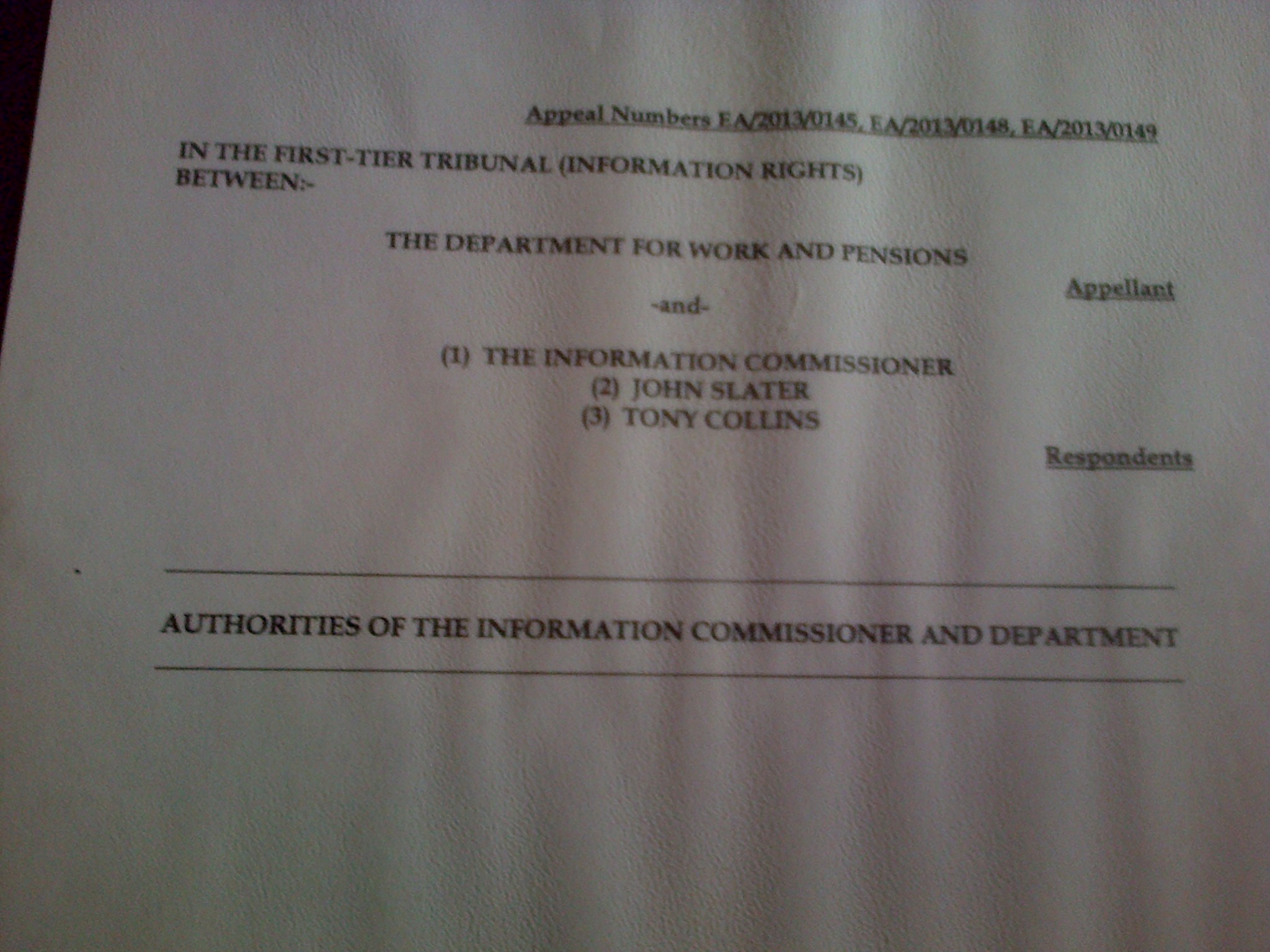
DWP FOI bundles2

The DWP fought for years at FOI tribunals and appeal hearings to stop the reports being published. Officials were expected to instigate a further appeal after an FOI tribunal ruled last month that the reports be published.

But it now appears that Stephen Crabb refused to sign off further public money for an appeal and officials were left with little choice but to release the reports.

The reports show the extent to which the DWP was economical with the truth in its self-praising departmental press releases and ministerial statements on the state of the Universal Credit programme in 2012 and 2013.

Trust

Indeed, how can we trust any DWP press statement on Universal Credit given that officials are still keeping hidden from Parliament and the public the risk registers, issues registers and project assessment reviews carried out on the UC programme since 2012.

Stephen Crabb

Stephen Crabb

Crabb’s appointment and the release of the three reports dated 2011 and 2012 are, from an FOI point of view, a good start.

But will the DWP become more open in the future about the state of its big IT-enabled change programmes?

Probably not. In a statement to Computer Weekly last week, a DWP spokesperson dismissed the released reports as “nearly five years old and out-of-date” and went on to praise the Universal Credit programme (which involves a waterfall approach and separate much cheaper, and to some extent competing, agile-based project).

This statement suggests that the DWP’s “no bad news” culture is still pervasive; that it is prepared to denigrate its own reports as out of date when they convey messages that conflict with officialdom’s good news culture.

A mass of DWP paperwork and legal bundles on the FOI appeals and hearings related to the documents show how earnest were the reasons for the DWP’s refusal to release the reports until this month.

It is likely that Crabb personally ordered their release. But, probably unknown to Crabb, the DWP has just refused an FOI request to release an Integrated Assurance and Approval Plan (IAAP) on the Universal Credit programme.

IT projects professional John Slater had requested the IAAP. He’d also made the original request for the UC risk register and issues register, and had campaigned long and hard for their release.

Some people may be surprised by the DWP’s refusal to release the IAAP, given that it is another very old Universal Credit report, dating back to the start of the programme. It may even pre-date the released risk register, issues register and project assessment review.

But the IAAP’s release could embarrass the DWP. IAAPs have been mandatory for all major projects since 1 April 2011. They show how well officials have planned a project or programme.

UC assumptions

The Treasury will not normally approve funding without a satisfactory IAAP. It is likely the DWP made a range of over-optimistic assumptions about the UC roll-out in its IAAP.

The DWP’s refusal to release it was under section 36 of FOI legislation. This requires sign off by a minister. In this case it is likely to have been signed off by Lord Freud, the welfare and pensions minister.

He was the minister who originally refused the FOI requests for the Universal Credit risk register, issues register, milestone schedule and project assessment review.

It is unlikely that Crabb knows anything about Slater’s request for the IAAP.

No Whitehall department has yet released contemporaneously – under FOI or outside it – any reports on the performance, progress or otherwise of its big IT-enabled projects or programmes, including Universal Credit.

Arguably it is the continued secrecy on the way officials manage big and costly schemes that contributes more than anything else to the poor record of central government when it comes to understanding and implementing IT-related change.

Out of control?

John Slater said of the released reports,

“Whilst the information disclosed relates to the UCP as it was back in 2012 it is still important and relevant to the programme today.

“The information shows a programme that appears to have been running at breakneck pace and was out of control.

“The normal checks and balances that a professional organisation should have had in place, especially cost control, simply weren’t there. Whilst these problems were recognised in the risks and issues there was no sense that the senior leadership team were willing or able to do anything about them.

“Having read the information it is not a surprise that the Major Projects Authority had no other option but to stop and restart the programme via the now infamous reset.

“The released information also raises questions about the validity of the Universal Credit business case that might explain why it still hasn’t been signed off by the Treasury.”

Comment

Well done to Stephen Crabb. He has given the culture of secrecy at the DWP a gentle shake. But can he make a lasting difference?

As we saw in “Yes Minister” it is difficult for a new minister – or any minister – to have any permanent influence on officialdom. And it remains the case that neither the DWP nor any other department has ever released contemporaneously reports on its own performance or the progress on a big IT-related change programme.

The nearest thing to it is a National Audit Office report, but these are usually retrospective and they are almost always dismissed by departmental press offices and ministers as out of date, whether they are or not.

It is abundantly clear that the DWP is pre-occupied – maybe paranoid – about negative media coverage of the Universal Credit programme.

The same thing happened at the Department of Health over media coverage of the NPfIT NHS IT programme: officials even issued written instructions to NHS staff on the tone of voice they should use with journalists and others when discussing the programme.

Many of the legal reasons the DWP gave to FOI tribunals and appeal judges revolved around the fear of releasing information that could fuel a negative response by the media to the Universal Credit programme.

dwpWhitehall’s war on FOI

Crabb has won an FOI battle but his officials are winning the pro-secrecy war. For Crabb to make a lasting difference he will need to persuade Lord Freud – and any of his successors – of the virtues of openness.

Until officials willingly publish contemporaneous reports on the progress or otherwise of big IT-enabled change programmes, government will probably continue to have a poor record when managing these schemes.

Success in government IT requires openness because IT-enabled projects and programmes are about solving problems; and if the problems cannot be admitted let alone discussed widely they are unlikely to be solved,as we saw with the initial problems on the Universal Credit programme.

Universal Credit involves many external organisations such as local authorities and housing associations. The DWP could start to embrace media coverage as giving healthy challenge to its decisions – challenges that may help to resolve a range of problems that are inevitable when the benefit system is being simplified.

Keeping reports such as the IAAP secret – even after five years – will continue to fuel the internal paranoia against open and constructive debate.

After decades of secrecy over the contemporaneous release of project and performance reports it is time for lasting change.

Universal Credit shows it’s time to make all major government projects open and transparent – Computer Weekly Editor’s Blog.

Judge orders Universal Credit reports must be published – The Register

Victory for campaigners as DWP finally publishes Universal Credit reports – Politics.co.uk

Judge orders FOI release of Universal Credit IT reports

By Tony Collins

universal creditA judge has ordered the Department for Work and Pensions to release three Universal Credit IT reports that ministers and their officials have spent public money trying to keep out of the public domain.

Judge Chris Ryan and his FOI tribunal panel went further: they concluded that had the reports in question been disclosed at the time they might have corrected misleading government statements about the robust state of the Universal Credit programme.

In their ruling this week the tribunal said that disclosure of the documents,

“might have corrected a false impression, derived from official government statements by revealing the very considerable difficulties that were beginning to develop around the time when the information requests were submitted.”

Two director-level officials at the Department for Work and Pensions had argued that civil servants needed a “safe space” in the reports in question to be candid in their assessments of risks and problems.

But the FOI tribunal, whose members have project management experience, concluded that it’s in the self interest of officials to be candid and professional about problems and risks rather than be associated with a failed project.

In addition, officials would not wish to be held partly responsible in a later review, such as one carried out by the National Audit Office, for having “failed to draw colleagues’ attention to problems with sufficient clarity to ensure that they were addressed effectively and in good time”.

Civil servants had an “awareness of the importance of candour in support of good decision-making and their professional obligation to assist that process”.

The tribunal said the three reports in question should have been  disclosed at the time they were requested in 2012. It directed the DWP to disclose them.

If the DWP’s barrister can identify good reasons why the tribunal might have made an error, or errors, in law, he can appeal within 28 days, though a tribunal could reject his appeal . The DWP could then appeal this decision.

This cycle of appeals that has already happened once – or the DWP could now decide that it has spent enough public money on fighting the case and release the reports.

dwpDid the DWP mislead?

The reports are expected to throw light on the problems and risks of Universal Credit IT at  a time when DWP’s officials, secretary of state Iain Duncan Smith and his ministers, were giving assurances that all was well with the programme.

An FOI tribunal ordered the reports to be released in 2014 but various DWP appeals led to a re-hearing of the case last month (22 February 2016) at Leicester Magistrates Court.

Now Judge Ryan and two other FOI tribunal panel members have ordered that the DWP release a risk register, issues register and Major Projects Authority project assessment review.

The risk register described risks, the possible impact should they occur, the probability of their occurring, a risk score, a traffic light status, a summary of the planned response if a risk materialised, and a summary of the risk mitigation.

The issues register included a list of problems, the dates they were identified, the mitigating steps required and the dates for review and resolution.

The project assessment review gave a high-level strategic view of the state of UC, its problems, risks and how well or badly it was being managed.

The DWP argued that routine disclosure of such reports could lead to sensationalist headlines that would have a “chilling effect”.  Not wanting to give food to a hostile media, officials writing or contributing to such reports could make them anodyne.

dwpDWP fears “over-stated”

But Judge Ryan said the DWP had “over-stated” its fears. The tribunal suggested that the DWP had not been entirely truthful about the Universal Credit programme.

“We do not accept the Department’s submission that the management of the Universal Credit Programme is already exposed to sufficient public scrutiny and that this dilutes the strength of the arguments in favour of disclosure. On the particular facts of this case it is clear that the true story about the troubles which the Programme team faced only came to light a long time after the event and then showed a markedly different picture than had been portrayed by government statements issued at the time.”

This difference between reality on the UC programme and government statements was a good reason in favour of the disclosure of the reports, said the judge.

Closed session

The DWP’s witness Cath Hamp, a senior DWP official, went into closed session at the latest hearing to argue that her concerns about civil servant behaviour would be more clearly shown by reference to specific items in the withheld documents.

Her closed-session arguments related to the risk of fraud and hacking into the system, relations with commercial organisations, and relations with local government. The tribunal was not convinced by her arguments.

Neither was the panel convinced by the “chilling effect” arguments.

“The evidence on the likelihood of civil servants altering their behaviour in future with regard to their contributions to the preparation of a risk or issues register or to the conduct of a project review was, as Ms Hamp fairly conceded, speculative…”

FOI a benefit more than a “burden”?

The DWP argued that disclosures of the reports would have placed a burden on DWP’s Universal Credit programme executives. They would have been forced to divert their energies and time into correcting media reports about the seriousness of problems and risks. But the tribunal concluded,

“Nor do we accept that resources would be wasted in providing explanations. It is clear from the press releases that we have been shown that the Department has been adept at presenting its case to the public and that it clearly has the specialist staff to carry out that function.”

The tribunal suggested that FOI obligations, rather than cause harm as the DWP had suggested, would be a benefit. The FOI Act had “brought with it an obligation on government to explain itself to a greater extent than had previously been found necessary”.

The tribunal rejected the DWP’s argument that it faced a hostile media which made officials defensive.

“… the evidence before us suggests that, on this issue, the media has adopted a relatively balanced approach to information about the Programme that has come into its possession.”

The judge said that in any event it is a

“perfectly appropriate performance of the media’s role in a modern democracy for it to investigate and comment on the implementation of a major reform involving large sums of public money and a potentially crucial impact on the lives of some of the least fortunate members of society”.

He added: “We do not therefore accept the Department’s submissions on the likelihood of the public misunderstanding the disputed information, or being misled as to its significance by the media”

In its final paragraph the tribunal said,

“… we have concluded that the public interest in maintaining the exemption in respect of each of the withheld documents does not outweigh the public interest in disclosure and that they should therefore have been disclosed when requested. Our decision is unanimous.”

Comment

My thanks to IT projects professional John Slater who has been the main force behind the case in favour of disclosure of the reports.

He made the original request in 2012 for the reports to be published. I requested one of them. He went to the original First Tier Tribunal and to Leicester Magistrates Court last month to cross examine the DWP’s witness. The points he made were quoted by the tribunal in its submission.

It’s campaigners like John Slater (and Dave Orr) who have helped to make FOI legislation more effective than it would otherwise have been.

If the DWP continues to pour money into fighting the disclosure of the reports in question, it will confirm to some of us that, when it comes to its own interest, that is its interest as a bureaucracy,  it may not be a fit authority to manage the spending of public money.

I hope it will release the reports now. It is time it started distinguishing between the public interest and its own.

Universal Credit FOI tribunal ruling – March 2016:  077 110316 Final Open Decision

DWP in court next week to stop Universal Credit reports being published

By Tony Collins

dwpAt an FOI tribunal next week at Leicester Magistrates Court  (Monday, 22 February 2016) a legal team paid for by taxpayers will do their best to convince a judge that three reports on the Universal Credit IT programme must not be published.

It will be the latest hearing in a succession of DWP legal actions to stop a risk register, issues register and a Major Projects Authority project assessment review being published.

Lawyers for the DWP have compiled a series of “bundles” – case folders. The volume of this legal paperwork hints at the mounting costs of the case which dates back three years.

In 2012 IT projects professional John Slater made an FOI request for three Universal Credit reports: the risk register,  issues register and milestone schedule.   Separately, but around the same time, I requested the project assessment review.

The DWP released the milestone schedule last year after refusing several times to disclose it. The DWP is still refusing to release the other three reports. Hence next week’s hearing in which the Information Commissioner is opposing the DWP’s case to keep the reports confidential.

“Safe space”

Although the reports in question have been superseded several times, the DWP is arguing they should not be published because of the “chilling effect”.

It claims that civil servants who write the reports or contribute to them need a “safe space” to be completely candid in their criticisms, without fear that their comments will be misinterpreted or taken out of context by a hostile media.

The Robert Walpole government in the 18th century used similar arguments to ban newspaper reports of debates in the House of Commons.

Concerned that hostile newspapers would misinterpret MPs’ speeches or report negative comments out of context, the House of Commons passed a resolution in April 1738 declaring that it was a “high indignity and a notorious breach of privilege” to report what was said in the Chamber, even when it was in recess (see separate post).

At next week’s hearing the Information Commissioner’s lawyers will argue that although the concerns of the DWP about the chilling effect were reasonable they did not over-ride the strong public interest in publishing the reports.

In their submission to the tribunal, the Information Commissioner’s lawyers emphasise the importance of the public’s ability to scrutinise high-cost, innovative and risky schemes such as the Universal Credit programme.

Had the reports been published when requested (in 2012) it would have enhanced the public’s chances of influencing the DWP’s actions on the programme.

Disclosure would have enabled the public to hold ministers and officials to account “at an appropriate time”, says the Commisioner’s submission.

The National Audit Office did not publish a report on Universal Credit’s early progress until September 2013. Before that DWP ministers and officials were confidently assuring the media, parliament and the public that the UC programme was on time and to budget.

If after the tribunal next week the judge orders disclosure of the reports – which is what happened at a previous “first-tier” FOI tribunal – the DWP will almost certainly appeal. It could be years before the case reaches a final conclusion.

But even if the DWP exhausts all its appeal options, ministers may be able to issue a “veto” to stop disclosure – though that could itself be challenged in the courts.

Comment

It’s appropriate that the FOI tribunal is being heard next week in a magistrates court, for the costs of the case so far border on the criminal.

I’ll post a fuller comment tomorrow on the similarities between the DWP’s arguments to the FOI tribunal and the arguments used in the 18th century to try and stop newspaper reporting of parliamentary debates.

Another NPfIT IT scandal in the making?

By Tony Collins

Jeremy Hunt may have forgotten what he told the FT 2013, as reported in the paper on 2 June 2o13.

Referring to the failed National Programme for IT [NPfIT] in the NHS he said at that time,

“It was a huge disaster . . . It was a project that was so huge in its conception but it got more and more specified and over-specified and in the end became impossible to deliver, but we musn’t let that blind us to the opportunities of technology and I think one of my jobs as health secretary is to say, look, we must learn from that and move on but we must not be scared of technology as a result.”

He added, “I’m not signing any big contracts from behind [my] desk; I am encouraging hospitals and clinical commissioning groups and GP practices to make their own investments in technology at the grassroots level.”

Now the Department of Health (and perhaps some large IT suppliers) have encouraged Hunt to find £4bn for spending on technology that is (again) of questionable immediate need.

Says Computing, “A significant part of the paperless NHS plans will involve enabling patients to book services and order prescriptions online, as well as giving them the choice of speaking to their doctor online or via a video link.”

The £4bn, if that’s what it will cost, is much less than the cost of the NPfIT. But are millions to be wasted again?

[NPfIT was originally due to cost £2.3bn over three years from 2003 but is expected to cost £9.8bn over 21 years, to 2024.]

Yesterday (8 February 2016) the Department of Health announced a “review of information technology in the NHS”. Announcing it Hunt said.

“Improving the standard of care patients receive even further means embracing technology and moving towards a fully digital and paperless NHS.

NHS staff do incredible work every day and we must give them and patients the most up-to-date technology – this review will tell us where we need to go further.”

The NPfIT was supposed to give the NHS up-to-date technology – but is that what’s needed?

A more immediate need is for any new millions of central funding (for the cost would be in the tens of millions, not billions) to be spent on the seemingly mundane objective of getting existing systems to talk to each other, so that patients can be treated in different parts of the NHS and have their electronic records go with them.

This doesn’t need a new national programme for IT. Some technologists working in the NHS say it would cost no more than £150m, a small sum by NHS IT standards, to allow patient data to reside where it is but be accessed by secure links anywhere, much as secure links work on the web.

But the review’s terms of reference make only a passing reference to the need for interoperability.

Instead the review will have terms of reference that are arguably vague – just as the objectives for the NPfIT were.

The Department of Health has asked the review board, when making recommendations, to consider the following points:

  • The experiences of clinicians and Trust leadership teams in the planning, implementation and adoption of digital systems and standards;
  • The current capacity and capability of Trusts in understanding and commissioning of health IT systems and workflow/process changes.
  • The current experiences of a number of Trusts using different systems and at different points in the adoption lifecycle;
  • The impact and potential of digital systems on clinical workflows and on the relationship between patients and their clinicians and carers.

The head of the review board Professor Wachter will report his recommendations to the secretary of state for health and the National Information Board in June 2016.

Members of the National Advisory Group on health IT in England (the review board) are:

  • Robert Wachter, MD, (Chair) Professor and Interim Chairman, Department of Medicine,University of California, San Francisco
  • Julia Adler-Milstein, PhD, Associate Professor, Schools of Information and of Public Health, University of Michigan
  • David Brailer, MD, PhD, CEO, Health Evolution Partners (current); First U.S. National Coordinator for Health IT (2004-6)
  • Sir David Dalton, CEO, Salford Royal NHS Foundation Trust, UK
  • Dave deBronkart, Patient Advocate, known as “e-Patient Dave”
  • Mary Dixon-Woods, MSc, DPhil, Professor of Medical Sociology, University of Leicester, UK
  • Rollin (Terry) Fairbanks, MD, MS, Director, National Center for Human Factors in Healthcare; Emergency Physician, MedStar Health (U.S.)
  • John Halamka, MD, MS, Chief Information Officer, Beth Israel Deaconess Medical Center; Professor, Harvard Medical School
  • Crispin Hebron, Learning Disability Consultant Nurse, NHS Gloucestershire
  • Tim Kelsey, Advisor to UK Government on Health IT
  • Richard Lilford, PhD, MB, Director, Centre for Applied Health Research and Delivery, University of Warwick, UK
  • Christian Nohr, MSc, PhD, Professor, Aalborg University (Denmark)
  • Aziz Sheikh, MD, MSc, Professor of Primary Care Research and Development, University of Edinburgh
  • Christine Sinsky, MD, Vice-President of Professional Satisfaction, AMA; Primary care internist, Dubuque, Iowa
  • Ann Slee, MSc, MRPharmS, ePrescribing Lead for Integrated Digital Care Record and Digital Medicines Strategy, NHS England
  • Lynda Thomas, CEO, MacMillan Cancer Support, UK
  • Wai Keong Wong, MD, PhD, Consultant Haematologist, University College London Hospitals; Inaugural chair, CCIO Leaders Network Advisory Panel
  • Harpreet Sood, MBBS, MPH, Senior Fellow to the Chair and CEO, NHS England and GP Trainee

Comment

Perhaps egged on by one or two major suppliers in behind-the-scenes lobbying, Hunt has apparently found billions to spend on improving NHS IT.

Nobody doubts that NHS IT needs improving.  But nearly all GPs have impressive systems, as do many hospitals.  But the systems don’t talk to each other.

The missing word  from the review board’s terms of reference is interoperability. True, it’s difficult to achieve. And it’s not politically aggrandizing to find money for making existing systems interoperable.

But at present you can have a blood test at the GP, then a separate blood test at the local hospital and the full results won’t go on your electronic record because the GP and hospital are on different systems with no interoperability between them.

If you’re treated at a specialist hospital for one ailment, and at a different hospital 10 to 20 (or say 100) miles away for something else, it may take weeks for your electronic record to reflect your latest treatment.

Separate NHS sites don’t always know what each other is doing to a patient, unless information is faxed or posted between them.

The fax is still one of the NHS’s main modes of cross-county communication. The DoH wants to be rid of the fax machine but it’s indispensable to the smooth running of the NHS, largely because new and existing systems don’t talk to each other.

The trouble with interoperability – apart from the ugliness of the word – is that it is an unattractive concept to some of the major suppliers, and to DoH executives, because it’s cheap, not leading edge and may involve agreements on data sharing.

Getting agreements on anything is not the DoH’s forte. [Unless it’s an agreement to spend more money on new technology, for the sake of having up-to-date technology.]

Last year I broke my ankle in Sussex and went to stay in the West Midlands at a house with a large ground floor and no need to use stairs. There was no communication between my local GP and the NHS in the West Midlands other than  by phone, post or fax, and even then only a summary of healthcare information went on my electronic record.

I had to carry my x-rays on a CD. Then doctors at my local orthopaedic department in Sussex found it difficult to see the PACS images because the hospital’s PCs didn’t have CD players.

A government employee told me this week of a hospital that gave medication to a patient in the hope she would not have an adverse reaction. The hospital did not have access to the patient’s GP records, and the patient was unsure of the name of the medication she’d previously had an allergic reaction to.

Much of the feedback I have had from those who have enjoyed NHS services is that their care and treatment has been impeded by their electronic records not moving with them across different NHS sites.

Mark Leaning, visiting professor, at University College, London, in a paper for health software supplier EMIS, says the NHS is “not doing very well when it comes to delivering a truly connected health system in 2016. That’s bad for patient outcomes.”

That GPs and their local hospital often cannot communicate electronically  is a disgrace given the billions various governments have spent on NHS IT.  It is on interoperability that any new DoH IT money needs to be spent.

Instead,  it seems huge sums will be wasted on the pie-in-the-sky objective of a paperless NHS by 2020. The review board document released today refers to the “ambition of a paper- free health and care system by 2020”.

What’s the point of a paperless NHS if a kaleidoscope of new or existing systems don’t properly communicate?

Congratulations, incidentally, to GP software suppliers TPP and EMIS. They last year announced direct interoperability between their core clinical systems.

Their SystmOne and EMIS Web systems hold the primary care medical records for most of the UK population.

And this month EMIS announced that it has become the first UK clinical systems provider to implement new open standards for interoperability in the NHS.

It says this will enable clinicians using its systems to securely share data with any third party supplier whose systems comply with a published set of open application programme interfaces.

The Department of Health and ministers need to stop announcing things that will never happen such as a paperless NHS and instead focus their attention – and any new IT money – on initiatives that are not subconsciously aimed at either political or commercial gain.

It would be ideal if they, before announcing any new IT initiative, weighed up diligently whether it is any more important, and any more of a priority, than getting existing systems to talk to each other.

Review of information technology in the NHS

EMIS implements open standards


DWP “evasive” and “selective” with information on Universal Credit programme

By Tony Collins

Has the Department for Work and Pensions put itself, to some extent, beyond the scrutiny  of Parliament on the Universal Credit IT programme?

Today’s report of the Public Accounts Committee Universal Credit progress update was drafted by the National Audit Office. All of the committee’s reports are effectively more strongly-worded NAO reports.

If the Department for Work and Pensions cannot be open with its own auditors – the National Audit Office audits the department’s annual accounts – are the DWP’s most senior officials in the happy position of being accountable to nobody on the Universal Credit IT programme?

The National Audit Office and the committee found the Department for Work and Pensions “selective or even inaccurate” when giving some information to the committee.

In answering some questions, the committee found officials “evasive”.

Today’s PAC report says:

“We remain disappointed by the persistent lack of clarity and evasive responses by the Department to our inquiries, particularly about the extent and impact of delays. The Department’s response to the previous Committee’s recommendations in the February 2015 report Universal Credit: progress update do not convince us that it is committed to improving transparency about the programme’s progress.”

On the basis of the limited information supplied by the DWP to Parliament the committee’s MPs believe that the Universal Credit has stabilised and made progress since the committee first reported on the programme in 2013, but there “remains a long way to go”.

So far the roll-out has largely involved the simplest of cases, and the ineligibility list for potential UC claimants is long.  By 10 December 2015, fewer than 200,000 people were on the DWP’s UC “caseload” list.

The actual number could be far fewer because the exact number recorded by the DWP by 10 December 2015 (175, 505)  does not include people whose claims have terminated because they have become ineligible by for example having capital more than £16,000 or earning more so that their benefits are reduced to zero.

The plan is to have more than seven million on the benefit, and the timetable for completion of the roll-out has stretched from 2017 originally to 2021,  although some independent experts believe the roll-out will not complete before 2023.

Meanwhile the DWP appears to be controlling carefully the information it gives to Parliament on progress. The committee accuses the DWP in today’s report of making it difficult for Parliament and taxpayers to hold the department to account. Says the report,

“The programme’s lack of clear and specific milestones creates uncertainty for claimants, advisers, and local authorities, and makes it difficult for Parliament and taxpayers to hold the Department to account.”

These are more excerpts from the report:

“In February 2015 the previous Committee of Public Accounts published Universal Credit: progress update … The Department accepted the Committee’s recommendations.

“However, we felt that the Department’s responses were rather weak and lacked specifics, and we were not convinced that it is committed to ensuring there is real clarity on this important programme’s progress.

“As a result, we recalled both the Department and HM Treasury to discuss a number of issues that concerned us, particularly around the business case, the continuing risks of delay, and the lack of transparency and clear milestones.

“Recommendation: The Department should set out clearly how it is tracking the costs of continuing delays, and who is responsible for ensuring benefits are maximised.

“The Department does not publish accessible information about plans and milestones and we are concerned by the lack of detail in the public domain about its expected progress.

“For proper accountability, this information should be published so that the Committee, the National Audit Office and the general public can be clear about progress…

“… the Department did not acknowledge that the slower roll-out affects two other milestones, because it delays the date when existing claimants start to be moved onto Universal Credit and reduces the number of Universal Credit claimants at the end of 2019.

“The flexible adaptation of milestones to circumstances is sensible, but the Department should be open about when this occurs and what the effects are. Instead, the Department’s continued lack of transparency makes it very difficult for us and the public to understand precisely how its plans are shifting.

“Claimants need to know more than just their benefits will change ‘soon’; local authorities need time to prepare additional support; and advisers need to be able to help people that come to them with concerns…

“Recommendation: By May 2016, the Department should set out and report publicly against a wider set of clearly stated milestones, based on ones it currently uses as internal measures, including plans for different claimant groups, local authority areas and for the development and use of new systems. We have set out the areas we expect these milestones to cover in an appendix to this report…

“The Department was selective or even inaccurate when highlighting the findings of its evaluation to us.”

The DWP has two IT projects to deliver UC, one based on its existing major suppliers delivering systems that integrate the simplest of new claims with legacy IT.

The other and more promising solution is a far cheaper “digital service” that is based on agile principles and is, in effect, entirely new IT that could eventually replace legacy systems. It is on trial in a small number of jobcentres.

The DWP’s slowly slowly approach to roll-out means it is reluctant to publish milestones, and it has reached only an early stage of the business case. The final business case is not expected before 2017 and could be later.

The committee has asked the DWP to be more transparent over the business case. It wants detail on:

  • Projected spending, including both investment and running costs for:
  • Live service (split between ‘staff and non staff costs’ and ‘external supplier costs’)
  • Digital service (split between ‘staff and non staff costs’ and ‘external supplier costs’)
  • Rest of programme (split between ‘staff and non staff costs’ and ‘External supplier costs’)
  • Net benefits realised versus forecasts.

Meanwhile the DWP’s response to those who criticise the slow roll-out is to give impressive statistics on the number of jobcentres now processing UC claims, without acknowledging that nearly all of them are processing only the simplest of claims.

Comment

To whom is the DWP accountable on the Universal Credit IT programme? To judge from today’s report it is not the all-party Public Accounts Committee or its own auditors the National Audit Office.

No government has been willing to force Whitehall departments to be properly accountable for their major IT-enabled projects or programmes. Sir Humphrey remains in control.

The last government with Francis Maude at the helm at the Cabinet Office came close to introducing real reforms (his campaign began too forcefully but settled into a good strategy of pragmatic compromise) but his departure has meant that open government and greater accountability for central departments have drifted into the shadows.

The DWP is not only beyond the ability of Parliament to hold it accountable it is spending undisclosed of public money sums on an FOI case to stop three ageing reports on the Universal Credit IT programme being published. The reports are nearly four years old.

Would that senior officials at the DWP could begin to understand a connection between openness and Lincoln’s famous phrase “government of the people, by the people, for the people”.

Public Accounts Committee report Universal Credit, progress update

DWP gives out “selective” information on welfare reform even to its auditors (a similar story in 2015)

Department for Work and Pensions “evasive” – Civil Service World (This article is aimed at its readers who are mostly civil servants. It is likely it will find favour with senior DWP IT staff who will probably mostly agree with the Public Accounts Committee’s view that the DWP hierarchy is, perhaps because of culture, evasive and selective with the information it gives to Parliament and the public.)


DWP fraud and mistakes cost an estimated £3.2bn – despite new HMRC data links

By Tony Collins

The Department for Work and Pensions’ auditors have qualified the department’s latest accounts for the 26th year in a row because of “unacceptably high” fraud and mistakes.

The high level of fraud and error is despite the DWP’s now being able to check every claimant’s benefit entitlements – particularly inconsistencies in earnings – through HMRC’s real-time information [RTI] tax system.

In 2014-15, the DWP carried out a bulk exercise to match RTI data against the DWP’s benefits information. The DWP uses RTI data to provide information on earnings as part of the calculation of claimants’ Universal Credit entitlement.

The National Audit Office, in today’s report on the DWP’s 2014-15 accounts, says that misreporting and incorrect processing of income and are responsible for estimated losses in 2014-15 of £1.12bn

A further £340m is lost through undisclosed and incorrect processing of data on living arrangements.

The DWP is the same department that’s pouring money into a protracted FOI legal battle to stop four reports on Universal Credit being published on the basis that their disclosure could affect the DWP’s “effective management of public affairs”.

The DWP publishes none of the reports on the progress or otherwise of its major projects and programmes.

One question is, in the light of the DWP’s repeatedly qualified accounts, whether the department’s officials are better or worse off running their affairs in an atmosphere of great secrecy.

Would the DWP’s senior management be able to manage the business better – and particularly the Universal Credit IT programme – if they had to publish their commissioned reports on major projects?

The added external scrutiny of business partners – including local authorities – plus MPs, journalists and the public could give extra force to attempts within the department to manage affairs more professionally.

Such is the DWP’s detachment from external scrutiny that its managers are legitimately able to decide to avoid measuring the Personal Independence Payment for fraud and error until 2016-17.

Some may wonder how any major organisation can delay measuring a major part of its business for fraud and error.

Says Amyas Morse, head of the NAO:

“We believe that the absence of up-to-date information on error rates in such a large benefit stream creates a risk that the Department is making decisions based on out-of-date measurements.”

He adds:

“Furthermore, some smaller value benefits have never undergone a (fraud and error) measurement exercise.”

Morse says the accounts DWP’s have been qualified because of the “unacceptably high level of fraud and error in benefit expenditure, other than State Pension where the level of fraud and error is lower”.

He says the accounts of the DWP and those of predecessor departments administering welfare spending, have been similarly qualified each year since 1988-89.

The DWP estimates total overpayments due to fraud and error in 2014-15 to be £3.2bn, which is 1.9%  of the total forecast benefit spending of £168.1bn.

The Department estimates the total underpayments in 2014-15 to be £1.4bn.

Morse says the DWP is not on track to achieve its target to reduce fraud and internal mistakes.

“Furthermore, the Department has reduced the pace of the roll out of Universal Credit. As a result, Universal Credit has not yet realized the £200m annual fraud and error savings originally expected by March 2015…”

This failure to meet savings targets on Universal Credit highlights the speculative nature of central government’s business case estimates of programme and project savings.

Morse said: “Issuing an audit qualification is a serious matter, and the fact that similar qualifications have been in place for such a long period of time does not lessen that seriousness.”

Fraud and error is defined as

– Official error, which arises when a benefit is paid incorrectly due to inaction, delay or a mistaken assessment by the Department, a local authority or HM Revenue and Customs;

– Claimant error, which occurs when claimants make inadvertent mistakes with no fraudulent intent; and

– Fraud, which arises when claimants deliberately seek to mislead the DWP or local authorities which administer benefits on the department’s behalf to claim money to which they are not entitled.

The DWP’s managers say the largest proportion of error enters the benefits system due to changes in claimants’ circumstances after a correct initial award.


FOI hearing today on DWP’s refusal to publish Universal Credit reports

By Tony Collins

External lawyers acting for the Department for Work and Pensions are due to appear before an FOI Upper Tribunal judge in London today to argue why four reports on Universal Credit should not be published.

It’s the latest step in a costly legal battle that has lasted two years so far.

A first-tier FOI tribunal judge in 2014 ordered the four reports to be published. The DWP asked for permission to appeal that decision and lost its case.  The DWP then asked an Upper Tribunal for permission to appeal and lost that case as well.

Then it asked a different Upper Tribunal judge for permission to appeal .  As a result, a 1 day hearing is taking place today.

The case takes in evidence from the DWP, the Information Commissioner, John Slater who requested 3 of the reports in question and me. Slater requested in 2012 a Universal Credit risks register, milestone schedule and issues register (which set out problems that had materialised with the Universal Credit programme).  I requested a project assessment review carried out in 2011 on the Universal Credit programme by the Cabinet Office’s Major Projects Authority.

The DWP has refused to publish the four reports – and millions of pounds worth of other similar reports.

Today the DWP will argue that the judge in an earlier Upper FOI Tribunal did not fully consider the “chilling effect” that disclosure of the reports would have on the behaviours of civil servants or consultants who helped to write the reports in question.

In essence the DWP’s lawyers are asking the judge to accept the arguments put forward against disclosure by Sarah Cox, the DWP’s main witness in the case. Cox is a former programme assurance director for Universal Credit.

Cox submitted 49 pages of evidence – plus secret evidence during a closed hearing – on why the UC reports should not be published.  She said that civil servants must be able to think the unthinkable and record the outcome of these thoughts without hesitation or fear of disclosure.

If contributors feared the reports would be routinely disclosed the documents could become “bland records” prepared with half an eye to how they would be received in the public domain.

She said the danger of damage to the public interest cannot be overstated.

Disclosure could adversely affect management of the Universal Credit programme – and “failure of proper programme management may be catastrophic”.

Emphasising the importance of effective management of risk, she referred to the banking system prior to the credit crunch and the stability of the Bank of England in that period.

“Inappropriate or premature disclosure of the information in the risk registers or the issues registers could lead to those failures occurring in government risk management with broader parallels for other project management tools.”

She then referred to “disaster myopia” – a phenomenon she said was well established in cognitive psychology.  It referred to “an underestimation of the likelihood of low frequency but high risk damage risks”.

She added: “This can result in a lack of appropriate mitigating actions, increasing the likelihood of the risk becoming an issue. In this case fear of disclosure and misinterpretation can exacerbate this myopia, leading to the toning down of the direct and forceful language used to describe risks, or worse, risks not being identified at all”.

If civil servants or consultants writing reports on projects were to downplay the risks because of a fear of disclosure, problems may be overlooked, solutions not found, or not found promptly. “Such an outcome would be seriously detrimental to the delivery of major projects.”

Cox’s evidence could appear to some to suggest the DWP was preoccupied with its image, and the image of the Universal Credit programme, in the media, and among MPs and the public. She said routine disclosure of such reports as those in question “will distract civil servants from their tasks at a crucial point in the process of programme management.

“Instead of concentrating on implementing the changes, they will be required to address stakeholder, press or wider public concerns which have been provoked by the premature disclosure of material.”

It would be unhelpful if “attention is focused on clarifying positions with stakeholders and addressing the concerns of media, opposition and interest groups in order to correct the often misleading impression created by premature disclosure”.

This issue is “magnified in a programme with as many delivery partners as Universal Credit, covering both central and local government, with implications for all territories in the UK”.

That is because of the “implications of issues for different partners are often slightly different, so that each partner may need to be given a slightly different, and tailored, response”.

This concern should not be understated, she said.

“From my experience of high profile matters which emerge with little warning, I can say that ministers and senior officials are likely to be forced to clear their diaries, cancelling planned meetings, events and other important engagements, to attend rapidly-convened meetings to discuss the handling of the premature disclosure.

“Officials in the relevant policy areas (and lawyers as appropriate) would need to set aside other essential and pressing work to prepare briefings on the likely impact of disclosure and options for next steps. ‘Lines to take’ and a stakeholder and media-handling strategy would need to be discussed, agreed and signed off by ministers.

“Ministers could also be called to respond to urgent questions tabled in Parliament, especially where the disclosure  is made in respect of a high-profile policy area. The media might press for interviews with ministers and/or senior officials, which require careful preparation…”

But, as the Information Commissioner has pointed out, disclosure of the documents under FOI is not the same as a leak to the media.

And the reports in question are now four years old and so massive media interest is unlikely. Any media interest could be managed by DWP press officers without distracting project managers.

Cox said disclosure could harm rather than assist public debate.

“Material that requires civil servants to think the unthinkable, or to consider unusual or highly unlikely events, using intentionally vivid and forceful language, at a single point in time, potentially pre-dating attempts to mitigate the position could easily distort the public perception of the real or likely situation and encourage sensationalist rather than responsible and balanced reporting.”

She said that officials may have to release further information to counteract any misunderstandings (from a misreading of the disclosed reports). But the “world of media” may ignore this further information.

Lawyers for the Information Commissioner, in their submission to today’s hearing, will argue that an earlier tribunal had not found any existence of a “chilling effect” in this case. The tribunal had not been persuaded by what the DWP had said.

The earlier tribunal had not dismissed all of the DWP’s concerns as entirely without merit. It accepted that disclosure of the documents in question “may not be a painless process for the DWP” and that there “may be some prejudice to the conduct of government of one or more of the kinds asserted by the DWP”. The tribunal was simply unpersuaded by the extent of those prejudices.

The Commissioner’s lawyers will say the earlier tribunal gave due weight to the evidence of Ms Cox but it was not obliged to agree with her.

There was no observable chilling effect from disclosures in the past where a chilling effect had been envisaged. The DWP had not provided any evidence that a chilling effect existed.

Indeed a Starting Gate Review on the Universal Credit project had been published (by Campaign4Change) after the DWP refused to release the document under FOI. The DWP had refused to publish the Starting Gate Review because of the chilling effect it would have on the contributors to such reports.

But there was no chilling effect in consequence of publication of the Starting Gate review, say the Information Commissioner’s lawyers.

The incident “illustrates that it is perfectly within the bounds of reason to be sceptical about the DWP’s assertions about the chilling effect and the like,” says the Information Commissioner’s submission to today’s hearing.

On Ms Cox’s point that disclosure of the reports in question would change behaviours of civil servants and consultants compiling the documents, the earlier tribunal had concluded that the public was entitled to expect from senior officials – and no doubt generally gets – a large measure of courage, frankness and independence in their assessments of risk and provision of advice.

The Information  Commissioner’s lawyers will today ask the judge to dismiss the DWP’s appeal.

Comment

The DWP’s evidence suggests that the reports in question today are critical to the effective delivery of Universal Credit. The reality is that excessive secrecy can make bureaucracies complacent and, in the the DWP’s case, somewhat chaotic.

When Campaign4Change asked the DWP under FOI for two Universal Credit reports – an end to end technical review carried out by IBM at a cost of £49,240 and a “delivery model assessment phases one and two” carried by McKinsey and Partners at a cost of £350,000 – the DWP mistakenly denied that the reports existed.

When we provided evidence the reports did exist the DWP said eventually that it had found them.  The DWP said in essence that the documents had been held so securely nobody knew until searching for them that they existed.

So much for the DWP’s argument that such reports are critical to the effective management of major projects.

And when Campaign4Change asked the DWP, under FOI, to supply a project assessment review report on the Universal Credit programme, officials mistakenly supplied an incorrect version of the report (a draft) to an FOI tribunal.  Officials later apologised for their mistake.

National Audit Office reports on Universal Credit do little to portray the DWP as a professional, competent and well-managed organisation.

Which all suggests that excessive secrecy within the DWP has made officials complacent and disorganised.

Continued excessive secrecy within the department could reinforce a suspicion, justified or not, that the department may not be in a strong position to run a programme as large and complex as Universal Credit.


Yet another NHS IT mess?

By Tony Collins

Last week the National Audit Office reported on the failure of the GP Extraction Service. Health officials  had signed off and paid for a contract even though the system was unfit for use.

The officials worked for organisations that have become part of the Health and Social Care Information Centre.

An unapologetic HSCIC issued a statement on its website in response to the Audit Office report. It said, in essence, that the problems with the GP Extraction Service were not the fault of the HSCIC but rather its predecessor organisations (ignoring the fact that many of the officials and contractors from those defunct organisations moved to the HSCIC).

Now it transpires that the HSCIC may have a new IT-related mess on its hands, this time one that is entirely of its own making – the e-Referral Service.

Last month the HSCIC went live with its e-Referral service without testing the system properly. It says it tested for thousands of hours but still the system went live with 9 pages of known problems.

Problems are continuing. Each time in their routine bulletins officials suggest that an upgrade will solve e-Referral’s problems. But each remedial upgrade is followed by another that does not appear to solve the problems.

The system went live on 15 June, replacing Choose and Book which was part of an earlier NHS IT disaster the £10bn National Programme for IT.

Problems more than teething?

Nobody expects a major new IT system to work perfectly first time but regular outages of the NHS e-Referral Service may suggest that it has more than teething problems.

It’s a common factor in IT-based project failures that those responsible have commissioned tests for many hours but with inadequately designed tests that did not always reflect real-world use of the system. They might also have underestimated loads on the available hardware and networks.

This means that after the system goes live it is brought down for regular hardware and software fixes that don’t solve the problems.  End-users lose faith in the system – as many GPs did with the Choose and Book system – and a misplaced optimism takes the place of realism in the thinking of managers who don’t want to admit the system may need a fundamental redesign.

On the day the e-Referral Service launched, a Monday, doctors had difficulties logging in. Software “fixes” that day made little difference. By the next day HSCIC’s optimism has set in. Its website said:

“The NHS e-Referral Service has been used by patients and professionals today to complete bookings and referrals comparable with the number on a typical Tuesday but we were continuing to see on-going performance and stability issues after yesterday’s fixes.

“We suspend access to the system at lunchtime today to implement another fix and this improved performance and stability in the afternoon.”

The “fix” also made little apparent difference. The next day, Wednesday 17 June, the entire system was “unavailable until further notice” said the HSCIC’s website.

By early evening all was apparently well. An HSCIC bulletin said:

“The NHS e-Referrals Service is now available again. We apologise for the disruption caused to users and thank everyone for their patience.”

In fact, by the next day, Thursday 18 June, all was not well. Said another bulletin:

“Yesterday’s outage enabled us to implement a number of improvements and hopefully this is reflected in your user experience today.

“This morning users reported that there were ongoing performance issues so work has now taken place to implement changes to the configuration to the NHS e-Referral Service hardware and we are currently monitoring closely to see if this resolved the issue.”

About 2 weeks later, on 30 June, HSCIC’s officials said there were ongoing problems, because of system performance in provider organisations that were processing referrals.

Was this HSCIC’s way of, again, blaming other organisations – as they did after the NAO report’s on the failure of the GP Extraction Service project? Said a statement on the HSCIC’s website on 30 June 2015:

“Since transition to the NHS e-Referral Service on Monday 15th June, we have unfortunately experienced a number of problems… Although most of the initial problems were related to poor performance of the system, some residual functional and performance issues persist and continue to affect some of our colleagues in their day-to-day working.

“Most of these on-going problems relate to the performance of the system in provider organisations that are processing referrals, though this does of course have a knock-on effect for referrers.

“Please be assured that the team are working to identify root causes and fixes for these issues.”

By last week – 2 July 2015 – HSCIC warned that it will require a “period of planned downtime on the NHS e-Referral Service tonight which is currently scheduled for between 21:00 and 23:00 for some essential maintenance to fix a high priority functional Incident.”

The fix worked – or did it? HSCIC told Government Computing: “An update was applied to the system overnight from Thursday (July 2) into Friday (July 3) which was successful.”

But …

Monday 6 July 2015 4.15pm. HSCIC e-Referral Service bulletin:

“We would like to apologise for the interruption to service between 13:15 and 13:54 today.  This was not a planned outage and we are investigating the root cause.  If any remedial activity is required we will give notice to all users. Once again please accept our sincere apologies for any inconvenience this caused.”

Why was testing inadequate?

Did senior managers go live without testing how the system would work in the real world, or did they select as test end-users only IT enthusiasts?

Perhaps managers avoided challenging the test system too much in case it gave poor results that could force a redesign.

We probably won’t know what has gone wrong unless the National Audit Office investigates. Even then it could be a year or more before a report is published. A further complicating factor is that the HSCIC itself may not know yet what has gone wrong and may be receiving conflicting reports on the cause or causes of the problems.

An IT failure? – change the organisation’s name

What’s certain is that the NHS has a history of national IT project failures which cause organisational embarrassment that’s soon assuaged by changing the name of the organisation, though the officials and contractors just switch from one to the next.

NHS Connecting for Health, which was largely responsible for the NPfIT disaster, was blended into the Department of Health’s informatics function which was then blended into the HSCIC.

Similarly the NHS Information Centre which was largely responsible for the GP Extraction Service disaster was closed in 2013 and its staff and contractors blended into the HSCIC.

Now, with the e-Referral Service, the HSCIC at least has a potential IT project mess that can be legitimately regarded as its own.

When will a centrally-run national NHS IT-based turn out to be a success? … care.data?

New SRO

Meanwhile NHS England is looking for a senior responsible owner for e-Referral Service on a salary of up to £98,453.

Usually in central government, SROs do the job as an adjunct to their normal work. It’s unusual for the NHS to employ a full-time project SRO which the NAO will probably welcome as a positive step.

But the job description is vague. NHS England says that the SRO for NHS e-Referrals programme will help with a switch from paper to digital for 100% of referrals in England by March 2018.

“The SRO … will have responsibility for the strategic and operational development of the digital journey, fulfilment of the patient and clinical process and the performance of the service. Plans to achieve the strategy will be underpinned by the delivery of short to medium term objectives, currently commissioned from HSCIC and other third party suppliers.”

Key aspects of this role will be to:-

– Ensure the strategy is formulated, understood by all stakeholders and is delivered utilising all available resources efficiently and effectively.

– Ensure the development and management of plans.

– Ensure appropriate system and processes are in place to enable the uptake and on-going use of digital referrals by GP’s, hospitals, patients and commissioners.

– Proactively manage the key risks and issues associated with ensuring appropriate actions are taken to mitigate or respond.

– Monitor and establish accountability on the overall progress of the strategy to ensure completion within agreed timescales.

– Manage the budgetary implications of activity.

– Avoid the destabilisation of business as usual.

– Manage and actively promote the relationships with key stakeholders.

The job will be fixed-term until 31/03/2017 and interviews will be held in London on the 20th July 2015.

The big challenge will be to avoid the destabilisation of business as usual – a challenge beyond the ability of one person?

Government Computing. 

Another fine NHS IT mess

Why was e-Referral Service launched with 9 pages of known problems?

National e-Referral Service unavailable until further notice


Another fine NHS IT mess

By Tony Collins

Today the National Audit Office reports on the General Practice Extraction Service, an IT system that allows patient data to be extracted from all GP practices in England.

The report says that Department of Health officials – who were then working for the NHS Information Centre – signed off and paid for a contract even though the system was unfit for use. The original business case for the system grossly underestimated costs.

And the system was developed using the highest-risk approach for new IT – a combination of agile principles and traditional fixed-price contract.

Some of the officials involved appear to be those who worked for NHS Connecting for Health – the organisation responsible for what has become the UK’s biggest IT-related failure, the £10bn National Programme for IT (NPfIT).

As with the NPfIT it is unlikely anyone responsible for the latest failure will be held accountable or suffer any damage to their career.

The NAO says officials made mistakes in the original procurement. “Contract management contributed to losses of public funds, through asset write-offs and settlements with suppliers.” More public money is needed to improve or replace the system.

Labour MP Meg Hillier MP, the new chairman of the Public Accounts Committee, sums up today’s NAO’s report:

“Failed government IT projects have long been an expensive cliché and, sadly for the taxpayer and service user, this is no exception.

“The expected cost of the General Practice Extraction Service ballooned from £14m to £40m, with at least £5.5m wasted on write-offs and delay costs.

“GPES has managed to provide data for just one customer – NHS England – and the data was received 4 years later than originally planned.

“While taxpayers are left picking up the tab for this failure, customers who could benefit, such as research and clinical audit organisations, are waiting around for the system to deliver what they need to improve our health service.”

Some GPs who do not want patient data to be extracted from their systems – they believe it could compromise their bond of confidentiality with patients – may be pleased the extraction system has failed to work properly.

But their concern about patient confidentiality being compromised will not make the failure of the extraction service any more palatable.

The NAO says it only learned of the failure of the extraction system through its financial audit of the Health and Social Care Information Centre. It learned that the system was not working as expected and that HSCIC had agreed to pay additional charges through a settlement with one of the main suppliers, Atos IT Services UK Ltd.

An NHS Connecting for Health legacy?

Work on the GP Extraction Service project began in 2007, first by the NHS Information Centre, and then by the HSCIC.

The NHS Information Centre closed in 2013 and responsibility transferred to the HSCIC which combines the Department of Health’s informatics functions – previously known as NHS Connecting for Health or CFH – and the former NHS Information Centre.

What went wrong 

The original business case said the extraction service would start in 2009-10, but it took until April 2014 for HSCIC to provide the first data extract to a customer.

Meanwhile other potential users of the system have found alternative sources of patient data in the absence of the HSCIC system.

The NAO says that officials changed the procurement strategy and technical design for the GPES extraction systems during the project. “This contributed to GPES being unable to provide the planned number and range of data extracts.”

The NHS Information Centre contracted with Atos to develop a tool to manage data extraction. In March 2013, the Centre accepted delivery of this system from Atos.

But officials at the HSCIC who took over the system on 1 April 2013 found that it had fundamental design flaws and did not work. “The system test did not reflect the complexity of a ‘real life’ data extract and was not comprehensive enough to identify these problems”.

To work in a ‘real life’ situation, the GPES query system needed to communicate accurately with the four separate extraction systems and other systems relying on its data.  The test officials and Atos agreed was less complex. It did not examine extractions from multiple extraction systems at once.

Nor did the test assess the complete process of extracting and then passing GPES data to third-party systems.

Fixed price and agile – a bad combination

Officials began procuring the GPES query tool in April 2009, using a fixed-price contractual model with ‘agile’ parts. The supplier and officials would agree some of the detailed needs in workshops, after they signed the contract.

But the NAO says there was already evidence in central government at this time that the contractual approach – combining agile with a fixed price – was high risk.

The NAO’s report “Shared Services in the Research Councils”reviewed how research councils had created a shared service centre, where a similarly structured IT contract failed.

In the report, Fujitsu and the shared service centre told the NAO that: “the fixed-rate contract awarded by the project proved to be unsuitable when the customers’ requirements were still unclear.”

The court case of De Beers vs. Atos Origin highlighted a similar failure.

To make matters worse officials relied too heavily on contractors for development and procurement expertise.  And 10 project managers were responsible for GPES between 2008 and 2013.

Once health officials and Atos had signed the query tool contract, they found it difficult to agree the detailed requirements. This delayed development, with Atos needing to start development work while some requirements had yet to be agreed. Officials and Atos agreed to remove some minor components. Others were built but never used by HSCIC.

A Department of Health Gateway 4 review in December 2012 found that difficulties with deciding requirements were possibly exacerbated by development being offshore.

They raised concerns about the project management approach:

“The GPET-Q [query tool] delivery is being project managed using a traditional ‘waterfall’ methodology. Given the degree of bespoke development required and the difficulties with translation of requirements during the elaboration parts of R1, the Review Team considers that, with hindsight, it might have been beneficial to have adopted an Agile Project Management approach instead.”

General Practice Extraction Service – an investigation. NAO report. 

Latest healthcare IT disaster is a reminder of how vital government digital transformation is.


Universal Credit at “amber/red” says latest DWP report

By Tony Collins

The Major Projects Authority, which is part of the Cabinet Office’s Efficiency and Reform Group, has today published its annual report on 188 projects including Universal Credit, about which it makes only positive comments.

But the authority’s annual report is, it appears, economical with the actualité. At the same time as the MPA published the report, the Department for Work and Pensions published a spreadsheet with statistics and its own narrative on the state of its major projects including the Universal Credit programme.

The spreadsheet said that the UC programme had an “amber/red” rating – but neither the MPA nor the Department for Work and Pensions has given the MPA’s reasons for the rating.

At the request of permanent secretaries the MPA has agreed not to publish its comments on the traffic light status of certain projects, including Universal Credit. The MPA and the Cabinet Office have agreed to allow officials in each departmental to give their own narrative to explain the traffic light status of their projects.

So the DWP, on its website, gives a summary of the state of its major projects, but its narrative on Universal Credit says nothing about the programme’s problems. Neither is there any of the MPA’s recommendations which related to the “amber/red” rating.

In a further shrinking from openness, the MPA and Cabinet Office have agreed with permanent secretaries that the traffic light status of major projects will be published only when they are out of date. So the “amber/red” rating on Universal Credit, although published today, is dated September 2014.

Comment

It is odd in a modern democracy that a large central government department – the DWP – can spend £330m on the IT for a major project and get away with publishing such obviously contradictory information on the scheme.

On the one hand the MPA, the Cabinet Office and the DWP publish only positive comments about progress on the Universal Credit programme.

These are some of the MPA’s comments on Universal Credit:

“Delivery remains on track against plans announced in September 2014. Additionally the Programme has brought forward testing of initiatives from which the programme can learn including the:

• Continued trialling of Universal Support in partnership areas to ensure the right integrated local foundations are in place to support UC expansion.

• Extending In work progression trials to help households increase their earnings once they have found work. • Extending the role of UC Work Coaches to engage with households at their work search interview to assess financial capability.”

Similarly the DWP’s comments in its spreadsheet on the status of its major projects reads like a government press release. Why was one of the government’s major projects – the whole life project costs of UC are estimated at £15.8bn – given an amber/red status?

We don’t know. Except we know that the MPA gives an amber/red rating when it regards a programme as not on track – a programme that needs an assurance and action plan to improve confidence in delivery. Why is the programme not on track? What does the assurance and action plan say? What is the rating today?

So much for open government. Indeed the DWP’s external lawyers are going to an FOI tribunal in London next month as part of a long legal battle to stop four old reports on Universal Credit being published.

Any ministerial announcements about open government in future should, perhaps, take this unedifying FOI episode into account.

Major Projects Authority annual report 2014/2015