Category Archives: excessive secrecy

Inside Universal Credit IT – analysis of document the DWP didn’t want published

dwpBy Tony Collins

Written evidence the Department for Work and Pensions submitted to an FOI tribunal – but did not want published (ever) – reveals that there was an internal “lack of candour and honesty throughout the [Universal Credit IT] Programme and publicly”.

It’s the first authoritative confirmation by the DWP that it has not always been open and honest when dealing with the media on the state of the Universal Credit IT programme.
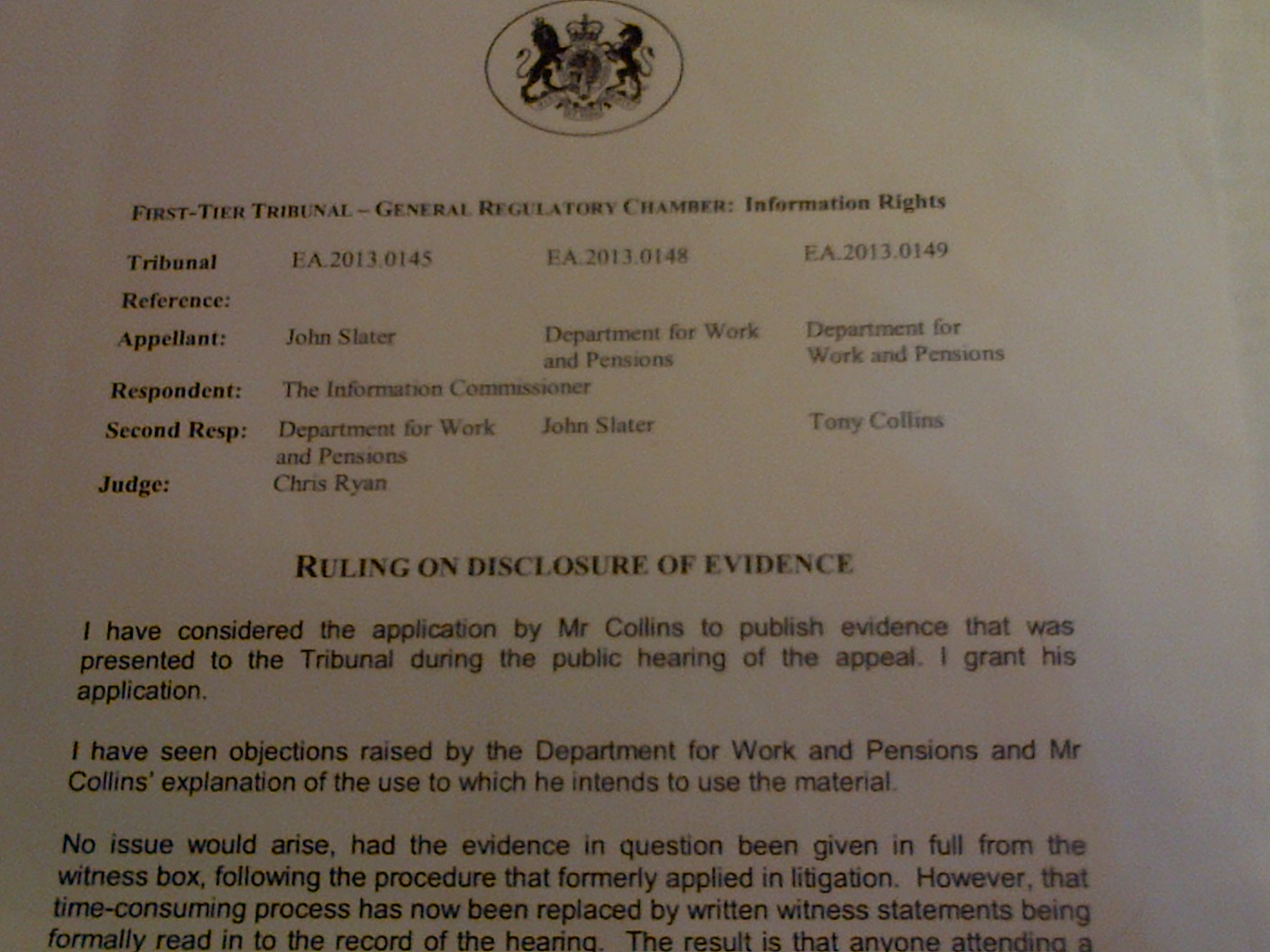
FOI tribunal grants request to publish DWP's written submission

FOI tribunal grants request to publish DWP’s written submission

According to the DWP submission, senior officials on the Programme became so concerned about leaks that a former member of the security services was brought in to lead an investigation. DWP staff and managers were the subjects of “detailed interviews”. Employee emails were “reviewed”, as were employee access rights to shared electronic areas.

Staff became “paranoid” about accidentally leaving information on a printer. Some of the high-security measures appear still to be in place.

Unpublished until now, the DWP’s written legal submission referred, in part, to the effects on employees of leak investigations.

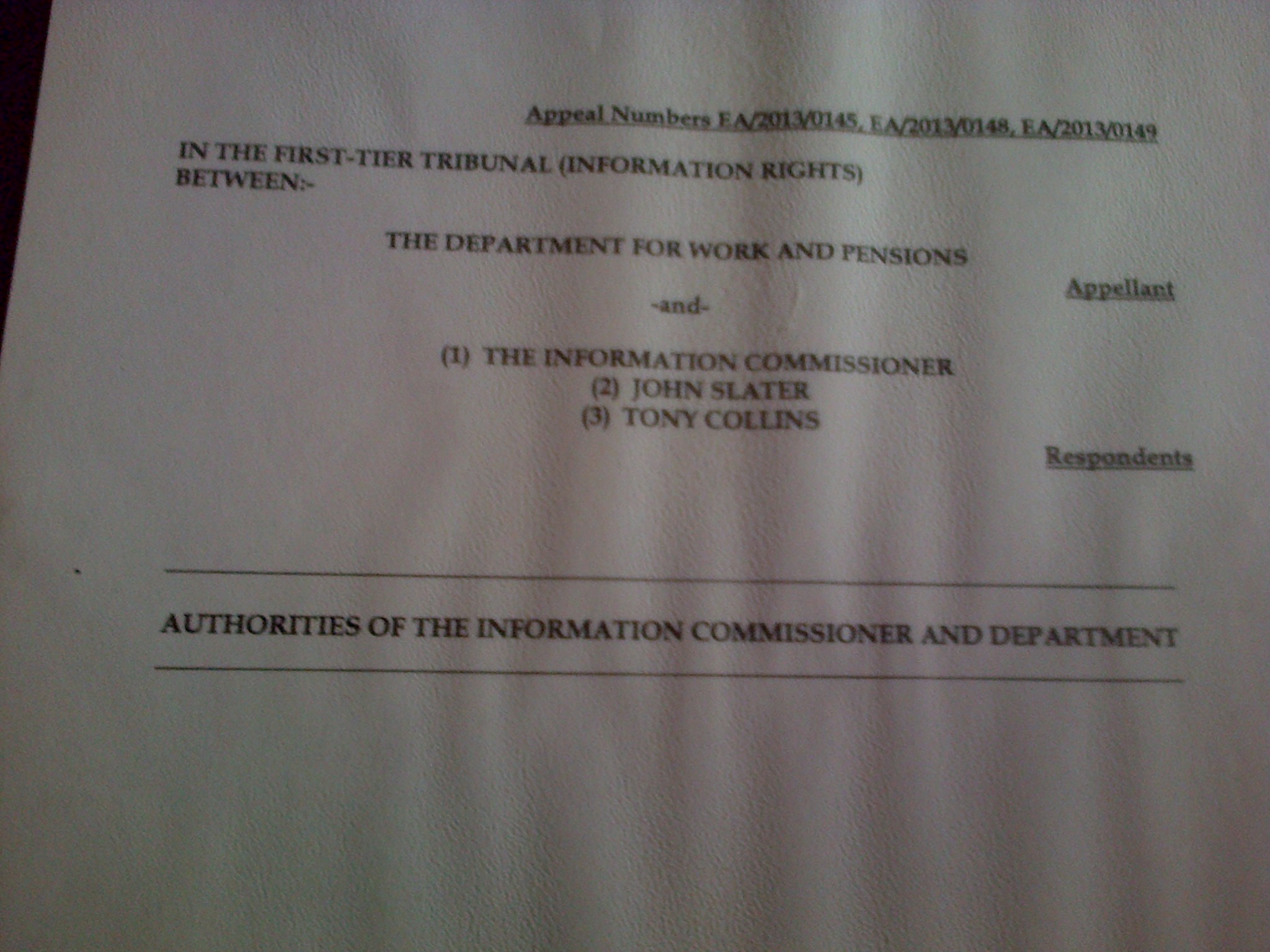
The submission was among the DWP’s written evidence to an FOI Tribunal in February 2016.

The Government Legal Service argued that the DWP’s written evidence was for the purposes of the tribunal only. It should not be published or passed to an MP.

The Legal Service went further: it questioned the right of an FOI Tribunal to decide on whether the submission could be published. Even so a judge has ruled that the DWP’s written evidence to the tribunal can be published.

Excerpts from the submission are here.

Analysis and Comment

The DWP’s submission gives a unique glimpse into day-to-day life and corporate sensitivities at or near the top of the Universal credit IT programme.

It reveals the lengths to which senior officials were willing to go to stop any authoritative “bad news” on the Universal Credit IT programme leaking out. Media speculation DWP’s senior officials do not seem to mind. What appears to concern them is the disclosure of any credible internal information on how things are progressing on Universal Credit IT.

Confidential

Despite multiple requests from IT suppliers, former government CIOs and MPs, for Whitehall to publish its progress reports on big IT-based change programmes (some examples below), all central departments keep them confidential.

That sensitivity has little to do with protecting personal data.

It’s likely that reviews of projects are kept confidential largely because they could otherwise expose incompetence, mistakes, poor decisions, risks that are likely to materialise, large sums that have been wasted or, worst of all, a project that should have been cancelled long ago and possibly re-started, but which has been kept going in its original form because nobody wanted to own up to failure.
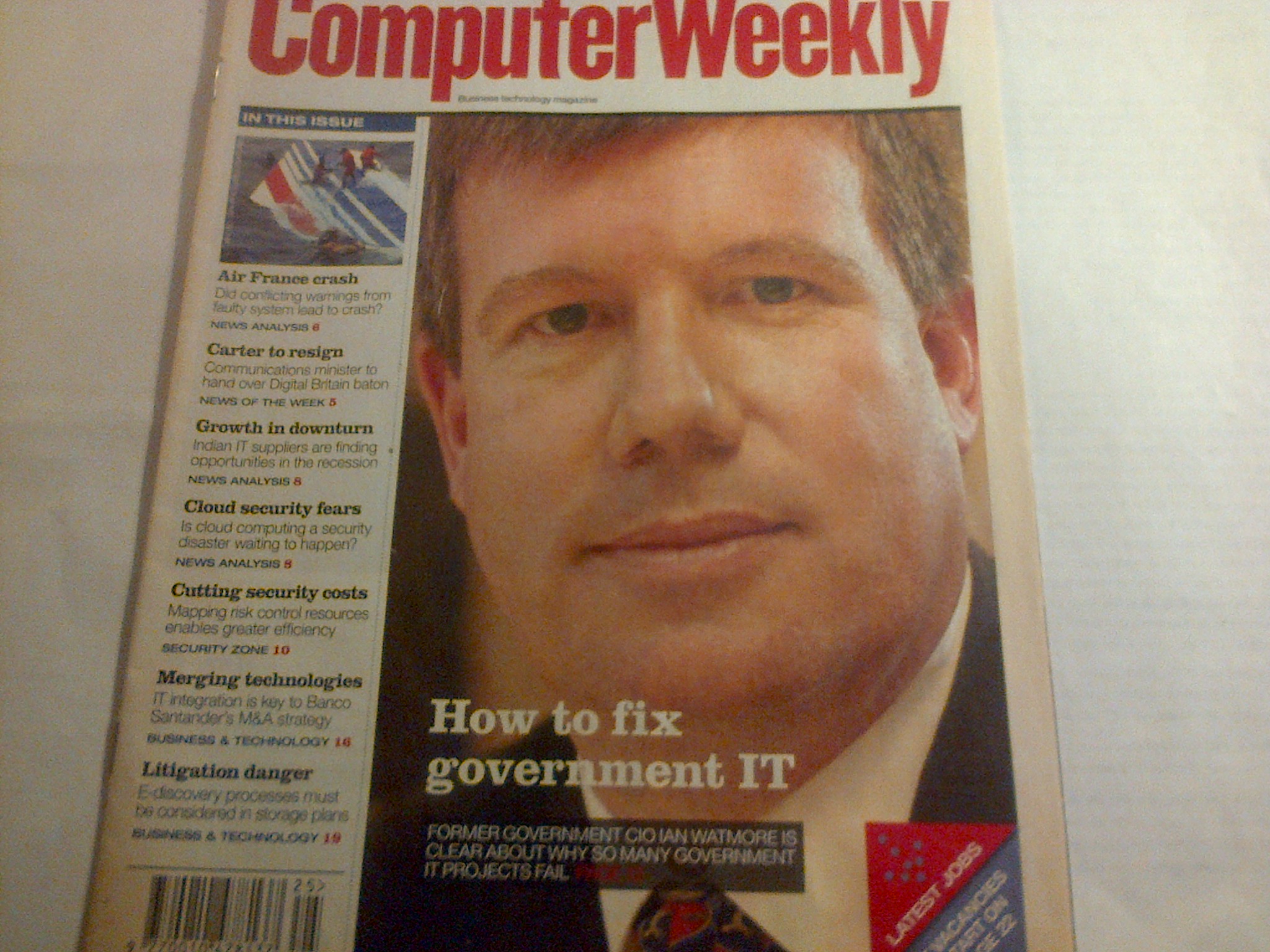
Ian watmore front cover How to fix government IROn this last point, former government CIO and permanent secretary Ian Watmore spoke to MPs in 2009 about how to fix government IT. He said,

“An innovative organisation tries a lot of things and sometimes things do not work. I think one of the valid criticisms in the past has been when things have not worked, government has carried on trying to make them work well beyond the point at which they should have been stopped.”

Individual accountability for failure?

Oblivious to MPs’ requests to publish IT progress reports, the DWP routinely refuses FOI requests to publish IT progress reports, even when they are several years old, even though by then officials and ministers involved will probably have moved on. Individual accountability for failure therefore continues to be non-existent.

Knowing this, MPs on two House of Commons select committees, Public Accounts and Work and Pensions, have called for the publication of reports such as “Gateway” reviews.

This campaign for more openness on government IT projects has lasted nearly three decades. And still Whitehall never publishes any contemporaneous progress reports on big IT programmes.

It took an FOI campaigner and IT projects professional John Slater [@AmateurFOI] three years of legal proceedings to persuade the DWP to release some old reports on the Universal Credit IT programme (a risk register, milestone schedule and issues log). And he had the support of the Information Commissioner’s legal team.

universal creditWhen the DWP reluctantly released the 2012 reports in 2016 – and only after an informal request by the then DWP secretary of state Stephen Crabb – pundits were surprised at how prosaic the documents were.

Yet we now know, thanks to the DWP’s submission, the lengths to which officials will go to stop such documents leaking out.

Understandable?

Some at the DWP are likely to see the submission as explaining some of understandable measures any government department would take to protect sensitive information on its largest project, Universal Credit. The DWP is the government largest department. It runs some of the world’s biggest IT systems. It possesses personal information on nearly everyone in Britain. It has to make the protection of its information a top priority.

Others will see the submission as proof that the DWP will do all it can to honour a decades-old Whitehall habit of keeping bad news to itself.

Need for openness

It’s generally accepted that success in running big IT-enabled change programmes requires openness – with staff and managers, and with external organisations and agencies.

IT-based change schemes are about solving problems. An introspective “good news only” culture may help to explain why the DWP has a poor record of managing big and successful IT-based projects and programmes. The last time officials attempted a major modernisation of benefit systems in the 1990s – called Operational Strategy – the costs rose from £713m to £2.6bn and the intended objective of joining up the IT as part of a “whole person” concept, did not happen.

Programme papers“watermarked”

The DWP’s power, mandate and funding come courtesy of the public. So do officials, in return, have the right to keep hidden mistakes and flawed IT strategies that may lead to a poor use – or wastage – of hundreds of millions of pounds, or billions?

The DWP’s submission reveals that recommendations from its assurance reports (low-level reports on the state of the IT programme including risks and problems) were not circulated and a register was kept of who had received them.

Concern over leaks

The submission said that surveys on staff morale ceased after concerns about leaks. IT programme papers were no longer sent electronically and were delivered by hand. Those that were sent were “double-enveloped” and any that needed to be retained were “signed back in”. For added security, Universal Credit programme papers were watermarked.

When a former member of the security services was brought in to conduct a leaks investigation, staff and mangers were invited by the DWP’s most senior civil servant to “speak to the independent investigator if they had any information”. This suggests that staff were expected to inform on any suspect colleagues.

People “stopped sharing comments which could be interpreted as criticism of the [Universal Credit IT] Programme,” said the submission. “People became suspicious of their colleagues – even those they worked closely with.

“There was a lack of trust and people were very careful about being honest with their colleagues…

“People felt they could no longer share things with colleagues that might have an honest assessment of difficulties or any negative criticism – many staff believed the official line was, ‘everything is fine’.

“People, even now, struggle to trust colleagues with sensitive information and are still fearful that anything that is sent out via email will be misused.

“For all governance meetings, all documents are sent out as password protected, with official security markings included, whether or not they contain sensitive information.”

“Defensive”

dwpLines to take with the media were added to a “Rolling Brief”, an internal update document, that was circulated to senior leaders of the Universal Credit IT programme, the DWP press office and special advisors.

These “lines to take” were a “defensive approach to media requests”. They emphasised the “positive in terms of progress with the Programme without acknowledging the issues identified in the leaked stories”.

This positive approach to briefing and media management “led to a lack of candour and honesty through the Programme and publically …”

How the DWP’s legal submission came about is explained in this separate post.

Were there leaks of particularly sensitive information?

It appears not. The so-called leaks revealed imperfections in the running of the Universal Credit programme; but there was no personal information involved. Officials were concerned about the perceived leak of a Starting Gate Review to the Telegraph (although the DWP had officially lodged the review with the House of Commons library).

The DWP also mentioned in its statement a leak to the Guardian of the results of an internal “Pulse” survey of staff morale – although it’s unclear why the survey wasn’t published officially given its apparent absence of sensitive commercial, personal, corporate or governmental information.

NPfIT

The greater the openness in external communications, the less likely a natural scepticism of new ways of working will manifest in a distrust of the IT programme as a whole.

The NHS’s National Programme for IT (NPfIT) – then the UK’s biggest IT programme costing about £10bn – was dismantled in 2011 after eight fraught years. One reason it was a disaster was the deep distrust of the NPfIT among clinicians, hospital technologists, IT managers, GPs and nurses. They had listened with growing scepticism to Whitehall’s oft-repeated “good news” announcements.

Ex-Government CIO wanted more openness on IT projects

When MPs have asked the DWP why it does not publish reports on the progress of IT-enabled projects, it has cited “commercial confidentiality”.

But in 2009, Ian Watmore (the former Government CIO) said in answer to a question by Public Account Committee MP Richard Bacon that he’d endorse the publication of Gateway reviews, which are independent assessments of the achievements, inadequacies, risks, progress and challenges on risky IT-based programmes.

“I am with you in that I would prefer Gateway reviews to be published because of the experience we had with capability reviews (published reports on a department’s performance). We had the same debate (as with Gateway reviews) and we published them. It caused furore for a few weeks but then it became a normal part of the furniture,” said Watmore.

Capability reviews are no longer published. The only “regular” reports of Whitehall progress with big IT programmes are the Infrastructure and Projects Authority’s annual reports. But these do not include Gateway reviews or other reports on IT projects and programmes. The DWP and other departments publish only their own interpretations of project reviews.

In the DWP’s latest published summary of progress on the Universal Credit IT programme, dated July 2016, the focus is on good news only.

But this creates a mystery. The Infrastructure and Projects Authority gave the Universal Credit programme an “amber” rating in its annual report which was published this month. But neither the DWP nor the Authority has explained why the programme wasn’t rated amber/green or green.

MPs and even IT suppliers want openness on IT projects

Work and Pensions Committee front coverIn 2004 HP, the DWP’s main IT supplier, told a Work and Pensions Committee inquiry entitled “Making IT work for DWP customers” in 2004 that “within sensible commercial parameters, transparency should be maintained to the greatest possible extent on highly complex programmes such as those undertaken by the DWP”.

The Work and Pensions Committee spent seven months investigating IT in the DWP and published a 240-page volume of oral and written in July 2004. On the matter of publishing “Gateway” reviews on the progress or otherwise of big IT projects, the Committee concluded,

“We found it refreshing that major IT suppliers should be content for the [Gateway] reviews to be published. We welcome this approach. It struck us as very odd that of all stakeholders, DWP should be the one which clings most enthusiastically to commercial confidentiality to justify non-disclosure of crucial information, even to Parliament.”

The Committee called for Gateway reviews to be published. That was 12 years ago – and it hasn’t happened.

Four years later the Committee found that the 19 most significant DWP IT projects were over-budget or late.

DWP headline late and over budget

In 2006 the National Audit Office reported on Whitehall’s general lack of openness in a report entitled “Delivering successful IT-enabled business change”.

The report said,

“The Public Accounts Committee has emphasised frequently the need for greater transparency and accountability in departments’ performance in managing their programmes and projects and, in particular, that the result of OGC Gateway Reviews should be published.”

But today, DWP officials seem as preoccupied as ever with concealing bad news on their big IT programmes including Universal Credit.

The costs of concealment

The DWP has had important DWP project successes, notably pension credits, which was listed by the National Audit Office as one of 24 positive case studies.

But the DWP has also wasted tens of millions of pounds on failed IT projects.

Projects with names such as “Camelot” [Computerisation and Mechanisation of Local Office Tasks] and Assist [Analytical Services Statistical Information System) were cancelled with losses of millions of pounds. More recently the DWP has run into problems on several big projects.

“Abysmal”

On 3 November 2014 the then chairman of the Public Accounts Committee Margaret Hodge spoke on Radio 4’s Analysis of the DWP’s ‘abysmal’ management of IT contracts.”

1984

As long ago as 1984, the House of Commons Public Accounts Committee called for the civil service to be more open about its progress on major computer projects.

Today there are questions about whether the Universal Credit IT will succeed. Hundreds of millions has already been spent. Yet, as mentioned earlier, current information on the progress of the DWP’s IT programmes remains a state secret.

It’s possible that progress on the Universal Credit IT programme has been boosted by the irregular (but thorough) scrutiny by the National Audit Office. That said, as soon as NAO reports on Universal Credit are published, ministers and senior officials who have seen copies in advance routinely dismiss any criticisms as retrospective and out-of-date.

Does it matter if the DWP is paranoid about leaks?

A paper published in 2009 looks at how damaging it can be for good government when bureaucracies lack internal challenge and seek to impose on officials a “good news” agenda, where criticism is effectively prohibited.

The paper quoted the then Soviet statesman Mikhail Gorbachev as saying, in a small meeting with leading Soviet intellectuals,

“The restructuring is progressing with great difficulty. We have no opposition party. How then can we control ourselves? Only through criticism and self-criticism. Most important: through glasnost.”

Non-democratic regimes fear a free flow of information because it could threaten political survival. In Russia there was consideration of partial media freedom to give incentives to bureaucrats who would otherwise have no challenge, and no reason to serve the state well, or avoid mistakes.

The Chernobyl nuclear disaster, which occurred on April 26, 1986, was not acknowledged by Soviet officials for two days, and only then after news had spread across the Western media.

The paper argued that a lack of criticism could keep a less democratic government in power. But it can lead to a complacency and incompetence in implementing policy that even a censored media cannot succeed in hiding.

As one observer noted after Chernobyl (Methvin in National Review, Dec. 4, 1987),

“There surely must be days—maybe the morning after Chernobyl—when Gorbachev wishes he could buy a Kremlin equivalent of the Washington Post and find out what is going on in his socialist wonderland.”

Red team

Iain DuncanSmithA lack of reliable information on the state of the Universal Credit IT programme prompted the then secretary of state Iain Duncan Smith to set up his own “red team” review.

That move was not known about at the time. Indeed in December 2012 – at a point when the DWP was issuing public statements on the success of the Universal Credit Programme – the scheme was actually in trouble. The DWP’s legal submission said,

“In summary we concluded (just before Christmas 2012) that the IT system that had been developed for the launch of UC [Universal Credit] had significant problems.”

One wonders whether DWP civil servants kept Duncan Smith in the dark because they themselves had not been fully informed about what was going on, or because they thought the minister was best protected from knowing what was going on, deniability being one key Whitehall objective.

But in the absence of reliable internal information a political leader can lose touch completely, said the paper on press freedom.

“On December 21, 1989, after days of local and seemingly limited unrest in the province of Timi¸ Ceausescu called for a grandiose meeting at the central square of Bucharest, apparently to rally the crowds in support of his leadership. In a stunning development, the meeting degenerated into anarchy, and Ceausescu and his wife had to flee the presidential palace, only to be executed by a firing squad two days later.”

Wrong assumptions

Many times, after the IT media has published articles on big government IT-based project failures, TV and radio journalists have asked to what extent the secretary of state was responsible and why he hadn’t acted to stop millions of pounds being wasted.

But why do broadcast journalists assume ministers control their departments? It is usually more likely that ministers know little about the real risks of failure until it is too late to act decisively.

Lord Bach, a minister at DEFRA, told a House of Commons inquiry in 2007 into the failure of the IT-based Single Payment Scheme that he was aware of the risks but still officials told him that systems would work as planned and farmers would receive payments on time. They didn’t. Chaos ensued.

Said Lord Bach,

“I do think that, at the end of the day, some of the advice that I received from the RPA [Rural Payments Agency] was over-optimistic.”

Lord WhittyAnother DEFRA minister at the time Lord Whitty, who was also party in charge of the Single Payment Scheme, told the same inquiry,

“Perhaps I ought also to say that this was the point at which I felt the advice I was getting was most misleading, and I have used the term ‘misleading’ publicly but I would perhaps prefer to rephrase that in the NAO terms …”

Even the impressive Stephen Crabb – who has now quit as DWP secretary of state – didn’t stand much of chance of challenging his officials. The department’s contracts, IT and other affairs, are so complex and complicated – there are bookcases full of rules and regulations on welfare benefits – that any new ministers soon find themselves overwhelmed with information and complexity.

They will soon realise they are wholly dependent on their officials; and it is the officials who decide what to tell the minister about internal mistakes and bad decisions. Civil servants would argue that ministers cannot be told everything or they would be swamped.

But the paper on press freedom said that in order to induce high effort within a bureacucracy, the leader needs “verifiable information on the bureaucrats’ performance”.

The paper made a fascinating argument that the more complacent the bureaucracy, the more aggressively it would control information. Some oil-rich countries, said the paper, have less media freedom than those with scarcer resources.

“Consistent with our theory, [some] non-democratic countries … have vast resources and poor growth performance, while the Asian tigers (South Korea, Taiwan, Hong Kong, and Singapore), while predominantly non-democratic in the 1970s and 1980s, have high growth rates and scarce natural resource.”

In an apparent opening up of information, the government in China passed a law along the lines of the U.S. Freedom of Information Act (“China Sets Out to Cut Secrecy, but Laws Leave Big Loopholes,” New York Times, Apr. 25, 2007). But was this law self-serving? It, and the launch of local elections, provided the central government with relatively reliable information on the performance of provincial bosses.

These stories from less democratic countries may be relevant in Britain because politicians here, including secretaries of state, seem to be the last to know when a big IT-based programme is becoming a disaster.

Bad news

Whtehall’s preoccupation with “good news only” goes well beyond the DWP.

T auditors Arthur D Little, in a forensic analysis of the delays, cost over-runs and problems on the development of a huge air traffic control IT project for National Air Traffic Services, whose parent was then the Civil Aviation Authority, which was part of the Department for Transport, referred to an “unwillingness to face up to and discuss bad news”.

Ministers helpless to force openness on unwilling officials?

Francis Maude came to the Cabinet Office with a reforming zeal and a sophisticated agenda for forcing through more openness, but the effects of his efforts began to evaporate as soon as he left office. Even when he was at the height of his power and influence, he was unable to persuade civil servants to publish Gateway reviews, although he’d said when in opposition that he intended to publish them.

His negotiations ended with central departments agreeing to publish only the “traffic light” status of big projects – but only after a minimum delay of at least six months. In practice the delay is usually a year or more.

Brexit

Brexit campaigners argue that the EC is undemocratic, that decisions are taken in Brussels in secret by unelected bureaucrats. But the EC is at least subject to the scrutiny, sometimes the competing scrutiny, of 29 countries.

Arguably Whitehall’s departments are also run by unelected bureaucrats who are not subject to any effective scrutiny other than inspections from time to time of the National Audit Office.

Yes Minister parodied Sir Humphrey’s firm grip on what the public should and should not be told. Usually his recommendation was that the information should be misleadingly reassuring. This was close enough to reality to be funny. And yet close enough to reality to be serious as well. It revealed a fundamental flaw in democracy.

Nowhere is that flaw more clearly highlighted than in the DWP’s legal submission. Is it any surprise that the DWP did not want the submission published?

If officials had the choice, would they publish any information that they did not control on any of their IT projects and programmes?

That’s where the indispensable work of the National Audit Office comes into the picture – but it alone, even with the help of the Public Accounts Committee, cannot plug the gaping hole in democracy that the DWP’s submission exposes.

These are some thoughts I am left with after reading the legal submission in the light of the DWP’s record on the management of IT-based projects …

  • Press freedom and the free flow of information cannot be controlled in a liberal democracy. But does Whitehall have its own subtle – and not so subtle – ways and means?
  • In light of the DWP’s track record, the public and the media are entitled to distrust whatever ministers and officials say publicly about their own performance on IT-related programmes, including Universal Credit.
  • More worryingly, would the DWP’s hierarchy care a jot if the media and public didn’t believe what the department said publicly about progress on big projects such as Universal Credit?
  • Is the DWP’s unofficial motto: Better to tell a beautiful lie than an ugly truth?
  • AL Kennedy mentioned the “botched” Universal Credit programme  when she gave a “point of view” on Radio 4 last week. Not referring specifically to Universal Credit she said facts can be massaged but nature can’t be fooled. A girder that won’t hold someone’s weight is likely to fail however many PR-dominated assurance reports have gone before. “Facts are uncompromising and occasionally grim. I wish they weren’t. Avoiding them puts us all at increased risk,” she said.

 Excerpts from the DWP submission

Some Twitter comments on this post:

tweet2

tweet3

tweet

tweet4

Another public sector IT project disaster – but a useful failure if lessons are disseminated

By Tony Collins

Comment and analysis

Government Computing reported on 1 July 2016 that the Scottish Police Authority has agreed with Accenture to end their “i6” programme.

It’s a classic public sector IT project disaster. It failed for the usual reasons (see below). What marks it out is the unusual post-failure approach: a limited openness.

Police in Scotland and the Scottish Government plan a review of what went wrong, which is likely to be published.

Usually senior civil and public servants in Whitehall, local government in England and Wales and the NHS rush to shut the blinds when an IT-enabled change project goes awry, which is what has happened recently after failures of the GP Support Services contract with Capita.  [GP magazine Pulse reports that NHS England is to withhold report on primary care support problems until 2017.]

The police in Scotland and the Scottish Parliament are being open but not completely. Their settlement with Accenture remains confidential, but the Scottish Police Authority has published the full business case for i6 and – under FOI – early “Gateway” reviews and “Healthcheck” reports, though with quite a few redactions.

Despite FOI, it’s almost unknown for Whitehall, the NHS or local government in England and Wales, to publish Gateway reviews of big IT projects.

All this means there may be a genuine attempt in Scotland to learn lessons from the failure of the i6 project, and perhaps even let the public sector as a whole benefit from them (if it’s interested),

Due originally to go live last December, and then in the autumn this year, i6 hit problems within months of the start of the contract with Accenture. The contract was signed in June 2013, work started in July and the two sides were reported as being in mediation by August 2013.

Exemplar?

But the programme had followed well-established preparatory routines. One internal report described the procurement approach as an exemplar for the rest of the public sector. Yet it still ended in failure.

In fact i6 followed the classic script of a traditional public sector IT-based project disaster:

  1. An over-ambitious plan for widespread “integration” – which is one of the most dangerous words in the history of public sector IT-enabled change projects. It seemed a great idea at the time: to save vast sums by bringing together in a single system similar things done in different ways by formerly separate organisations.
  2. A variety of early independent reports that highlighted risks and strengths of the programme but didn’t ask the biggest question of all: could a single national system ever work satisfactorily given the amount of organisational change required – changes that would impose on the system design constant modification as end-users discovered new things they wanted and didn’t want that were in the original design – and changes that would require a large team on the police side to have the time to understand the detail and convey it accurately to Accenture.
  3. An assumption that the supplier would be able to deliver an acceptable system within tight deadlines in a fast-changing environment.
  4. Milestones that were missed amid official denials that the project was in disarray.
  5. An agreement to end the contract that was on the basis of a secret settlement, which brought little or no accountability for the failure. Nobody knows how much has been spent on the project in staff and managerial time, hiring of various consultancies, the commissioning of various reports, and money paid over to the supplier.

What are the lessons?


The 10-year programme, which was said to cost between £40m and £60m, was ambitious. It was supposed to replace 135 IT-and paper-based systems across Scotland with a single national integrated system that would be rolled out to all Police Scotland divisions.

A “Gateway review” of the project in March 2013 said the project involved the “largest organisagtional change in the history of Scottish policing”.

The released documents have much praise for the police’s preparatory work on the contract with Accenture. Private consultants were involved as the technical design authority. Deloitte was hired for additional support. There were regular “healthcheck” and Gateway reviews.

Too ambitious?

Bringing together dozens of systems and paper-based processes into a new standardised system that’s supposed to work across a variety of business units, requires – before a single new server is installed – agreement over non-IT changes that are difficult in practice to achieve. It’s mainly a business-change project rather than an IT one.

The business case promised “Full interoperability, of processes and technology, at local and national level.” Was that ever really possible?

The disastrous Raytheon/Home Office e-borders project was a similar classic public sector project failure based on “integration”.  Although it was a much bigger project and far more complex than i6, it followed similar principles: a new national system that would replace a  patchwork of different systems and business processes.

Raytheon could not force change on end-users who did not want change in the way Raytheon envisaged. The Home Office wasted hundreds of millions on the project, according to the National Audit Office which said,

“During the period of the e-borders programme the Department made unrealistic assumptions about programme delivery without recognising the importance of managing a diverse range of stakeholders.

“Delivering the e-borders vision requires that more than 600 air, ferry and rail carriers supply data on people they are bringing in and out of the country, while around 30 government agencies supply data on persons of interest.

“During the e-borders period, the contract made Raytheon responsible for connecting e-borders to these stakeholders’ systems, under the Department’s strategic direction. But carriers and agencies expressed general concerns about the costs and other implications of revising their systems to connect to e-borders, including the interfaces they were expected to use.

“The contract strongly incentivised Raytheon to deliver the roll-out to the agreed schedules but provided less incentive for Raytheon to offer a wider choice of interfaces…Lack of clarity on what was legal under European law further exacerbated the difficult relationships with carriers. These difficulties affected progress in rolling out e-borders from the outset…

“Following the cancellation of the e-borders contract in 2010, the Department [Home Office] took more direct ownership of external relationships instead of working through Raytheon. Transport carriers told us there is now a better understanding of needs and requirements between themselves and the Department.”

The NHS National Programme for IT [NPfIT] was another similar failure, in part because of overly ambitious plans for “integration” – on a scale that could never be imposed on a diverse range of largely autonomous NHS organisations. Some hospitals and GPs did not want a national system that did less than their existing systems. Why would they want to replace their own proven IT with cruder standardised systems for the sake of the common good?

More recently the GP support services contract with Capita has run into serious problems largely because of an overly ambitious objective of replacing fragmented ways of working with a national “common good” system.

A Capita spokesperson said of the new system: ‘NHS England asked Capita to transform what was a locally agreed, fragmented primary care support service, to a national standardised system.”

It’s naïve for politicians and senior public servants to view integration as a public benefit without questioning its necessity in the light of the huge risks.

[Mao Tsedong saw the Great Leap Forward as a public benefit. It was a costly catastrophe, in human and financial terms. ]

Disputes over whether proposals would meet actual needs?

It appears that i6 officials found Accenture’s solutions unconvincing; but it’s likely Accenture found that requirements were growing and shifting, leading to disagreements over varying interpretations of different parts of the contract. Accenture could not compel cooperation by various forces even it wanted to.

It may work elsewhere – but that doesn’t mean it’ll work for you.

This is one of the oldest lessons from countless disaster in the history of the IT industry. It was listed as a key factor in some of the world’s biggest IT disasters in “Crash”.

The business case for i6 says:

“The [Accenture] solution is based on a system delivered to 80,000 officers in the Guardia Civil, Spain’s national police force.

“The procured solution includes software components, software licences, specialist hardware, integration tools and services, business change activities, implementation services, reporting capabilities, data management activities, ongoing support, optional managed service arrangements, additional integration services and other relevant services necessary for the successful implementation of the solution.”

Is it wise to promise huge savings many times greater than projected costs?

Clearly i6 is a political scheme. It’s easy in the public sector to declare at the outset any amount of anticipated savings when it’s clear to everyone that the actual audited savings – or losses – will probably never be announced.

Initial costs were put at £12m, but later revisions put the cost nearer to £46m. More recently costs of £60m have been reported. In 2013, cashable savings to be made by developing i6 were said to be over £61m, with the total cashable and non-cashable savings estimated to be £218m over ten years.

That said, the police appear to have paid over relatively small sums to Accenture, not tens of millions of pounds.

Lessons from past failures have been learned – really?

The Scottish Police Authority gave an unequivocal assurance to its members in June 2013 that i6 will “not suffer the same fate as other high profile large scale IT projects”. This is what the Authority said to its members,

“Delivery Assurance – SPA [Scottish Police Authority] members have sought and been provided with significant assurance that the i6 programme will deliver the intended outcomes and not suffer the same fate as other high profile large scale IT projects.

“The robustness and diligent detail that has gone into the full business case itself provides much of that assurance. Further delivery confidence around i6 comes from a number of sources including:
1. Rigorous Programme Governance.
2. Widespread User Engagement and Robust Requirements Gathering.
3. The creation of a ‘live’ multi-sector i6 Learning Network.
4. The formation of strategic partnership groups.
5. Alignment to the wider Scottish Government Digital Strategy.
6. Active learning from the Audit Scotland Review of Public Sector IT Projects and the Common Performance Management Project (‘Platform’).
7. Significant time and investment in the use of Competitive Dialogue.
8. The formation of a strong and consistent programme team with integrated professional advice & support.
9. Exposure to the full independent OGC Gateway Review Process.
10. An independent Scottish Government Technical Assurance Review.

A growing list of changes.

In February 2016 Accenture said, “This is a very complex project. The complexity of the solution, which has been driven by the client, has increased significantly over the last two years.”

This suggests the scope and specification grew as the many different stakeholders gradually formed a view of what they wanted.

Criticism of the supplier, as if it were the only party responsible or delivering the system.

Police Scotland told members of the Scottish Parliament in February 2016 that Accenture has let the police down.

One question auditors may ask is whether it would have been better for local policing divisions to keep control of their own IT.

Internal reviews too soft, too reassuring?

A technical assurance review in June 2013 gave the i6 project an “amber/green” status.

A secret settlement leaves taxpayers having no clue of how much money has gone down the drain.

The Scottish Police Authority says the settlement is confidential. “The terms of the agreement are commercially confidential. However we can confirm that the settlement results in no financial detriment to the police budget.”

The current police budget may not be affected but how much has already been paid and how much of this is wasted? If no figures are ever given, how can there be proper accountability that could deter a new set of officials making similar mistakes in a future project?

Doomsday Register?

If the public sector kept a published “Doomsday” register of failed projects and programmes and the mistakes made in them, as identified by auditors, the same mistakes would be less likely to be repeated.

Perhaps i6 could be the first entry into a new Doomsday register.

The future’s looking bright (?).

When a project is cancelled, it’s almost inevitable that the consequences will be declared to be minimal; and we’re all left wondering why the project was needed in the first place if the future is so rosy.

Half the story

As things stand,  when a council, police, NHS, or Whitehall project fails and millions of pounds, sometimes tens of millions, even billions, are lost, there’s no incentive for anyone but taxpayers to care – and even then they don’t know half the story.

In the case of i6, once the settlement with Accenture is finalised – with hardly anyone knowing the details – officialdom is free to embark on a similar project in a few years time, with different people involved, and describing it in a different way.

Who cares when the public sector has another IT disaster that follows an age-old script?

**

Project summary

The i6 project was introduced to merge more than 130 different computer and paper systems left in place after eight regional forces were merged to form Police Scotland.

Police Scotland told MSPs in February that they were looking at contingency options because they could not solve scores of faults that had emerged during testing.

Officers involved in the tests said at one point they had found 12 critical errors that made it unusable, and a total of 76 defects that required further work.

Accenture said in February that i6 passed its internal testing but flaws emerged when Police Scotland tested the programme.

**

The Guardian reports on another IT-enabled project problems in Scotland.

“Scottish ministers have already been forced to seek an extension from the European commission after its new £178m farming payments system had to be dramatically scaled back and failed to meet an EU deadline.

“There have been significant delays and cost rises too in a new call-handling and IT system for NHS Scotland’s telephone advice service, NHS 24, which has not yet become operational. Its budget has risen by 55% to nearly £118m, and it is four years late.”

Scottish Police Authority and Accenture terminate i6 contract – Government Computing


Avon and Somerset Police to end outsourcing deal after years of proclaiming its success

avon and somerset police logoBy Tony Collins

Avon and Somerset Police has been consistent in its good news statements on the force’s “innovative” outsourcing deal with IBM-owned Southwest One.

These announcements and similar FOI responses have a clear message: that savings from the deal are more than expected.

But the statements have differed in tone and substance from those of Somerset County Council which ended up in a legal action with Southwest One.

Somerset’s losses on its Southwest One deal could leave the casual observer wondering why and how Avon and Somerset Police had made a success of its deal with Southwest One, whereas the county council has had a disastrous experience.

Now the BBC reports that Avon and Somerset will not be renewing its contract with Southwest One when the deal expires in 2018.

Southwest One is 75% owned by IBM and carries out administrative, IT and human resources tasks for the force.

Avon and Somerset Police’s “new” chief constable Andy Marsh – who took up the post in February 2016 – confirmed he has “given notice” that the Southwest On contract will not be renewed.

Andy Marsh, chief constable, Avon and Somerset.

Andy Marsh, chief constable, Avon and Somerset.

Instead he said he wants to work with neighbouring police and fire services. Marsh said,

“We will be finding a new way of providing those services. It is my intention to collaborate with other forces. I do believe I can save some money and I want to protect frontline numbers.”

Marsh came to Avon and Somerset with a reputation for making value for money a priority.

These are some of the statements made by Avon and Somerset Police on the progress of the Southwest One contract before Marsh joined the force:

  • “I am delighted with the level of procurement savings Southwest One is delivering for us, particularly as it is our local communities who will benefit most as front-line services are protected. “
  • “Using Southwest One’s innovative approach, we have been able to exceed our expected savings level.”
  • “I am looking forward to building on our close working relationship with Southwest One to deliver even greater savings in the future.”

FOI campaigner David Orr says of the police’s decision not to renew its contract with Southwest One,

“This controversial contract with IBM for Southwest One was signed in 2007 with the County Council, the Police and Taunton Deane Borough Council.

“We were promised £180m of cash savings, an iconic building in Taunton at Firepool, as well as new jobs and a boost to the economy. None of that ever materialised. “

Comment

If Avon and Somerset Police is happy with its outsourcing deal with Southwest One, why is it not renewing or extending the contract?

It’s clear the “new” chief constable Andy Marsh believes he can save money by finding a new way of delivering services, including IT. This sounds sensible given that the client organisation will at some point have to contribute to the supplier’s profits, usually in the later years of the contract.

Savings by ending outsourcing

Public authorities, particularly councils, when they announce the end of an outsourcing contract, will often say they plan to make substantial savings by doing something different in future – Somerset County Council and Liverpool Council among them.

Liverpool Council announced it would save £30m over three years  by ending its outsourcing deal.

Dexter Whitfield of the European Services Strategy Unit which monitors the success or otherwise of major outsourcing deals, is quoted in a House of Commons briefing paper last month entitled “Local government – alternative models of service delivery” as saying,

“Councils have spent £14.2bn on 65 strategic public-private partnership contracts, but there is scant evidence of full costs and savings”.

According to Whitfield, this is due to “the lack of transparent financial audits of contracts, secretive joint council-contractor governance arrangements, poor monitoring, undisclosed procurement costs, a lack of rigorous scrutiny and political fear of admitting failure”.

If it’s so obvious that outsourcing suppliers will eventually try to make up later for any losses in the early stages of a contract – suppliers are not registered charities – why are such deals signed in the first place?

Do officials and councillors not realise that  their successors will probably seek to save money by jettisoning the same outsourcing deal?

The problem, perhaps, is that those who preside over the early years of an outsourcing contract are unlikely to be around in the later years. For them, there is no effective accountability.

Hence the enthusiastic public announcements of savings and new investments in IT and other facilities in the early stages of an outsourcing  contract.

It’s likely things will go quiet in the later years of the contract when the supplier may be trying to recoup losses incurred in the early years.

Then, suddenly, the public authority will announce it is ending its outsourcing deal. Outsiders are left wondering why.

Good news?

Given Avon and Somerset’s determination to end its relationship with Southwest One, can we trust all the good news statements by the force’s officials in past years?

With facts in any outsourcing deal so hard to come by, even for FOI campaigners, selective statements by public servants or ruling councillors about how successful their deal is, and how many tens of millions of pounds they are saving, are best taken with a pinch of salt.

Especially if the announcements were at an early stage of the contract and things have now gone quiet.

Thank you to David Orr for alerting me to the BBC story and providing links to much of the material that went into this post.

From hubris to the High Court (almost) – the story of Southwest One.

Too easy for councils to make up savings figures for outsourcing deals?

Hidden for four years – a review of Universal Credit IT

By Tony Collins

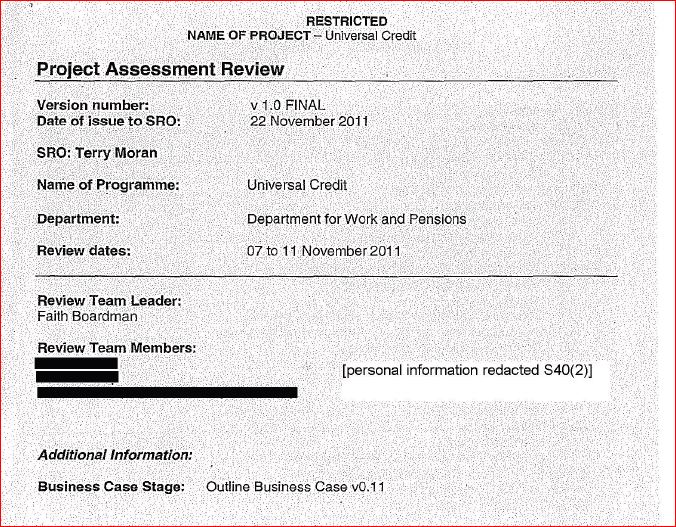
Front page of a report the DWP kept hidden for four years. The DWP's lawyers went through numerous FOI appeals to try and stop the report being published.

Front page of a report the DWP kept hidden for four years. The DWP’s lawyers went through numerous FOI appeals to try and stop the report being published.

This is the independent Universal Credit Project Assessment Review  that lawyers for the Department for Work and Pensions went through numerous FOI tribunal appeals trying to keep hidden.

It  was written for the DWP by the Cabinet Office’s Major Projects Authority. Interviewees included Iain Duncan Smith and Lord Freud who was – and is – a work and pensions minister.

In 2012 Lord Freud signed off the DWP’s recommendation that an FOI request for the report’s release be refused.

Remarkable

The now-released report is remarkable for its professionalism and neutrality. It’s also remarkably ordinary given the number of words that have been crafted by the DWP’s lawyers to FOI tribunals and appeals in an effort to keep the report from being published.

The DWP’s main reason for concealing the report – and others that IT projects professional John Slater had requested under FOI in 2012 – was that publication could discourage civil servants from speaking candidly about project problems and risks, fearing negative publicity for the programme.

In the end the DWP released the report 11 days ago. This was probably because the new work and pensions secretary Stephen Crabb refused to agree the costs of a further appeal. Last month an FOI tribunal ordered that the project assessment review, risk register and issues register be published.

Had the reports been published at the time of the FOI request in 2012 it might have restricted what ministers and the DWP’s press office were able to say publicly about the success so far of the Universal Credit programme.

In the absence of their publication, the DWP issued repeated statements that dismissed criticisms of its programme management. Ministers and DWP officials were able to say to journalists and MPs that the Universal Credit programme was progressing to time and to budget.

In fact the project assessment review questioned a projected increase of £25m of IT spend in the budget.

MPRG is the Major Projects Review Group, part of the Cabinet Office. OBC is the Outline Business Case for Universal Credit. SOBC is the Strategic Outline Business Case.

MPRG is the Major Projects Review Group, part of the Cabinet Office. OBC is the Outline Business Case for Universal Credit. SOBC is the Strategic Outline Business Case.


The DWP claimed in the report that the projected of £25m in IT spend was a “profiling”rather than budgetary issue.

By this the DWP meant that it planned to boost significantly the projected savings in later years of the project. Those anticipated savings would have offset the extra IT spend in the early years. Hence the projected overspend was a “profiling” issue.

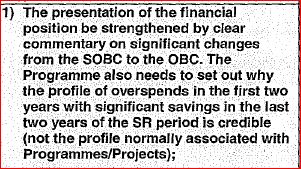
But the report questioned the credibility of the profiling exercise.

credibility extract

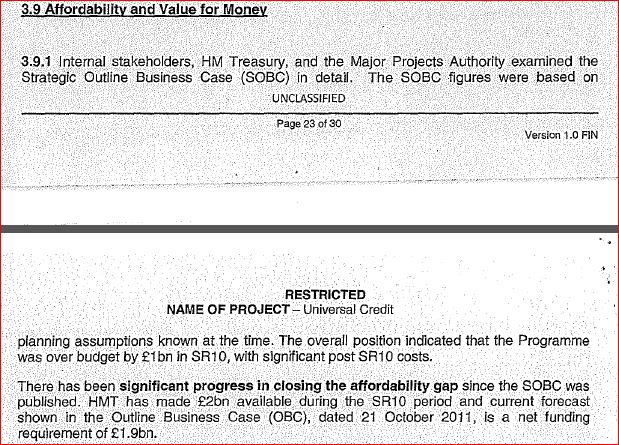
On the question  of whether the whole programme could be afforded the report had mixed views.

affordability extract

The report was largely positive about the DWP’s work on Universal Credit. It also revealed that in some ways not all was progressing as well as had been hoped (which was contrary to DWP statements at the time). The report said,

behind the curve extract

And a further mention of “behind the curve”…

behind the curve excerpt

None of these problems was even hinted at in official DWP statements in 2012. About six months after the project assessment review was conducted, this was a statement by a DWP minister (who uses words that were probably drafted by civil servants).

“The development of Universal Credit is progressing extremely well. By next April we will be ready to test the end to end service and use the feedback we get from claimants to make final improvements before the national launch.

“This will ensure that we have a robust and reliable new service for people to make a claim when Universal Credit goes live nationally in October 2013.”

And the following is a statement by the then DWP secretary  of state Iain Duncan Smith in November 2011, which was around the time the project assessment review was carried out. Doubtless his comments were based on briefings he received from officials.

“The [Universal Credit] programme is on track and on time for implementing from 2013.

“We are already testing out the process on single and couple claimants, with stage one and two now complete. Stage 3 is starting ahead of time – to see how it works for families.

“And today we have set out our migration plans which will see nearly twelve million working age benefit claimants migrate onto the new benefits system by 2017.”

Ironic

It’s ironic that the DWP spent four years concealing a report that could have drawn attention to the need for better communications.

communications extract

The report highlighted the need for three types of communication, internal, external and with stakeholders.

communications extract2

On communications with local authorities ..

communications extract3

Comment

The DWP has denigrated the released documents. A spokesperson described them as “nearly four years old and out of date”.

It’s true the reports are nearly four years old. They are not out of date.

They could hardly be more important if they highlight a fundamental democratic flaw, a flaw that allows Whitehall officials and ministers to make positive public statements about a huge government project while hiding reports that could contradict those statements or could put their comments into an enlightening context.

Stephen Crabb, IDS’s replacement at the DWP, is said by the Sunday Times to want officials to come clean to him and the public about problems on the Universal Credit programme.

To do that his officials will have to set themselves against a culture of secrecy that dates back decades. Though not as far as the early 1940s.

Official proceedings of parliament show how remarkably open were statements made to the House during WW2. It’s odd that Churchill, when the country’s future was in doubt, was far more open with Parliament about problems with the war effort than the DWP has ever been with MPs over the problems on Universal Credit.

I have said it before but it’s time for Whitehall departments, particularly the DWP, to publish routinely and contemporaneously their project assessment reviews, issues registers and risk registers.

Perhaps then the public, media and MPs will be better able to trust official statements on the current state of multi-billion pound IT-based programmes; and a glaring democratic deficit would be eliminated.

Openness may even help to improve the government’s record on managing IT.

Universal Credit Project Assessment Review

Is DWP’s Universal Credit FOI case a scandalous waste of money?

Crabb’s momentous FOI decision on Universal Credit IT?

By Tony Collins

Some of the DWP legal "bundles" in its protracted and pointless FOI case to try and stop Universal Credit reports being released.

Some of the DWP legal “bundles” in its protracted and pointless FOI case to try and stop Universal Credit reports being released.

Stephen Crabb, the new DWP secretary of state who replaces IDS, has started to make a difference.

On 3 April 2016 the Sunday Times reported that Crabb had ordered officials to stop refusing FOI requests and come clean with him and the public about problems on the Universal Credit programme.

Five days later (8 April 2016) the DWP released three reports under FOI on the Universal Credit programme: a risk register, an issues register and a Major Projects Authority project assessment review.

DWP FOI bundles2

The DWP fought for years at FOI tribunals and appeal hearings to stop the reports being published. Officials were expected to instigate a further appeal after an FOI tribunal ruled last month that the reports be published.

But it now appears that Stephen Crabb refused to sign off further public money for an appeal and officials were left with little choice but to release the reports.

The reports show the extent to which the DWP was economical with the truth in its self-praising departmental press releases and ministerial statements on the state of the Universal Credit programme in 2012 and 2013.

Trust

Indeed, how can we trust any DWP press statement on Universal Credit given that officials are still keeping hidden from Parliament and the public the risk registers, issues registers and project assessment reviews carried out on the UC programme since 2012.

Stephen Crabb

Stephen Crabb

Crabb’s appointment and the release of the three reports dated 2011 and 2012 are, from an FOI point of view, a good start.

But will the DWP become more open in the future about the state of its big IT-enabled change programmes?

Probably not. In a statement to Computer Weekly last week, a DWP spokesperson dismissed the released reports as “nearly five years old and out-of-date” and went on to praise the Universal Credit programme (which involves a waterfall approach and separate much cheaper, and to some extent competing, agile-based project).

This statement suggests that the DWP’s “no bad news” culture is still pervasive; that it is prepared to denigrate its own reports as out of date when they convey messages that conflict with officialdom’s good news culture.

A mass of DWP paperwork and legal bundles on the FOI appeals and hearings related to the documents show how earnest were the reasons for the DWP’s refusal to release the reports until this month.

It is likely that Crabb personally ordered their release. But, probably unknown to Crabb, the DWP has just refused an FOI request to release an Integrated Assurance and Approval Plan (IAAP) on the Universal Credit programme.

IT projects professional John Slater had requested the IAAP. He’d also made the original request for the UC risk register and issues register, and had campaigned long and hard for their release.

Some people may be surprised by the DWP’s refusal to release the IAAP, given that it is another very old Universal Credit report, dating back to the start of the programme. It may even pre-date the released risk register, issues register and project assessment review.

But the IAAP’s release could embarrass the DWP. IAAPs have been mandatory for all major projects since 1 April 2011. They show how well officials have planned a project or programme.

UC assumptions

The Treasury will not normally approve funding without a satisfactory IAAP. It is likely the DWP made a range of over-optimistic assumptions about the UC roll-out in its IAAP.

The DWP’s refusal to release it was under section 36 of FOI legislation. This requires sign off by a minister. In this case it is likely to have been signed off by Lord Freud, the welfare and pensions minister.

He was the minister who originally refused the FOI requests for the Universal Credit risk register, issues register, milestone schedule and project assessment review.

It is unlikely that Crabb knows anything about Slater’s request for the IAAP.

No Whitehall department has yet released contemporaneously – under FOI or outside it – any reports on the performance, progress or otherwise of its big IT-enabled projects or programmes, including Universal Credit.

Arguably it is the continued secrecy on the way officials manage big and costly schemes that contributes more than anything else to the poor record of central government when it comes to understanding and implementing IT-related change.

Out of control?

John Slater said of the released reports,

“Whilst the information disclosed relates to the UCP as it was back in 2012 it is still important and relevant to the programme today.

“The information shows a programme that appears to have been running at breakneck pace and was out of control.

“The normal checks and balances that a professional organisation should have had in place, especially cost control, simply weren’t there. Whilst these problems were recognised in the risks and issues there was no sense that the senior leadership team were willing or able to do anything about them.

“Having read the information it is not a surprise that the Major Projects Authority had no other option but to stop and restart the programme via the now infamous reset.

“The released information also raises questions about the validity of the Universal Credit business case that might explain why it still hasn’t been signed off by the Treasury.”

Comment

Well done to Stephen Crabb. He has given the culture of secrecy at the DWP a gentle shake. But can he make a lasting difference?

As we saw in “Yes Minister” it is difficult for a new minister – or any minister – to have any permanent influence on officialdom. And it remains the case that neither the DWP nor any other department has ever released contemporaneously reports on its own performance or the progress on a big IT-related change programme.

The nearest thing to it is a National Audit Office report, but these are usually retrospective and they are almost always dismissed by departmental press offices and ministers as out of date, whether they are or not.

It is abundantly clear that the DWP is pre-occupied – maybe paranoid – about negative media coverage of the Universal Credit programme.

The same thing happened at the Department of Health over media coverage of the NPfIT NHS IT programme: officials even issued written instructions to NHS staff on the tone of voice they should use with journalists and others when discussing the programme.

Many of the legal reasons the DWP gave to FOI tribunals and appeal judges revolved around the fear of releasing information that could fuel a negative response by the media to the Universal Credit programme.

dwpWhitehall’s war on FOI

Crabb has won an FOI battle but his officials are winning the pro-secrecy war. For Crabb to make a lasting difference he will need to persuade Lord Freud – and any of his successors – of the virtues of openness.

Until officials willingly publish contemporaneous reports on the progress or otherwise of big IT-enabled change programmes, government will probably continue to have a poor record when managing these schemes.

Success in government IT requires openness because IT-enabled projects and programmes are about solving problems; and if the problems cannot be admitted let alone discussed widely they are unlikely to be solved,as we saw with the initial problems on the Universal Credit programme.

Universal Credit involves many external organisations such as local authorities and housing associations. The DWP could start to embrace media coverage as giving healthy challenge to its decisions – challenges that may help to resolve a range of problems that are inevitable when the benefit system is being simplified.

Keeping reports such as the IAAP secret – even after five years – will continue to fuel the internal paranoia against open and constructive debate.

After decades of secrecy over the contemporaneous release of project and performance reports it is time for lasting change.

Universal Credit shows it’s time to make all major government projects open and transparent – Computer Weekly Editor’s Blog.

Judge orders Universal Credit reports must be published – The Register

Victory for campaigners as DWP finally publishes Universal Credit reports – Politics.co.uk

Judge orders FOI release of Universal Credit IT reports

By Tony Collins

universal creditA judge has ordered the Department for Work and Pensions to release three Universal Credit IT reports that ministers and their officials have spent public money trying to keep out of the public domain.

Judge Chris Ryan and his FOI tribunal panel went further: they concluded that had the reports in question been disclosed at the time they might have corrected misleading government statements about the robust state of the Universal Credit programme.

In their ruling this week the tribunal said that disclosure of the documents,

“might have corrected a false impression, derived from official government statements by revealing the very considerable difficulties that were beginning to develop around the time when the information requests were submitted.”

Two director-level officials at the Department for Work and Pensions had argued that civil servants needed a “safe space” in the reports in question to be candid in their assessments of risks and problems.

But the FOI tribunal, whose members have project management experience, concluded that it’s in the self interest of officials to be candid and professional about problems and risks rather than be associated with a failed project.

In addition, officials would not wish to be held partly responsible in a later review, such as one carried out by the National Audit Office, for having “failed to draw colleagues’ attention to problems with sufficient clarity to ensure that they were addressed effectively and in good time”.

Civil servants had an “awareness of the importance of candour in support of good decision-making and their professional obligation to assist that process”.

The tribunal said the three reports in question should have been  disclosed at the time they were requested in 2012. It directed the DWP to disclose them.

If the DWP’s barrister can identify good reasons why the tribunal might have made an error, or errors, in law, he can appeal within 28 days, though a tribunal could reject his appeal . The DWP could then appeal this decision.

This cycle of appeals that has already happened once – or the DWP could now decide that it has spent enough public money on fighting the case and release the reports.

dwpDid the DWP mislead?

The reports are expected to throw light on the problems and risks of Universal Credit IT at  a time when DWP’s officials, secretary of state Iain Duncan Smith and his ministers, were giving assurances that all was well with the programme.

An FOI tribunal ordered the reports to be released in 2014 but various DWP appeals led to a re-hearing of the case last month (22 February 2016) at Leicester Magistrates Court.

Now Judge Ryan and two other FOI tribunal panel members have ordered that the DWP release a risk register, issues register and Major Projects Authority project assessment review.

The risk register described risks, the possible impact should they occur, the probability of their occurring, a risk score, a traffic light status, a summary of the planned response if a risk materialised, and a summary of the risk mitigation.

The issues register included a list of problems, the dates they were identified, the mitigating steps required and the dates for review and resolution.

The project assessment review gave a high-level strategic view of the state of UC, its problems, risks and how well or badly it was being managed.

The DWP argued that routine disclosure of such reports could lead to sensationalist headlines that would have a “chilling effect”.  Not wanting to give food to a hostile media, officials writing or contributing to such reports could make them anodyne.

dwpDWP fears “over-stated”

But Judge Ryan said the DWP had “over-stated” its fears. The tribunal suggested that the DWP had not been entirely truthful about the Universal Credit programme.

“We do not accept the Department’s submission that the management of the Universal Credit Programme is already exposed to sufficient public scrutiny and that this dilutes the strength of the arguments in favour of disclosure. On the particular facts of this case it is clear that the true story about the troubles which the Programme team faced only came to light a long time after the event and then showed a markedly different picture than had been portrayed by government statements issued at the time.”

This difference between reality on the UC programme and government statements was a good reason in favour of the disclosure of the reports, said the judge.

Closed session

The DWP’s witness Cath Hamp, a senior DWP official, went into closed session at the latest hearing to argue that her concerns about civil servant behaviour would be more clearly shown by reference to specific items in the withheld documents.

Her closed-session arguments related to the risk of fraud and hacking into the system, relations with commercial organisations, and relations with local government. The tribunal was not convinced by her arguments.

Neither was the panel convinced by the “chilling effect” arguments.

“The evidence on the likelihood of civil servants altering their behaviour in future with regard to their contributions to the preparation of a risk or issues register or to the conduct of a project review was, as Ms Hamp fairly conceded, speculative…”

FOI a benefit more than a “burden”?

The DWP argued that disclosures of the reports would have placed a burden on DWP’s Universal Credit programme executives. They would have been forced to divert their energies and time into correcting media reports about the seriousness of problems and risks. But the tribunal concluded,

“Nor do we accept that resources would be wasted in providing explanations. It is clear from the press releases that we have been shown that the Department has been adept at presenting its case to the public and that it clearly has the specialist staff to carry out that function.”

The tribunal suggested that FOI obligations, rather than cause harm as the DWP had suggested, would be a benefit. The FOI Act had “brought with it an obligation on government to explain itself to a greater extent than had previously been found necessary”.

The tribunal rejected the DWP’s argument that it faced a hostile media which made officials defensive.

“… the evidence before us suggests that, on this issue, the media has adopted a relatively balanced approach to information about the Programme that has come into its possession.”

The judge said that in any event it is a

“perfectly appropriate performance of the media’s role in a modern democracy for it to investigate and comment on the implementation of a major reform involving large sums of public money and a potentially crucial impact on the lives of some of the least fortunate members of society”.

He added: “We do not therefore accept the Department’s submissions on the likelihood of the public misunderstanding the disputed information, or being misled as to its significance by the media”

In its final paragraph the tribunal said,

“… we have concluded that the public interest in maintaining the exemption in respect of each of the withheld documents does not outweigh the public interest in disclosure and that they should therefore have been disclosed when requested. Our decision is unanimous.”

Comment

My thanks to IT projects professional John Slater who has been the main force behind the case in favour of disclosure of the reports.

He made the original request in 2012 for the reports to be published. I requested one of them. He went to the original First Tier Tribunal and to Leicester Magistrates Court last month to cross examine the DWP’s witness. The points he made were quoted by the tribunal in its submission.

It’s campaigners like John Slater (and Dave Orr) who have helped to make FOI legislation more effective than it would otherwise have been.

If the DWP continues to pour money into fighting the disclosure of the reports in question, it will confirm to some of us that, when it comes to its own interest, that is its interest as a bureaucracy,  it may not be a fit authority to manage the spending of public money.

I hope it will release the reports now. It is time it started distinguishing between the public interest and its own.

Universal Credit FOI tribunal ruling – March 2016:  077 110316 Final Open Decision

Why keep risk registers secret?

By Tony Collins

FOI Commission front coverThe Freedom of Information Commission reported comprehensively yesterday on the workings of the FOI Act. It raised the question of whether risk registers and Major Project Authority project assessment reviews should be published.

The Commission’s members, who included former Tory leader Michael Howard and Labour’s Jack Straw, received over 30,000 responses to their call for evidence. They met numerous stakeholders, heard ten hours of oral evidence and  produced an impressive report that opposed the idea of charging for FOI requests.

Two of the seven Cabinet vetoes have been on FOI requests related to risk assessments. Indeed the Department for Work and Pensions is fighting a protracted legal battle (three years so far) to stop three reports on the Universal Credit IT programme being published, including a risk register and project assessment review.

Is there any good reason not to publish a risk register, or a project assessment review? Aren’t the public entitled to know the extent to which their money is at risk on a project or programme?

No, argue civil servants, whose views on confidentiality are almost always supported by their ministers. Civil servants contend that they need a “safe space” to be imaginatively negative, to think the unthinkable, without the media and opposition MPs seizing on a risk register as evidence that an innovative scheme should not get off the ground.

Civil servants and ministers argue that disclosing risk registers (and project assessment reviews) would mean that those who contribute to them would tone down or sanitise their comments. Civil servants would not be completely honest or candid when setting out the scale or magnitude of the risks.

This is what the FOI Commission concluded:

Risk assessments

“In our call for evidence we described risk assessments as a particularly relevant example of the tension between the public’s right to know, and the need for public bodies to have an internal deliberative space.

Many documents will contain mention of risks, but here we are concerned principally with documents that are explicitly devoted to setting out a candid risk assessment. We drew particular attention to risk assessments because two of the seven Cabinet vetoes have been in respect of risk assessments.

The most obvious example of a candid risk assessment is the ‘risk register’. Project management processes typically utilise risk registers as part of their methodology. Risks are normally given a rating on a scale of 1 to 5 of the likelihood of the risk occurring (where 5 is the highest likelihood of the risk occurring) and the scale of the impact if that risk occurred. Using the scores for likelihood and impact, a “Red / Amber / Green” (RAG) rating is created denoting how serious a risk is.

Risk registers do not generally provide detailed explanations of the risks involved, but only the headline risk and potential mitigation.

The Office of Government Commerce (OGC) Gateway Review is another example of a risk assessment. Gateway Reviews examine programmes and projects at key decision points using a peer review process in which independent practitioners examine progress and likelihood of successful delivery. These reviews can apply to e.g. IT or procurement processes, but can also apply to policy development.

Policy impact assessments are formal evidence based procedures that assess the economic, social and environmental costs and risks and benefits of a policy. These are published for example: at the same time as a consultation, response to consultation or at introduction of a Bill or as part of any change during the passage of the Bill.

Major Project Authority Project Assessment Reviews (PARs) are detailed assessments of large projects. They are more tailored to specific projects than Gateway Reviews. Following frank interviews with staff they culminate in a report for the Senior Risk Owner for the project setting out recommendations and assessment of risks.

In its response to the call for evidence Kent County Council highlighted the difficulties that could arise if candid risk assessments were made routinely available:

‘…it could mean that people do not feel confident enough to put risks they have identified onto the registers, or that risk registers themselves are not compiled in the first place for fear of repercussions. This could lead to potential “nasty surprises” and poor decision-making if people choose to keep risks ‘in their heads’ (paragraph 3.3)

By contrast, in their evidence the Open Government Network said:

‘The public acknowledgement of the existence of certain risks will enhance the public debate about major projects and their implementation. It is when risks can be silently ignored that the consequences are dramatic, often then requiring the complete publication of a flawed risk register when it is too late to prevent the overlooked problems.’

The Commission agrees with the evidence of the IC [Information Commissioner] in which he says that the impact of disclosing candid risk assessments can vary depending on the sensitivity of the topic and what is already in the public domain.

There will be risk assessments where it is so keenly in the public interest that the risks identified be disclosed (for example, where these concern serious risks to public health or life) that, notwithstanding the need for these assessments to be part of an internal deliberative process, they should be disclosed.

In other cases the nature and candour of the risks may mean that they should not be published. The Commission has reached that the conclusion that the public interest test provides the best way to assess whether specific risk assessments should be published, and that no additional or specific protection is required for risk assessments.”

Comment

There are times when civil servants and ministers take themselves and what they do too seriously. The continuing confidentiality of risk registers is an example.

NHS trusts routinely publish risk registers in their board papers and nobody notices, not even the local press, because risk registers highlight things that haven’t happened, but may happen.

Even a high-risk score is an esoteric and speculative concept that is unlikely to interest the general public. So risk registers in the NHS go unreported.

Central government, on the other hand, generally protects risk registers as if they are new-born babies.

Civil servants fear the media would have a field day if risk registers were routinely disclosed.

In fact they would go largely unreported. Journalism tends to be about things that are happening, and have happened, rather than risks that may materialise if certain circumstances come together.

Few journalists will convince their news editor of a potential story about a project or programme that has a high risk assessment score.

Instinct will tell civil servants and bureaucracies to prefer confidentiality to openness.  Secrecy reduces the pressure for accountability. It minimises the risk of dissent.

I have the impression that some civil servants – perhaps mainly in the Department for Work and Pensions – would lie down in front of a bulldozer rather than allow it to break down the barriers of confidentiality over risk assessments.

But there is no sound reason for keeping risk registers and project assessment reviews confidential.  The public is entitled to know when tax money is at risk.

Civil servants and ministers often forget when are locking away risk assessment reports that they are locking out the public that pays their salaries, and is paying for the projects and programmes where the risks are being kept secret.

Government secrecy is an inevitable part of life in North Korea and China.  Should it be inevitable in Whitehall?

Thank you to Government Computing for drawing my attention to the risk registers section of the FOI Commission’s report.

Thanks also to FOI campaigner Dave Orr who pointed out that the FOI Commission’s report quotes Maurice Frankel of the Campaign for Freedom of Information who says: “We now need to ensure that the Act is extended to contractors providing public services…”

FOI Commission report

Why FOI Commission has surprised observers – BBC

Government Computing

Commission members:

Lord Burns, Chair, Lord Carlile, Dame Patricia Hodgson, Michael Howard (former Tory leader) and Jack Straw.


Is DWP’s Universal Credit FOI case a scandalous waste of public money?

By Tony Collins

It’s extraordinary that some of the Department for Work and Pensions’ main arguments against publishing three reports on the Universal Credit programme resemble, in part, those given by the Walpole government of 1738 when the House of Commons passed a  resolution against the publishing of Parliamentary debates.

The DWP argues that the media could misinterpret the three Universal Credit reports or take negative comments in them out of context, which would have a “chilling effect” on the officials who contribute to or write the reports.

In the 17th and 18th centuries, members of the House of Commons and House of Lords were concerned that parliament could be brought into disrepute by the irresponsible reporting of its proceedings, and that MPs could be influenced in what they said in debates by the knowledge that their speeches could be reported .

Sir Robert Walpole, the then prime minister, in winding up an 1738 debate on banning newspaper reporting of Parliament, said press coverage of parliamentary proceedings was a “forgery of the worst kind”.

Neither officials nor ministers had at that time invented the phrase “chilling effect” but they held to its meaning: they expressed concern that if debates were in the public domain members would shape what they said in debates to win influence, or avoid criticism by, newspapers.

Eventually Parliament decided in the 19th century that it was in its own interests to have debates in the public domain partly because important speeches were going unreported.

Today the DWP is a long way from reaching the stage of openness of Parliament in the 18th century.

universal creditAfter hearing the DWP’s evidence in the case of the three Universal Credit reports, an FOI tribunal judge sympathised with the department. He (Judge Edward Jacobs) said, “It is not difficult, looking at the Risk Register (one of the three Universal Credit reports in question), to see how a journalist or blogger with an agenda could select and present parts of the material in a way that would generate attention and attract criticism of the Department (DWP).”

Still referring to the media, he said, “There is no limit to the ways in which seemingly innocuous details can be used as a means of causing trouble.”

The judge’s apparent sympathy for the DWP’s case surprised me, given that Parliament decided centuries ago that the risk of MPs being influenced by the media when making speeches was a minor consideration when weighed against the importance of reporting the proceedings of parliament.

Democracy is far from perfect but it is surely not served by departments such as the DWP keeping secret for as long as they can reports on their performance on high-cost, risky and innovative programmes such as Universal Credit.

The National Audit Office will usually report on programmes as big as Universal Credit, and will usually do so with skill, insight and professionalism.  But it didn’t report on the UC programme until September 2013.

Disclosure of the risk and issues registers and project assessment review  when they were requested under FOI would have given MPs, the public and stakeholders the chance to hold ministers and officials to account in 2012 – at a time when Iain Duncan Smith and senior officials at the DWP were confidently claiming that the UC programme was on time and to budget. IDS said nothing in 2012 about the problems the programme was facing.

“High indignity”

It’s fascinating to look back at debates of the House of Commons in the 17th and 18th centuries to see how closely some of the speeches resemble the arguments the DWP is making in its submissions to next week’s FOI tribunal.

In April 1738 the Commons passed a resolution declaring that it was a “high indignity and a notorious breach of privilege” to report what was said in the Chamber, even when it was in recess.

This was the 1738 resolution:

“That it is an high indignity to, and a notorious breach of privilege of, this House, for any News writer, in letters, or other papers (as Minutes or under any other denomination) or for any printer or publisher of any printed newspaper, of any denomination, to presume to infer in the said letters or papers, or to give therein, any account of the debates, or other proceedings of this House, or any Committee thereof, as well during the recess, as the sitting of Parliament; and that this House will proceed with the utmost severity against such offenders.”

Part of the DWP’s case to the FOI tribunal next week in Leicester is that, if the reports in question are published, they could be misinterpreted by the public, which would involve ministers and civil servants being diverted from the Universal Credit programme to correct the media.

It may be worth noting some of the actions taken by the House of Commons in 1771 against newspaper proprietors who published proceedings of the Commons – and allegedly got it wrong.

The Gazetteer and New Daily Advertiser on Friday 8 February 8 1771, which was printed for R. Thomson, and also the Middlesex Journal on Tuesday 5 February 5 to Thursday 7 February 1771, which was printed for J Weeble, were accused of “misrepresenting the speeches, and reflecting on several of the members of this House, in contempt of the order, and in breach of the privilege of this House”.

The House issued a proclamation for the apprehension of John Weeble and R Thompson.

Today the DWP seems not to accept that being held to account by journalists, even incompetent and hostile ones, is a price to be paid for democracy.

Accountability

Parliament banned newspaper reports of its debates in the 17th and 18th centuries in part because publication would have meant contemporaneous accountability.

That, it seems to me, is the main reason the DWP opposes disclosure of any independent and authoritative reports on its performance on the UC programme.

Senior officials are understandably concerned about personal and contemporaneous accountability on a big, risky, high-cost IT-enabled programme. Not the IT professionals who, incidentally, are largely in favour of openness.

Middle-ranking managers on the UC programme have a tough time of it.  They rarely get any credit for what they achieve. But there is a notable divide between the cultures of middle and senior management.

Now that the House of Commons allows reporting of its proceedings, and even allows TV cameras, the DWP’s ministers and senior officials look as if they are stuck in a bygone era. They believe that the public can wait for accountability until the National Audit Office decides to publish its reports.

But how well can the public hold the DWP to account if people doesn’t know how hundreds of millions of pounds are being spent – at the time it is spent – on the Universal Credit IT programme?

The high turnover of senior management on big programmes all but ensures that the most senior officials will probably have moved on by the time the National Audit Office reports on their programmes.

No bureaucracy will embrace openness until it is forced to. Nobody should be surprised that the DWP is fighting the publication of the disputed UC reports.

Kicking and screaming

What’s needed, therefore, is a campaigning minister, to bring today’s top officials at the DWP kicking and screaming into the modern world.

There is a serious consequence to the DWP’s antiquated approach to openness: the mounting legal costs of the FOI case it keeps appealing.

Officials and ministers at the DWP are launching FOI appeals as if money were no object. Bundles of documents have been produced by barristers and other lawyers who have been working on behalf of the DWP.

I don’t believe senior officials care particularly what is in the reports.

They are really fighting, perhaps subconsciously, to continue their control of official information on the UC programme.

For that privilege they will continue to dig deeply into the public purse for the legal costs of this case. That’s a scandalous waste of money, especially in a supposed era of open government.


DWP in court next week to stop Universal Credit reports being published

By Tony Collins

dwpAt an FOI tribunal next week at Leicester Magistrates Court  (Monday, 22 February 2016) a legal team paid for by taxpayers will do their best to convince a judge that three reports on the Universal Credit IT programme must not be published.

It will be the latest hearing in a succession of DWP legal actions to stop a risk register, issues register and a Major Projects Authority project assessment review being published.

Lawyers for the DWP have compiled a series of “bundles” – case folders. The volume of this legal paperwork hints at the mounting costs of the case which dates back three years.

In 2012 IT projects professional John Slater made an FOI request for three Universal Credit reports: the risk register,  issues register and milestone schedule.   Separately, but around the same time, I requested the project assessment review.

The DWP released the milestone schedule last year after refusing several times to disclose it. The DWP is still refusing to release the other three reports. Hence next week’s hearing in which the Information Commissioner is opposing the DWP’s case to keep the reports confidential.

“Safe space”

Although the reports in question have been superseded several times, the DWP is arguing they should not be published because of the “chilling effect”.

It claims that civil servants who write the reports or contribute to them need a “safe space” to be completely candid in their criticisms, without fear that their comments will be misinterpreted or taken out of context by a hostile media.

The Robert Walpole government in the 18th century used similar arguments to ban newspaper reports of debates in the House of Commons.

Concerned that hostile newspapers would misinterpret MPs’ speeches or report negative comments out of context, the House of Commons passed a resolution in April 1738 declaring that it was a “high indignity and a notorious breach of privilege” to report what was said in the Chamber, even when it was in recess (see separate post).

At next week’s hearing the Information Commissioner’s lawyers will argue that although the concerns of the DWP about the chilling effect were reasonable they did not over-ride the strong public interest in publishing the reports.

In their submission to the tribunal, the Information Commissioner’s lawyers emphasise the importance of the public’s ability to scrutinise high-cost, innovative and risky schemes such as the Universal Credit programme.

Had the reports been published when requested (in 2012) it would have enhanced the public’s chances of influencing the DWP’s actions on the programme.

Disclosure would have enabled the public to hold ministers and officials to account “at an appropriate time”, says the Commisioner’s submission.

The National Audit Office did not publish a report on Universal Credit’s early progress until September 2013. Before that DWP ministers and officials were confidently assuring the media, parliament and the public that the UC programme was on time and to budget.

If after the tribunal next week the judge orders disclosure of the reports – which is what happened at a previous “first-tier” FOI tribunal – the DWP will almost certainly appeal. It could be years before the case reaches a final conclusion.

But even if the DWP exhausts all its appeal options, ministers may be able to issue a “veto” to stop disclosure – though that could itself be challenged in the courts.

Comment

It’s appropriate that the FOI tribunal is being heard next week in a magistrates court, for the costs of the case so far border on the criminal.

I’ll post a fuller comment tomorrow on the similarities between the DWP’s arguments to the FOI tribunal and the arguments used in the 18th century to try and stop newspaper reporting of parliamentary debates.

DWP “evasive” and “selective” with information on Universal Credit programme

By Tony Collins

Has the Department for Work and Pensions put itself, to some extent, beyond the scrutiny  of Parliament on the Universal Credit IT programme?

Today’s report of the Public Accounts Committee Universal Credit progress update was drafted by the National Audit Office. All of the committee’s reports are effectively more strongly-worded NAO reports.

If the Department for Work and Pensions cannot be open with its own auditors – the National Audit Office audits the department’s annual accounts – are the DWP’s most senior officials in the happy position of being accountable to nobody on the Universal Credit IT programme?

The National Audit Office and the committee found the Department for Work and Pensions “selective or even inaccurate” when giving some information to the committee.

In answering some questions, the committee found officials “evasive”.

Today’s PAC report says:

“We remain disappointed by the persistent lack of clarity and evasive responses by the Department to our inquiries, particularly about the extent and impact of delays. The Department’s response to the previous Committee’s recommendations in the February 2015 report Universal Credit: progress update do not convince us that it is committed to improving transparency about the programme’s progress.”

On the basis of the limited information supplied by the DWP to Parliament the committee’s MPs believe that the Universal Credit has stabilised and made progress since the committee first reported on the programme in 2013, but there “remains a long way to go”.

So far the roll-out has largely involved the simplest of cases, and the ineligibility list for potential UC claimants is long.  By 10 December 2015, fewer than 200,000 people were on the DWP’s UC “caseload” list.

The actual number could be far fewer because the exact number recorded by the DWP by 10 December 2015 (175, 505)  does not include people whose claims have terminated because they have become ineligible by for example having capital more than £16,000 or earning more so that their benefits are reduced to zero.

The plan is to have more than seven million on the benefit, and the timetable for completion of the roll-out has stretched from 2017 originally to 2021,  although some independent experts believe the roll-out will not complete before 2023.

Meanwhile the DWP appears to be controlling carefully the information it gives to Parliament on progress. The committee accuses the DWP in today’s report of making it difficult for Parliament and taxpayers to hold the department to account. Says the report,

“The programme’s lack of clear and specific milestones creates uncertainty for claimants, advisers, and local authorities, and makes it difficult for Parliament and taxpayers to hold the Department to account.”

These are more excerpts from the report:

“In February 2015 the previous Committee of Public Accounts published Universal Credit: progress update … The Department accepted the Committee’s recommendations.

“However, we felt that the Department’s responses were rather weak and lacked specifics, and we were not convinced that it is committed to ensuring there is real clarity on this important programme’s progress.

“As a result, we recalled both the Department and HM Treasury to discuss a number of issues that concerned us, particularly around the business case, the continuing risks of delay, and the lack of transparency and clear milestones.

“Recommendation: The Department should set out clearly how it is tracking the costs of continuing delays, and who is responsible for ensuring benefits are maximised.

“The Department does not publish accessible information about plans and milestones and we are concerned by the lack of detail in the public domain about its expected progress.

“For proper accountability, this information should be published so that the Committee, the National Audit Office and the general public can be clear about progress…

“… the Department did not acknowledge that the slower roll-out affects two other milestones, because it delays the date when existing claimants start to be moved onto Universal Credit and reduces the number of Universal Credit claimants at the end of 2019.

“The flexible adaptation of milestones to circumstances is sensible, but the Department should be open about when this occurs and what the effects are. Instead, the Department’s continued lack of transparency makes it very difficult for us and the public to understand precisely how its plans are shifting.

“Claimants need to know more than just their benefits will change ‘soon’; local authorities need time to prepare additional support; and advisers need to be able to help people that come to them with concerns…

“Recommendation: By May 2016, the Department should set out and report publicly against a wider set of clearly stated milestones, based on ones it currently uses as internal measures, including plans for different claimant groups, local authority areas and for the development and use of new systems. We have set out the areas we expect these milestones to cover in an appendix to this report…

“The Department was selective or even inaccurate when highlighting the findings of its evaluation to us.”

The DWP has two IT projects to deliver UC, one based on its existing major suppliers delivering systems that integrate the simplest of new claims with legacy IT.

The other and more promising solution is a far cheaper “digital service” that is based on agile principles and is, in effect, entirely new IT that could eventually replace legacy systems. It is on trial in a small number of jobcentres.

The DWP’s slowly slowly approach to roll-out means it is reluctant to publish milestones, and it has reached only an early stage of the business case. The final business case is not expected before 2017 and could be later.

The committee has asked the DWP to be more transparent over the business case. It wants detail on:

  • Projected spending, including both investment and running costs for:
  • Live service (split between ‘staff and non staff costs’ and ‘external supplier costs’)
  • Digital service (split between ‘staff and non staff costs’ and ‘external supplier costs’)
  • Rest of programme (split between ‘staff and non staff costs’ and ‘External supplier costs’)
  • Net benefits realised versus forecasts.

Meanwhile the DWP’s response to those who criticise the slow roll-out is to give impressive statistics on the number of jobcentres now processing UC claims, without acknowledging that nearly all of them are processing only the simplest of claims.

Comment

To whom is the DWP accountable on the Universal Credit IT programme? To judge from today’s report it is not the all-party Public Accounts Committee or its own auditors the National Audit Office.

No government has been willing to force Whitehall departments to be properly accountable for their major IT-enabled projects or programmes. Sir Humphrey remains in control.

The last government with Francis Maude at the helm at the Cabinet Office came close to introducing real reforms (his campaign began too forcefully but settled into a good strategy of pragmatic compromise) but his departure has meant that open government and greater accountability for central departments have drifted into the shadows.

The DWP is not only beyond the ability of Parliament to hold it accountable it is spending undisclosed of public money sums on an FOI case to stop three ageing reports on the Universal Credit IT programme being published. The reports are nearly four years old.

Would that senior officials at the DWP could begin to understand a connection between openness and Lincoln’s famous phrase “government of the people, by the people, for the people”.

Public Accounts Committee report Universal Credit, progress update

DWP gives out “selective” information on welfare reform even to its auditors (a similar story in 2015)

Department for Work and Pensions “evasive” – Civil Service World (This article is aimed at its readers who are mostly civil servants. It is likely it will find favour with senior DWP IT staff who will probably mostly agree with the Public Accounts Committee’s view that the DWP hierarchy is, perhaps because of culture, evasive and selective with the information it gives to Parliament and the public.)