Another public sector IT project disaster – but a useful failure if lessons are disseminated

By Tony Collins

Comment and analysis

Government Computing reported on 1 July 2016 that the Scottish Police Authority has agreed with Accenture to end their “i6” programme.

It’s a classic public sector IT project disaster. It failed for the usual reasons (see below). What marks it out is the unusual post-failure approach: a limited openness.

Police in Scotland and the Scottish Government plan a review of what went wrong, which is likely to be published.

Usually senior civil and public servants in Whitehall, local government in England and Wales and the NHS rush to shut the blinds when an IT-enabled change project goes awry, which is what has happened recently after failures of the GP Support Services contract with Capita.  [GP magazine Pulse reports that NHS England is to withhold report on primary care support problems until 2017.]

The police in Scotland and the Scottish Parliament are being open but not completely. Their settlement with Accenture remains confidential, but the Scottish Police Authority has published the full business case for i6 and – under FOI – early “Gateway” reviews and “Healthcheck” reports, though with quite a few redactions.

Despite FOI, it’s almost unknown for Whitehall, the NHS or local government in England and Wales, to publish Gateway reviews of big IT projects.

All this means there may be a genuine attempt in Scotland to learn lessons from the failure of the i6 project, and perhaps even let the public sector as a whole benefit from them (if it’s interested),

Due originally to go live last December, and then in the autumn this year, i6 hit problems within months of the start of the contract with Accenture. The contract was signed in June 2013, work started in July and the two sides were reported as being in mediation by August 2013.

Exemplar?

But the programme had followed well-established preparatory routines. One internal report described the procurement approach as an exemplar for the rest of the public sector. Yet it still ended in failure.

In fact i6 followed the classic script of a traditional public sector IT-based project disaster:

  1. An over-ambitious plan for widespread “integration” – which is one of the most dangerous words in the history of public sector IT-enabled change projects. It seemed a great idea at the time: to save vast sums by bringing together in a single system similar things done in different ways by formerly separate organisations.
  2. A variety of early independent reports that highlighted risks and strengths of the programme but didn’t ask the biggest question of all: could a single national system ever work satisfactorily given the amount of organisational change required – changes that would impose on the system design constant modification as end-users discovered new things they wanted and didn’t want that were in the original design – and changes that would require a large team on the police side to have the time to understand the detail and convey it accurately to Accenture.
  3. An assumption that the supplier would be able to deliver an acceptable system within tight deadlines in a fast-changing environment.
  4. Milestones that were missed amid official denials that the project was in disarray.
  5. An agreement to end the contract that was on the basis of a secret settlement, which brought little or no accountability for the failure. Nobody knows how much has been spent on the project in staff and managerial time, hiring of various consultancies, the commissioning of various reports, and money paid over to the supplier.

What are the lessons?


The 10-year programme, which was said to cost between £40m and £60m, was ambitious. It was supposed to replace 135 IT-and paper-based systems across Scotland with a single national integrated system that would be rolled out to all Police Scotland divisions.

A “Gateway review” of the project in March 2013 said the project involved the “largest organisagtional change in the history of Scottish policing”.

The released documents have much praise for the police’s preparatory work on the contract with Accenture. Private consultants were involved as the technical design authority. Deloitte was hired for additional support. There were regular “healthcheck” and Gateway reviews.

Too ambitious?

Bringing together dozens of systems and paper-based processes into a new standardised system that’s supposed to work across a variety of business units, requires – before a single new server is installed – agreement over non-IT changes that are difficult in practice to achieve. It’s mainly a business-change project rather than an IT one.

The business case promised “Full interoperability, of processes and technology, at local and national level.” Was that ever really possible?

The disastrous Raytheon/Home Office e-borders project was a similar classic public sector project failure based on “integration”.  Although it was a much bigger project and far more complex than i6, it followed similar principles: a new national system that would replace a  patchwork of different systems and business processes.

Raytheon could not force change on end-users who did not want change in the way Raytheon envisaged. The Home Office wasted hundreds of millions on the project, according to the National Audit Office which said,

“During the period of the e-borders programme the Department made unrealistic assumptions about programme delivery without recognising the importance of managing a diverse range of stakeholders.

“Delivering the e-borders vision requires that more than 600 air, ferry and rail carriers supply data on people they are bringing in and out of the country, while around 30 government agencies supply data on persons of interest.

“During the e-borders period, the contract made Raytheon responsible for connecting e-borders to these stakeholders’ systems, under the Department’s strategic direction. But carriers and agencies expressed general concerns about the costs and other implications of revising their systems to connect to e-borders, including the interfaces they were expected to use.

“The contract strongly incentivised Raytheon to deliver the roll-out to the agreed schedules but provided less incentive for Raytheon to offer a wider choice of interfaces…Lack of clarity on what was legal under European law further exacerbated the difficult relationships with carriers. These difficulties affected progress in rolling out e-borders from the outset…

“Following the cancellation of the e-borders contract in 2010, the Department [Home Office] took more direct ownership of external relationships instead of working through Raytheon. Transport carriers told us there is now a better understanding of needs and requirements between themselves and the Department.”

The NHS National Programme for IT [NPfIT] was another similar failure, in part because of overly ambitious plans for “integration” – on a scale that could never be imposed on a diverse range of largely autonomous NHS organisations. Some hospitals and GPs did not want a national system that did less than their existing systems. Why would they want to replace their own proven IT with cruder standardised systems for the sake of the common good?

More recently the GP support services contract with Capita has run into serious problems largely because of an overly ambitious objective of replacing fragmented ways of working with a national “common good” system.

A Capita spokesperson said of the new system: ‘NHS England asked Capita to transform what was a locally agreed, fragmented primary care support service, to a national standardised system.”

It’s naïve for politicians and senior public servants to view integration as a public benefit without questioning its necessity in the light of the huge risks.

[Mao Tsedong saw the Great Leap Forward as a public benefit. It was a costly catastrophe, in human and financial terms. ]

Disputes over whether proposals would meet actual needs?

It appears that i6 officials found Accenture’s solutions unconvincing; but it’s likely Accenture found that requirements were growing and shifting, leading to disagreements over varying interpretations of different parts of the contract. Accenture could not compel cooperation by various forces even it wanted to.

It may work elsewhere – but that doesn’t mean it’ll work for you.

This is one of the oldest lessons from countless disaster in the history of the IT industry. It was listed as a key factor in some of the world’s biggest IT disasters in “Crash”.

The business case for i6 says:

“The [Accenture] solution is based on a system delivered to 80,000 officers in the Guardia Civil, Spain’s national police force.

“The procured solution includes software components, software licences, specialist hardware, integration tools and services, business change activities, implementation services, reporting capabilities, data management activities, ongoing support, optional managed service arrangements, additional integration services and other relevant services necessary for the successful implementation of the solution.”

Is it wise to promise huge savings many times greater than projected costs?

Clearly i6 is a political scheme. It’s easy in the public sector to declare at the outset any amount of anticipated savings when it’s clear to everyone that the actual audited savings – or losses – will probably never be announced.

Initial costs were put at £12m, but later revisions put the cost nearer to £46m. More recently costs of £60m have been reported. In 2013, cashable savings to be made by developing i6 were said to be over £61m, with the total cashable and non-cashable savings estimated to be £218m over ten years.

That said, the police appear to have paid over relatively small sums to Accenture, not tens of millions of pounds.

Lessons from past failures have been learned – really?

The Scottish Police Authority gave an unequivocal assurance to its members in June 2013 that i6 will “not suffer the same fate as other high profile large scale IT projects”. This is what the Authority said to its members,

“Delivery Assurance – SPA [Scottish Police Authority] members have sought and been provided with significant assurance that the i6 programme will deliver the intended outcomes and not suffer the same fate as other high profile large scale IT projects.

“The robustness and diligent detail that has gone into the full business case itself provides much of that assurance. Further delivery confidence around i6 comes from a number of sources including:
1. Rigorous Programme Governance.
2. Widespread User Engagement and Robust Requirements Gathering.
3. The creation of a ‘live’ multi-sector i6 Learning Network.
4. The formation of strategic partnership groups.
5. Alignment to the wider Scottish Government Digital Strategy.
6. Active learning from the Audit Scotland Review of Public Sector IT Projects and the Common Performance Management Project (‘Platform’).
7. Significant time and investment in the use of Competitive Dialogue.
8. The formation of a strong and consistent programme team with integrated professional advice & support.
9. Exposure to the full independent OGC Gateway Review Process.
10. An independent Scottish Government Technical Assurance Review.

A growing list of changes.

In February 2016 Accenture said, “This is a very complex project. The complexity of the solution, which has been driven by the client, has increased significantly over the last two years.”

This suggests the scope and specification grew as the many different stakeholders gradually formed a view of what they wanted.

Criticism of the supplier, as if it were the only party responsible or delivering the system.

Police Scotland told members of the Scottish Parliament in February 2016 that Accenture has let the police down.

One question auditors may ask is whether it would have been better for local policing divisions to keep control of their own IT.

Internal reviews too soft, too reassuring?

A technical assurance review in June 2013 gave the i6 project an “amber/green” status.

A secret settlement leaves taxpayers having no clue of how much money has gone down the drain.

The Scottish Police Authority says the settlement is confidential. “The terms of the agreement are commercially confidential. However we can confirm that the settlement results in no financial detriment to the police budget.”

The current police budget may not be affected but how much has already been paid and how much of this is wasted? If no figures are ever given, how can there be proper accountability that could deter a new set of officials making similar mistakes in a future project?

Doomsday Register?

If the public sector kept a published “Doomsday” register of failed projects and programmes and the mistakes made in them, as identified by auditors, the same mistakes would be less likely to be repeated.

Perhaps i6 could be the first entry into a new Doomsday register.

The future’s looking bright (?).

When a project is cancelled, it’s almost inevitable that the consequences will be declared to be minimal; and we’re all left wondering why the project was needed in the first place if the future is so rosy.

Half the story

As things stand,  when a council, police, NHS, or Whitehall project fails and millions of pounds, sometimes tens of millions, even billions, are lost, there’s no incentive for anyone but taxpayers to care – and even then they don’t know half the story.

In the case of i6, once the settlement with Accenture is finalised – with hardly anyone knowing the details – officialdom is free to embark on a similar project in a few years time, with different people involved, and describing it in a different way.

Who cares when the public sector has another IT disaster that follows an age-old script?

**

Project summary

The i6 project was introduced to merge more than 130 different computer and paper systems left in place after eight regional forces were merged to form Police Scotland.

Police Scotland told MSPs in February that they were looking at contingency options because they could not solve scores of faults that had emerged during testing.

Officers involved in the tests said at one point they had found 12 critical errors that made it unusable, and a total of 76 defects that required further work.

Accenture said in February that i6 passed its internal testing but flaws emerged when Police Scotland tested the programme.

**

The Guardian reports on another IT-enabled project problems in Scotland.

“Scottish ministers have already been forced to seek an extension from the European commission after its new £178m farming payments system had to be dramatically scaled back and failed to meet an EU deadline.

“There have been significant delays and cost rises too in a new call-handling and IT system for NHS Scotland’s telephone advice service, NHS 24, which has not yet become operational. Its budget has risen by 55% to nearly £118m, and it is four years late.”

Scottish Police Authority and Accenture terminate i6 contract – Government Computing


Aspire: eight lessons from the UK’s biggest IT contract

By Tony Collins

How do you quit a £10bn IT contract in which suppliers have become limbs of your organisation?

Thanks to reports by the National Audit Office, the questioning of HMRC civil servants by the Public Accounts Committee, answers to FOI requests, and job adverts for senior HMRC posts, it’s possible to gain a rare insight into some of the sensitive commercial matters that are usually hidden when the end of a huge IT contract draws closer.

Partly because of the footnotes, the latest National Audit Office memorandum on Aspire (June 2016) has insights that make it one of the most incisive reports it has produced on the department’s IT in more than 30 years.

Soaring costs?

Aspire is the government’s biggest IT-related contract. Inland Revenue, as it was then, signed a 10-year outsourcing deal with HP (then EDS) in 1994, and transferred about 2,000 civil servants to the company. The deal was expected to cost £2bn over 10 years.

After Customs and Excise, with its Fujitsu VME-based IT estate, was merged with Inland Revenue’s in 2005, the cost of the total outsourcing deal with HP rose to about £3bn.

In 2004 most of the IT staff and HMRC’s assets transferred to Capgemini under a contract known as Aspire – Acquiring Strategic Partners for Inland Revenue. Aspire’s main subcontractors were Accenture and Fujitsu.

In subsequent years the cost of the 10-year Aspire contract shot up from about £3bn to about £8bn, yielding combined profits to Capgemini and Fujitsu of £1.2bn – more than double the £500m originally modelled. The profit margin was 15.8% compared to 12.3% originally modelled.

The National Audit Office said in a report on Aspire in 2014 that HMRC had not handled costs well. The NAO now estimates the cost of the extended (13-year) Aspire contract from 2004 to 2017 to be about £10bn.

Between April 2006 and March 2014, Aspire accounted for about 84% of HMRC’s total spending on technology.

Servers that typically cost £30,000 a year to run under Aspire – and there are about 4,000 servers at HMRC today – cost between £6,000 when run internally or as low as £4,000 a year in the commodity market.

How could the Aspire spend continue – and without a modernisation of the IT estate?

A good service

HMRC has been generally pleased with the quality of service from Aspire’s suppliers.  Major systems have run with reducing amounts of downtime, and Capgemini has helped to build many new systems.

Where things have gone wrong, HMRC appears to have been as much to blame as the suppliers, partly because development work was hit routinely by a plethora of changes to the agreed specifications.

Arguably the two biggest problems with Aspire have been cost and lack of control.  In the 10 years between 2004 and 2014 HMRC paid an average of £813m a year to Aspire’s suppliers.  And it paid above market rates, according to the National Audit Office.

By the time the Cabinet Office’s Efficiency and Reform Group announced in 2014 that it was seeking to outlaw “bloated and wasteful” contracts, especially ones over £100m, HMRC had already taken steps to end Aspire.

It decided to break up its IT systems into chunks it could manage, control and, to some extent, commoditise.

HMRC’s senior managers expected an end to Aspire by 2017. But unexpected events at the Department for Work and Pensions put paid to HMRC’s plan …

Eight lessons from Aspire

1. Your IT may not be transformed by outsourcing.  That may be the intention at the outset. But it didn’t happen when Somerset County Council outsourced IT to IBM in 2007 and it hasn’t happened in the 12 years of the Aspire contract.

 “The Aspire contract has provided stable but expensive IT systems. The contract has contributed to HMRC’s technology becoming out of date,” said the National Audit Office in its June 2016 memorandum.

Mark DearnleyAnd Mark Dearnley, HMRC’s Chief Digital Information Officer and main board member, told the Public Accounts Committee last week,

“Some of the technology we use is definitely past its best-before date.”

2. You won’t realise how little you understand your outsourced IT until you look at ending a long-term deal.

Confidently and openly answering a series of trenchant questions from MP Richard Bacon at last week’s Public Accounts Committee hearing, Dearnley said,

“It’s inevitable in any large black box outsourcing deal that there are details when you get right into it that you don’t know what’s going on. So yes, that’s what we’re learning.”

3. Suppliers may seem almost philanthropic in the run-up to a large outsourcing deal because they accept losses in the early part of a contract and make up for them in later years.

Dearnley said,

“What we are finding is that it [the break-up of Aspire] is forcing us to have much cleaner commercial conversations, not getting into some of the traditional arrangements.

” If I go away from Aspire and talk about the typical outsourcing industry of the last ten years most contracts lost money in their first few years for the supplier, and the supplier relied on making money in the later years of the contract.

“What that tended to mean was that as time moved on and you wanted to change the contract the supplier was not particularly incented to want to change it because they wanted to make their money at the end.

“What we’re focusing on is making sure the deals are clean, simple, really easy to understand, and don’t mortgage the future and that we can change as the environment evolves and the world changes.”

4. If you want deeper-than-expected costs in the later years of the contract, expect suppliers to make up the money in contract extensions.

Aspire was due originally to end in 2004. Then it went to 2017 after suppliers negotiated a three-year extension in 2007. Now completion of the exit is not planned until 2020, though some services have already been insourced and more will be over the next four years.

The National Audit Office’s June 2016 memorandum reveals how the contract extension from 2017 to 2020 came about.

HMRC had a non-binding agreement with Capgemini to exit from all Aspire services by June 2017. But HMRC had little choice but to soften this approach when Capgemini’s negotiating position was unexpectedly strengthened by IT deals being struck by other departments, particularly the Department for Work and Pensions.

Cabinet Office “red lines” said that government would not extend existing contracts without a compelling case. But the DWP found that instead of being able to exit a large hosting contract with HP in February 2015 it would have to consider a variation to the contract to enable a controlled disaggregation of services from February 2015 to February 2018.

When the DWP announced it was planning to extend its IT contract with its prime supplier HP Enterprise, HMRC was already in the process of agreeing with Capgemini the contract changes necessary to formalise their agreement to exit the Aspire deal in 2017.

“Capgemini considered that this extension, combined with other public bodies planning to extend their IT contracts, meant that the government had changed its position on extensions…

“Capgemini therefore pushed for contract extensions for some Aspire services as a condition of agreeing to other services being transferred to HMRC before the end of the Aspire contract,” said the NAO’s June 2016 memo.

5. It’s naïve to expect a large IT contract to transfer risks to the supplier (s).

At last week’s Public Accounts Committee hearing, Richard Bacon wanted to know if HMRC was taking on more risk by replacing the Aspire contract with a mixture of insourced IT and smaller commoditised contracts of no more than three years. Asked by Bacon whether HMRC is taking on more risk Dearnley replied,

“Yes and no – the risk was always ours. We had some of it backed of it backed off in contract. You can debate just how valuable contract backing off is relative to £500bn (the annual amount of tax collected).  We will never back all of that off. We are much closer and much more on top of the service, the delivery, the projects and the ownership (in the gradual replacement of Aspire).”

6. Few organisations seeking to end monolithic outsourcing deals will have the transition overseen by someone as clear-sighted as Mark Dearnley.

His plain speaking appeared to impress even the chairman of the Public Accounts Committee Meg Hillier who asked him at the end of last week’s hearing,

Meg Hillier

Meg Hillier

“And what are your plans? One of the problems we often see in this Committee is people in very senior positions such as yours moving on very quickly. You have had a stellar career in the private sector…

“We hope that those negotiations move apace, because I suspect – and it is perhaps unfair to ask Mr Dearnley to comment – that to lose someone senior at this point would not be good news, given the challenges outlined in the [NAO] Report,” asked Hillier.

Dearnley then gave a slightly embarrassed look to Jon Thomson, HMRC’s chief executive and first permanent secretary. Dearnley replied,

“Jon and I are looking at each other because you are right. Technically my contract finishes at the end of September because I was here for three years. As Jon has just arrived, it is a conversation we have just begun.”

Hiller said,

“I would hope that you are going to have that conversation.”

Richard Bacon added,

“Get your skates on, Mr Thompson; we want to keep him.”

Thompson said,

“We all share the same aspiration. We are in negotiations.”

7. Be prepared to set aside millions of pounds – in addition to the normal costs of the outsourcing – on exiting.

HMRC is setting aside a gigantic sum – £700m. Around a quarter of this, said the National Audit Office, is accounted for by optimism bias. The estimates also include costs that HMRC will only incur if certain risks materialise.

In particular, HMRC has allowed around £100m for the costs of transferring data from servers currently managed by Aspire suppliers to providers that will make use of cloud computing technology. This cost will only be incurred if a second HMRC programme – which focuses on how HMRC exploits cloud technology – is unsuccessful.

Other costs of the so-called Columbus programme to replace Aspire include the cost of buying back assets, plus staff, consultancy and legal costs.

8. Projected savings from quitting a large contract could dwarf the exit costs.

HMRC has estimated the possible minimum and possible maximum savings from replacing Aspire. Even the minimum estimated savings would more than justify the organisational time involved and the challenge of building up new corporate cultures and skills in-house while keeping new and existing services running smoothly.

By replacing Aspire and improving the way IT services are organised and delivered, HMRC expects to save – each year – about £200m net, after taking into account the possible exit costs of £700m.

The National Audit Office said most of the savings are calculated on the basis of removing supplier profit margins and overheads on services being brought in-house, and reducing margins on other services from contract changes.

Even if the savings don’t materialise as expected and costs equal savings the benefits of exiting are clear. The alternative is allowing costs to continue to soar while you allow the future of your IT to be determined by what your major suppliers can or will do within reasonable cost limits.

Comment

HMRC is leading the way for other government departments, councils, the police and other public bodies.

Dearnley’s approach of breaking IT into smaller manageable chunks that can be managed, controlled, optimised and to some extent commoditised is impressive.  On the cloud alone he is setting up an internal team of 50.

In the past, IT empires were built and retained by senior officials arguing that their systems were unique – too bespoke and complex to be broken up and treated as a commodity to be put into the cloud.

Dearnley’s evidence to the Public Accounts Committee exposes pompous justifications for the status quo as Sir Humphrey-speak.

Both Richard Feynman and Einstein said something to the effect that the more you understand a subject, the simpler you can explain it.

What Dearnley doesn’t yet understand about the HMRC systems that are still run by Capgemini he will doubtless find out about – provided his contract is renewed before September this year.

No doubt HMRC will continue to have its Parliamentary and other critics who will say that the risks of breaking up HMRC’s proven IT systems are a step too far. But the risks to the public purse of keeping the IT largely as it is are, arguably, much greater.

The Department for Work and Pensions has proved that it’s possible to innovate with the so-called digital solution for Universal Credit, without risking payments to vulnerable people.

If the agile approach to Universal Credit fails, existing benefit systems will continue, or a much more expensive waterfall development by the DWP’s major suppliers will probably be used instead.

It is possible to innovate cheaply without endangering existing tax collection and benefit systems.

Imagine the billions that could be saved if every central government department had a Dearnley on the board. HMRC has had decades of largely negative National Audit Office reports on its IT.  Is that about to change?

Update:

This morning (22 June 2016) on LinkedIn, management troubleshooter and board adviser Colin Beveridge wrote,

“Good analysis of Aspire and outsourcing challenges. I have seen too many business cases in my career, be they a case for outsourcing, provider transition or insourcing.

“The common factor in all the proposals has been the absence of strategy end of life costs. In other words, the eventual transition costs that will be incurred when the sourcing strategy itself goes end of life. Such costs are never reflected in the original business case, even though their inevitability will have an important impact on the overall integrity of the sourcing strategy business case.

“My rule of thumb is to look for the end of strategy provision in the business case, prior to transition approval. If there is no provision for the eventual sourcing strategy change, then expect to pay dearly in the end.”

June 2016 memorandum on Aspire – National Audit Office

Dearney’s evidence to the Public Accounts Committee

Avon and Somerset Police to end outsourcing deal after years of proclaiming its success

avon and somerset police logoBy Tony Collins

Avon and Somerset Police has been consistent in its good news statements on the force’s “innovative” outsourcing deal with IBM-owned Southwest One.

These announcements and similar FOI responses have a clear message: that savings from the deal are more than expected.

But the statements have differed in tone and substance from those of Somerset County Council which ended up in a legal action with Southwest One.

Somerset’s losses on its Southwest One deal could leave the casual observer wondering why and how Avon and Somerset Police had made a success of its deal with Southwest One, whereas the county council has had a disastrous experience.

Now the BBC reports that Avon and Somerset will not be renewing its contract with Southwest One when the deal expires in 2018.

Southwest One is 75% owned by IBM and carries out administrative, IT and human resources tasks for the force.

Avon and Somerset Police’s “new” chief constable Andy Marsh – who took up the post in February 2016 – confirmed he has “given notice” that the Southwest On contract will not be renewed.

Andy Marsh, chief constable, Avon and Somerset.

Andy Marsh, chief constable, Avon and Somerset.

Instead he said he wants to work with neighbouring police and fire services. Marsh said,

“We will be finding a new way of providing those services. It is my intention to collaborate with other forces. I do believe I can save some money and I want to protect frontline numbers.”

Marsh came to Avon and Somerset with a reputation for making value for money a priority.

These are some of the statements made by Avon and Somerset Police on the progress of the Southwest One contract before Marsh joined the force:

  • “I am delighted with the level of procurement savings Southwest One is delivering for us, particularly as it is our local communities who will benefit most as front-line services are protected. “
  • “Using Southwest One’s innovative approach, we have been able to exceed our expected savings level.”
  • “I am looking forward to building on our close working relationship with Southwest One to deliver even greater savings in the future.”

FOI campaigner David Orr says of the police’s decision not to renew its contract with Southwest One,

“This controversial contract with IBM for Southwest One was signed in 2007 with the County Council, the Police and Taunton Deane Borough Council.

“We were promised £180m of cash savings, an iconic building in Taunton at Firepool, as well as new jobs and a boost to the economy. None of that ever materialised. “

Comment

If Avon and Somerset Police is happy with its outsourcing deal with Southwest One, why is it not renewing or extending the contract?

It’s clear the “new” chief constable Andy Marsh believes he can save money by finding a new way of delivering services, including IT. This sounds sensible given that the client organisation will at some point have to contribute to the supplier’s profits, usually in the later years of the contract.

Savings by ending outsourcing

Public authorities, particularly councils, when they announce the end of an outsourcing contract, will often say they plan to make substantial savings by doing something different in future – Somerset County Council and Liverpool Council among them.

Liverpool Council announced it would save £30m over three years  by ending its outsourcing deal.

Dexter Whitfield of the European Services Strategy Unit which monitors the success or otherwise of major outsourcing deals, is quoted in a House of Commons briefing paper last month entitled “Local government – alternative models of service delivery” as saying,

“Councils have spent £14.2bn on 65 strategic public-private partnership contracts, but there is scant evidence of full costs and savings”.

According to Whitfield, this is due to “the lack of transparent financial audits of contracts, secretive joint council-contractor governance arrangements, poor monitoring, undisclosed procurement costs, a lack of rigorous scrutiny and political fear of admitting failure”.

If it’s so obvious that outsourcing suppliers will eventually try to make up later for any losses in the early stages of a contract – suppliers are not registered charities – why are such deals signed in the first place?

Do officials and councillors not realise that  their successors will probably seek to save money by jettisoning the same outsourcing deal?

The problem, perhaps, is that those who preside over the early years of an outsourcing contract are unlikely to be around in the later years. For them, there is no effective accountability.

Hence the enthusiastic public announcements of savings and new investments in IT and other facilities in the early stages of an outsourcing  contract.

It’s likely things will go quiet in the later years of the contract when the supplier may be trying to recoup losses incurred in the early years.

Then, suddenly, the public authority will announce it is ending its outsourcing deal. Outsiders are left wondering why.

Good news?

Given Avon and Somerset’s determination to end its relationship with Southwest One, can we trust all the good news statements by the force’s officials in past years?

With facts in any outsourcing deal so hard to come by, even for FOI campaigners, selective statements by public servants or ruling councillors about how successful their deal is, and how many tens of millions of pounds they are saving, are best taken with a pinch of salt.

Especially if the announcements were at an early stage of the contract and things have now gone quiet.

Thank you to David Orr for alerting me to the BBC story and providing links to much of the material that went into this post.

From hubris to the High Court (almost) – the story of Southwest One.

Too easy for councils to make up savings figures for outsourcing deals?

Capita NHS contract under scrutiny after “teething problems”.

By Tony Collins

A seven-year £330m contract signed by NHS England and Capita last September has run into problems.

The difficulties and complaints by GPs raise a question about how officials at NHS England considered it possible that Capita could save 40% in the first year, transform services for GPs, and make a profit – all concurrently.

Pulse reports that the true cost of NHS managers’ bid to save money by contracting Capita to carry out support services for GP practices is “now becoming clear”.

It’s emerged that NHS England expected Capita to help cut costs while contractors were learning the exact nature of the range of services they were contracted to deliver.

On 1 September 2015, Capita took on responsibility for the delivery of NHS England’s primary care support services for GPs. It included the transportation of paper-based records when patients move home.

NHS England’s vision was to create “modern, easy to use administrative and business support services, which are consistent across England and which help lower the administrative burden on primary care”.

NHS England asked Capita to look at cutting costs in year one by:

  • Moving the delivery of all services from over 40 sites across England to three
  • Opening a new national customer support centre for all customer queries
  • Introducing a new online portal.

In a succession of articles this year Pulse, the magazine for GPs,  says the outsourcing has led to some GP practices

–              buying their own clinical supplies to continue running patient clinics

–              not receiving payments they are due

–              experiencing delays in the manual transfer of patient records

–              reporting that they that they have been sent the wrong patient records or those of patients who have been recently deceased.

–              stockpiling the records of patients who have moved home

Pulse says that the Information Commissioner’s Office is now investigating whether patient records have gone missing. The ICO will question Capita on the matter.

The magazine says Capita has come under fire from NHS England, the General Practitioners Committee of the British Medical Association and GPs.

The General Practitioners Committee said in a letter Capita had been “considerably underprepared for the level of work and resource required for the rollout”.

NHS England told Pulse there were “transition issues” that need to be fixed. Capita said it had been tasked with “transforming” a previously “ fragmented” system, and that initial teething problems were inevitable.

Capita said,

“Capita are in the process of delivering a range of changes to primary care support services which are designed to make services more efficient, more reliable and ultimately better for GP practices.

We will continue to work closely to monitor, review progress and investigate any issues raised by users… reported issues are routinely logged and investigated to determine root causes and the appropriate remedial action in line with NHS England information governance procedures.”

The General Practitioners Committee has asked for GP practices to be compensated for the disruption.

Problems have continued despite various assurances they were being addressed.

In April Pulse reported that “GP practices are missing thousands in payments following the outsourcing of a national primary care support service.”

An anonymous healthcare professional on Pulse’s website asked why it had taken so long for officials to “realise the situation is so bad”.

Even before NHS England received bids for the outsourcing contract, the then head of the contracts and regulation subcommittee of the GP Committee of the British Medical Association, Dr Robert Morley, told Pulse,

“The portents are absolutely horrendous for general practice I’m afraid…There’s nothing at all that reassures me this isn’t going to be an absolute bloody disaster.”

Last month, in a letter dated 11 May 2016 to NHS England, the head of the GP Committee of the BMA, Chaand Nagpaul, said

“Practices have advised that due to a failure in the provision of medical supplies (such as syringes, needles) and prescriptions stationery, patient services have been disrupted.

“Clearly this presents a significant risk to the care provided to patients.

“We understand that measures are being put in place to mitigate against the lack of supplies, but often these mitigations increase workload and cost to practices and despite the reassurances we received some weeks ago there does not seem to be improvement.”

The letter added:

“NHS England made this change to a reliable and trusted NHS service with the explicit intent of making significant financial savings through the use of a commercial provider.

“The result has been an unacceptable transfer of unfunded work on to already hard-pressed practices.

“Therefore every practice should receive recurrent recompense for the extra workload related to the new Capita services, in addition to compensation for increased workload and inconvenience caused by the unsatisfactory introduction of these services.”

Dr Richard Vautrey, deputy chairman of the GP Committee, told Pulse the BMA has ‘been contacted by more practice managers on this issue than anything we’ve ever had’.

The letter said that there has been much trepidation about the future transformation of the service. There needs to be “vigorous testing and scrutiny” and acceptance by the end-user. Robust contingency planning needs to be in place.

Paul Cundy, the IT voice of the BMA’s GP committee, said on Pulse’s website,

“What has happened is that NHSE [NHS England] has given a contract to Capita for 40% less than it used to pay PCSS [Primary Care Support Service] services.

“That 40% has been re-couped by Capita and NHSE by expecting GP staff to do the sorting , collating, bagging and labelling of individual medical records in our surgeries. In other words we are now doing their work for them and for no extra money.”

An NHS manager Emma Bravery told Pulse:

“Medical records are being delivered to the wrong practices and being returned to the originating practice.

“As notes only get requested once a patient has moved practices, and this is updated on the spine, surely if Capita’s working systems were fit for purpose this simply couldn’t happen?

“In once instant the same set of notes was returned to the orginating practice twice!

“This is a massive IG breach, and it needs to be sorted now before we see medical notes being discovered in skips, or floating down the Trent.”

Paul Attwood, a GP partner, wrote on Pulse’s website,

“Our practice is winding down (retiring) and we had something like 200 sets of notes bagged and ready to go. Despite several telephone calls with the Capita lady assuring us they would be collected they took 3 weeks…”

He said support services for GPs were by no means perfect but have been made worse by attempts to save “only to find they have to spend that money and more to rescue the mess that they have helped create”.

He called for the names of those who awarded the contract to be made known.

Comment

There’s a silver lining.

Outsourcing problems don’t always reach the public domain. Suppliers and their clients sometimes keep quiet (especially in local government) because any difficulties are usually the fault of both sides.

But when GPs have problems it doesn’t get hidden. GPs – rightly – will not think twice about criticising anything that gets in the way of their caring for patients.

When bad news leaks out in the world of local authorities and central government, officials and suppliers will say that media reports are wrong. All problems however serious and enduring will be said to be teething.

One result is that outsourcing still has a generally good reputation. This is, perhaps, how it was possible for officials at NHS England to see a large hole opening up before them and still walk into it believing it didn’t really exist.

It was obvious to some others that you could not cut costs by 40%, transform services and make a profit. Something has to give.

Why then do officials at NHS England who awarded the contract to Capita still have their jobs?

They would probably says it is normal in outsourcing to cut costs while transforming services. But what’s normal doesn’t always make it right.

The Space Shuttle “O ring” disaster was caused in part by NASA officials doing what they thought “normal”. Bad practice at NASA had become what Diane Vaughan called “normalised”.

Is irrational optimism made credible by the exercise of financial creativity in writing business cases? There are experts in writing business cases in Whitehall, local government and the NHS.

One council built a credible business case for saving millions of pounds by outsourcing IT and other services and, a few years later, when the deal turned sour, presented a new business case showing how many millions could be saved by taking services back in-house. At least those officials have a sense of humour.

I would hope problems on the GP support services contract will give officials the chance in future outsourcing talks to put enthusiasm and over-optimism aside and look more sceptically at exactly what is and is not achievable, whatever the business case says.

2015

Practices suffering ‘significant and unpredictable’ disruption due to privatisation of support services – Pulse August 2015

2016

NHS England vows to hold Capita “to account” for disruption to GP practices – Pulse May 2016

Information Commissioner to question Capita over missing GP patient records – Pulse May 2016

Can all councils open up like this please – even Barnet?

By Tony Collins

Bitten by misfortune over its outsourcing/joint venture deal with IBM, Somerset County  Council has become more open – which seemed unlikely nearly a decade ago.

In 2007 the council and IBM formed Southwest One, a joint services company owned by IBM. The deal was characterised by official secrecy. Even non-confidential financial information on the deal was off-limits.

That’s no longer the case. Humbled a little by a failure of the outsourcing deal (including a legal action launched by IBM that cost the council’s taxpayers at least £5.9m)  local officials and their lawyers don’t automatically reach for the screens when things go wrong.

In 2014 Somerset County Council published a useful report on the lessons learnt from its Southwest One contract.

The latest disclosure is a report to the council’s audit committee meeting in June. The report focuses on the poor management and lack of oversight by some of Somerset’s officers of a range of contractor contracts. The council has 800 contracts, 87 of which are worth over £1m and some worth a lot more.

Given that the Council is committed to becoming an increasingly commissioning authority, it is likely that the total value of contracts will increase in the medium term, says the audit report by the excellent South West Audit Partnership (SWAP).

SWAP put the risk of contracts not being delivered within budget as “high”, but council officers had put this risk initially at only “medium”. SWAP found that the risk of services falling below expected standards or not delivering was “high” but, at the start of the audit assessment, council officers had put the risk at only “medium”.

somerset county council2One contract costing more than £10m a year had no performance indicators that were being actively monitored, said SWAP.

None of the contracts reviewed had an up-to-date risk register to inform performance monitoring.

No corporate contract performance framework was in place for managing contracts above defined thresholds.

“Some key risks are not well managed,” says the report.

“It is acknowledged that the Council has implemented new contract procedural rules from May 2015 which post-dates the contracts reviewed in this audit; however these procedural rules contain only ‘headline’ statements relating to contract management.

“Most notable in the audit work undertaken was the lack of consistency in terms of the approach to contract management across the contracts reviewed. Whilst good practice was found to be in place in several areas, the level of and approach to management of contracts varied greatly.

“No rationale based on proportionality, value, or risk for this variation was found to be in place. The largest contract reviewed had an annual value of over £10 million but no performance indicators were currently being actively monitored.”

Report withdrawn

Soon after the report was published the council withdrew it from its website. It says the Audit Committee meeting for 3 May has been postponed until June. It’s expected that the audit report will be published (again) shortly before that meeting.

Fortunately campaigner Dave Orr downloaded the audit report before it was taken down.

Comment

How many councils manage outsourcing and other contracts as unpredictably as Somerset but keep quiet about it?

Why, for example, have Barnet’s officers and ruling councillors not made public any full audit reports on the council’s performance in managing its contracts with Capita?

It could be that councils up and down the country are not properly managing their contracts – or are leaving it to the outsourcing companies to reveal when things go wrong.

Would that regular SWAP reports were published for every council.

All public authorities have internal auditors who may well do a good job but their findings, particularly if they are critical of the management of suppliers, are usually kept confidential.

Freedom of information legislation has made councils more open generally, as has guidance the Department for Communities and Local Government issued in 2014.

But none of this has made councils such as Barnet more open about any problems on its outsourcing deals.

Indeed clear and perceptive audit reports such as the one from SWAP are rare in the world of local government.

All of which raises the question of whether one reason some councils love outsourcing is that they can pass responsibility to suppliers for things that go wrong knowing the public may never find out the full truth because secrecy is still endemic in local government.

Thank you to Dave Orr for drawing my attention to the audit report – and its (temporary) withdrawal.

Somerset Council’s (withdrawn) Audit Committee report

Southwest One – the complete story by Dave Orr

Hidden for four years – a review of Universal Credit IT

By Tony Collins

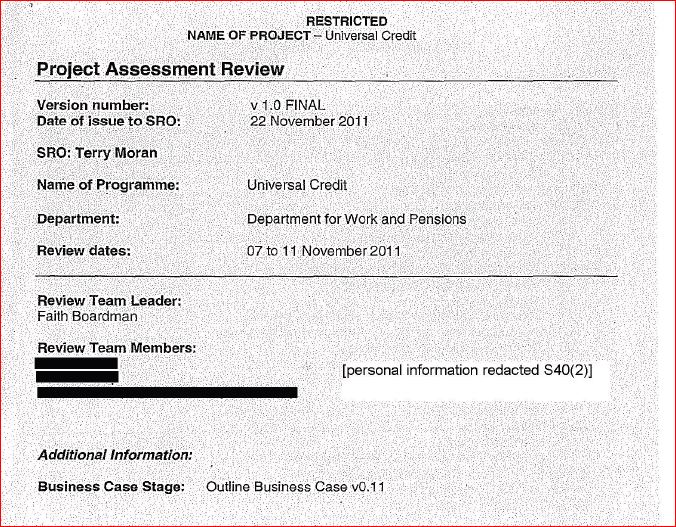
Front page of a report the DWP kept hidden for four years. The DWP's lawyers went through numerous FOI appeals to try and stop the report being published.

Front page of a report the DWP kept hidden for four years. The DWP’s lawyers went through numerous FOI appeals to try and stop the report being published.

This is the independent Universal Credit Project Assessment Review  that lawyers for the Department for Work and Pensions went through numerous FOI tribunal appeals trying to keep hidden.

It  was written for the DWP by the Cabinet Office’s Major Projects Authority. Interviewees included Iain Duncan Smith and Lord Freud who was – and is – a work and pensions minister.

In 2012 Lord Freud signed off the DWP’s recommendation that an FOI request for the report’s release be refused.

Remarkable

The now-released report is remarkable for its professionalism and neutrality. It’s also remarkably ordinary given the number of words that have been crafted by the DWP’s lawyers to FOI tribunals and appeals in an effort to keep the report from being published.

The DWP’s main reason for concealing the report – and others that IT projects professional John Slater had requested under FOI in 2012 – was that publication could discourage civil servants from speaking candidly about project problems and risks, fearing negative publicity for the programme.

In the end the DWP released the report 11 days ago. This was probably because the new work and pensions secretary Stephen Crabb refused to agree the costs of a further appeal. Last month an FOI tribunal ordered that the project assessment review, risk register and issues register be published.

Had the reports been published at the time of the FOI request in 2012 it might have restricted what ministers and the DWP’s press office were able to say publicly about the success so far of the Universal Credit programme.

In the absence of their publication, the DWP issued repeated statements that dismissed criticisms of its programme management. Ministers and DWP officials were able to say to journalists and MPs that the Universal Credit programme was progressing to time and to budget.

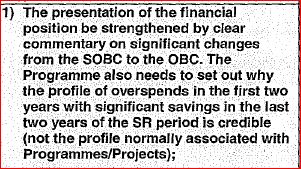
In fact the project assessment review questioned a projected increase of £25m of IT spend in the budget.

MPRG is the Major Projects Review Group, part of the Cabinet Office. OBC is the Outline Business Case for Universal Credit. SOBC is the Strategic Outline Business Case.

MPRG is the Major Projects Review Group, part of the Cabinet Office. OBC is the Outline Business Case for Universal Credit. SOBC is the Strategic Outline Business Case.


The DWP claimed in the report that the projected of £25m in IT spend was a “profiling”rather than budgetary issue.

By this the DWP meant that it planned to boost significantly the projected savings in later years of the project. Those anticipated savings would have offset the extra IT spend in the early years. Hence the projected overspend was a “profiling” issue.

But the report questioned the credibility of the profiling exercise.

credibility extract

On the question  of whether the whole programme could be afforded the report had mixed views.

affordability extract

The report was largely positive about the DWP’s work on Universal Credit. It also revealed that in some ways not all was progressing as well as had been hoped (which was contrary to DWP statements at the time). The report said,

behind the curve extract

And a further mention of “behind the curve”…

behind the curve excerpt

None of these problems was even hinted at in official DWP statements in 2012. About six months after the project assessment review was conducted, this was a statement by a DWP minister (who uses words that were probably drafted by civil servants).

“The development of Universal Credit is progressing extremely well. By next April we will be ready to test the end to end service and use the feedback we get from claimants to make final improvements before the national launch.

“This will ensure that we have a robust and reliable new service for people to make a claim when Universal Credit goes live nationally in October 2013.”

And the following is a statement by the then DWP secretary  of state Iain Duncan Smith in November 2011, which was around the time the project assessment review was carried out. Doubtless his comments were based on briefings he received from officials.

“The [Universal Credit] programme is on track and on time for implementing from 2013.

“We are already testing out the process on single and couple claimants, with stage one and two now complete. Stage 3 is starting ahead of time – to see how it works for families.

“And today we have set out our migration plans which will see nearly twelve million working age benefit claimants migrate onto the new benefits system by 2017.”

Ironic

It’s ironic that the DWP spent four years concealing a report that could have drawn attention to the need for better communications.

communications extract

The report highlighted the need for three types of communication, internal, external and with stakeholders.

communications extract2

On communications with local authorities ..

communications extract3

Comment

The DWP has denigrated the released documents. A spokesperson described them as “nearly four years old and out of date”.

It’s true the reports are nearly four years old. They are not out of date.

They could hardly be more important if they highlight a fundamental democratic flaw, a flaw that allows Whitehall officials and ministers to make positive public statements about a huge government project while hiding reports that could contradict those statements or could put their comments into an enlightening context.

Stephen Crabb, IDS’s replacement at the DWP, is said by the Sunday Times to want officials to come clean to him and the public about problems on the Universal Credit programme.

To do that his officials will have to set themselves against a culture of secrecy that dates back decades. Though not as far as the early 1940s.

Official proceedings of parliament show how remarkably open were statements made to the House during WW2. It’s odd that Churchill, when the country’s future was in doubt, was far more open with Parliament about problems with the war effort than the DWP has ever been with MPs over the problems on Universal Credit.

I have said it before but it’s time for Whitehall departments, particularly the DWP, to publish routinely and contemporaneously their project assessment reviews, issues registers and risk registers.

Perhaps then the public, media and MPs will be better able to trust official statements on the current state of multi-billion pound IT-based programmes; and a glaring democratic deficit would be eliminated.

Openness may even help to improve the government’s record on managing IT.

Universal Credit Project Assessment Review

Is DWP’s Universal Credit FOI case a scandalous waste of money?

Crabb’s momentous FOI decision on Universal Credit IT?

By Tony Collins

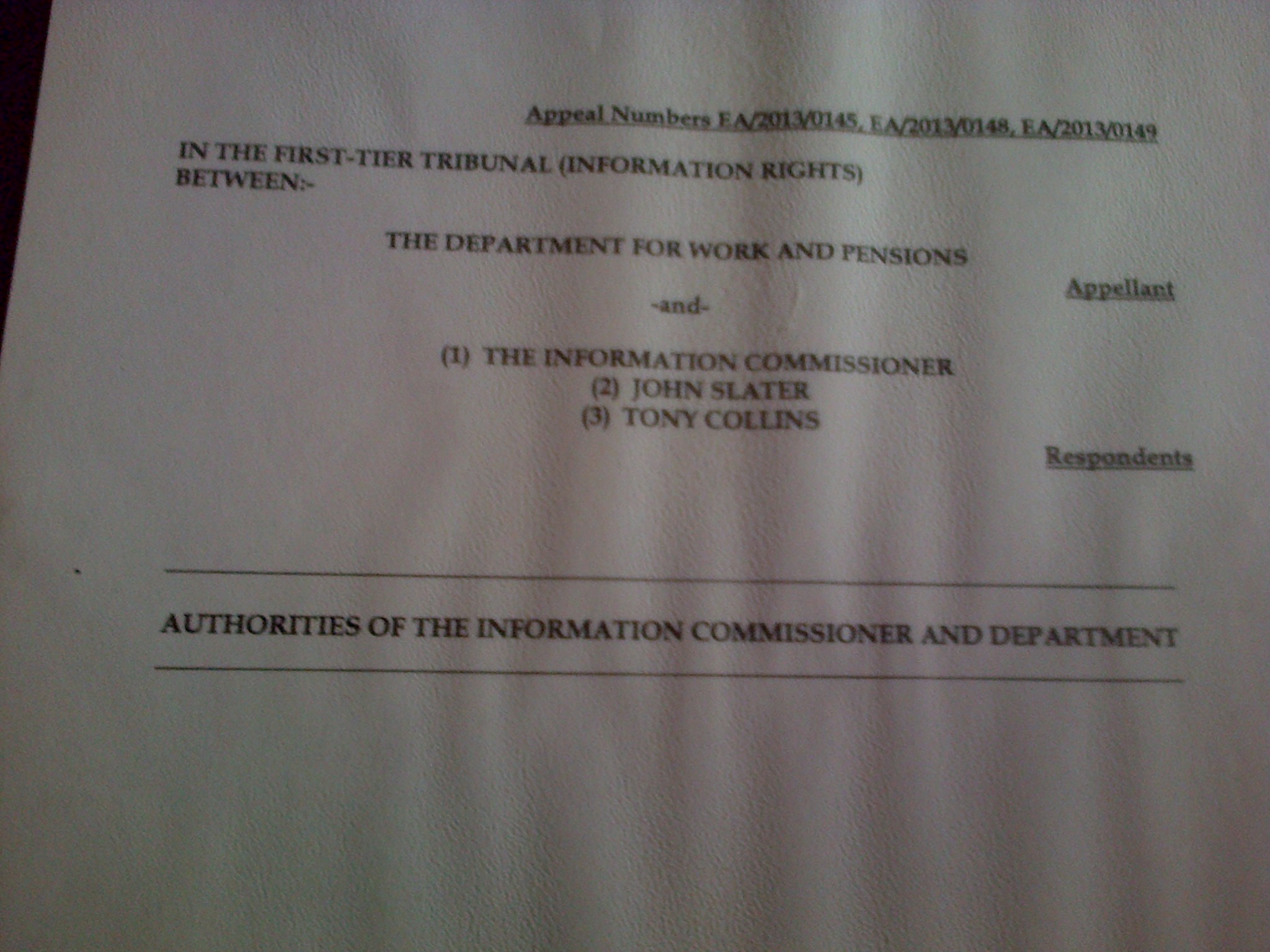
Some of the DWP legal "bundles" in its protracted and pointless FOI case to try and stop Universal Credit reports being released.

Some of the DWP legal “bundles” in its protracted and pointless FOI case to try and stop Universal Credit reports being released.

Stephen Crabb, the new DWP secretary of state who replaces IDS, has started to make a difference.

On 3 April 2016 the Sunday Times reported that Crabb had ordered officials to stop refusing FOI requests and come clean with him and the public about problems on the Universal Credit programme.

Five days later (8 April 2016) the DWP released three reports under FOI on the Universal Credit programme: a risk register, an issues register and a Major Projects Authority project assessment review.

DWP FOI bundles2

The DWP fought for years at FOI tribunals and appeal hearings to stop the reports being published. Officials were expected to instigate a further appeal after an FOI tribunal ruled last month that the reports be published.

But it now appears that Stephen Crabb refused to sign off further public money for an appeal and officials were left with little choice but to release the reports.

The reports show the extent to which the DWP was economical with the truth in its self-praising departmental press releases and ministerial statements on the state of the Universal Credit programme in 2012 and 2013.

Trust

Indeed, how can we trust any DWP press statement on Universal Credit given that officials are still keeping hidden from Parliament and the public the risk registers, issues registers and project assessment reviews carried out on the UC programme since 2012.

Stephen Crabb

Stephen Crabb

Crabb’s appointment and the release of the three reports dated 2011 and 2012 are, from an FOI point of view, a good start.

But will the DWP become more open in the future about the state of its big IT-enabled change programmes?

Probably not. In a statement to Computer Weekly last week, a DWP spokesperson dismissed the released reports as “nearly five years old and out-of-date” and went on to praise the Universal Credit programme (which involves a waterfall approach and separate much cheaper, and to some extent competing, agile-based project).

This statement suggests that the DWP’s “no bad news” culture is still pervasive; that it is prepared to denigrate its own reports as out of date when they convey messages that conflict with officialdom’s good news culture.

A mass of DWP paperwork and legal bundles on the FOI appeals and hearings related to the documents show how earnest were the reasons for the DWP’s refusal to release the reports until this month.

It is likely that Crabb personally ordered their release. But, probably unknown to Crabb, the DWP has just refused an FOI request to release an Integrated Assurance and Approval Plan (IAAP) on the Universal Credit programme.

IT projects professional John Slater had requested the IAAP. He’d also made the original request for the UC risk register and issues register, and had campaigned long and hard for their release.

Some people may be surprised by the DWP’s refusal to release the IAAP, given that it is another very old Universal Credit report, dating back to the start of the programme. It may even pre-date the released risk register, issues register and project assessment review.

But the IAAP’s release could embarrass the DWP. IAAPs have been mandatory for all major projects since 1 April 2011. They show how well officials have planned a project or programme.

UC assumptions

The Treasury will not normally approve funding without a satisfactory IAAP. It is likely the DWP made a range of over-optimistic assumptions about the UC roll-out in its IAAP.

The DWP’s refusal to release it was under section 36 of FOI legislation. This requires sign off by a minister. In this case it is likely to have been signed off by Lord Freud, the welfare and pensions minister.

He was the minister who originally refused the FOI requests for the Universal Credit risk register, issues register, milestone schedule and project assessment review.

It is unlikely that Crabb knows anything about Slater’s request for the IAAP.

No Whitehall department has yet released contemporaneously – under FOI or outside it – any reports on the performance, progress or otherwise of its big IT-enabled projects or programmes, including Universal Credit.

Arguably it is the continued secrecy on the way officials manage big and costly schemes that contributes more than anything else to the poor record of central government when it comes to understanding and implementing IT-related change.

Out of control?

John Slater said of the released reports,

“Whilst the information disclosed relates to the UCP as it was back in 2012 it is still important and relevant to the programme today.

“The information shows a programme that appears to have been running at breakneck pace and was out of control.

“The normal checks and balances that a professional organisation should have had in place, especially cost control, simply weren’t there. Whilst these problems were recognised in the risks and issues there was no sense that the senior leadership team were willing or able to do anything about them.

“Having read the information it is not a surprise that the Major Projects Authority had no other option but to stop and restart the programme via the now infamous reset.

“The released information also raises questions about the validity of the Universal Credit business case that might explain why it still hasn’t been signed off by the Treasury.”

Comment

Well done to Stephen Crabb. He has given the culture of secrecy at the DWP a gentle shake. But can he make a lasting difference?

As we saw in “Yes Minister” it is difficult for a new minister – or any minister – to have any permanent influence on officialdom. And it remains the case that neither the DWP nor any other department has ever released contemporaneously reports on its own performance or the progress on a big IT-related change programme.

The nearest thing to it is a National Audit Office report, but these are usually retrospective and they are almost always dismissed by departmental press offices and ministers as out of date, whether they are or not.

It is abundantly clear that the DWP is pre-occupied – maybe paranoid – about negative media coverage of the Universal Credit programme.

The same thing happened at the Department of Health over media coverage of the NPfIT NHS IT programme: officials even issued written instructions to NHS staff on the tone of voice they should use with journalists and others when discussing the programme.

Many of the legal reasons the DWP gave to FOI tribunals and appeal judges revolved around the fear of releasing information that could fuel a negative response by the media to the Universal Credit programme.

dwpWhitehall’s war on FOI

Crabb has won an FOI battle but his officials are winning the pro-secrecy war. For Crabb to make a lasting difference he will need to persuade Lord Freud – and any of his successors – of the virtues of openness.

Until officials willingly publish contemporaneous reports on the progress or otherwise of big IT-enabled change programmes, government will probably continue to have a poor record when managing these schemes.

Success in government IT requires openness because IT-enabled projects and programmes are about solving problems; and if the problems cannot be admitted let alone discussed widely they are unlikely to be solved,as we saw with the initial problems on the Universal Credit programme.

Universal Credit involves many external organisations such as local authorities and housing associations. The DWP could start to embrace media coverage as giving healthy challenge to its decisions – challenges that may help to resolve a range of problems that are inevitable when the benefit system is being simplified.

Keeping reports such as the IAAP secret – even after five years – will continue to fuel the internal paranoia against open and constructive debate.

After decades of secrecy over the contemporaneous release of project and performance reports it is time for lasting change.

Universal Credit shows it’s time to make all major government projects open and transparent – Computer Weekly Editor’s Blog.

Judge orders Universal Credit reports must be published – The Register

Victory for campaigners as DWP finally publishes Universal Credit reports – Politics.co.uk

Is DWP minister on verge of momentous FOI decision on Universal Credit?

By Tony Collins

universal creditStephen Crabb, IDS’s replacement at the Department for Work and Pensions, faces in the next few days an important first test of his desire for openness over problems on the Universal Credit IT-enabled programme.

The Sunday Times reported yesterday (3 April 2016) that Crabb has ordered weekly updates on the UC programme and has told officials to stop blocking freedom of information requests.

The paper has had, it appears, an off-the-record briefing on an internal DWP meeting last Thursday at which Crabb is said to have ordered officials to come clean with him and the public about problems on the UC programme.  The meeting is said to have lasted about six hours.

A source quoted in the Sunday Times  said,

“We need much greater transparency. This is such a public-facing project. We have nothing to fear from public scrutiny.”

But it’s almost inevitable that Crabb will face passionate opposition within the DWP. It will be surprising if he gets his way.

The DWP has spent years in legal actions to stop the release under FOI of old reports (dating back to 2012) on the problems and risks related to the UC programme. Crabb faces a key decision on the case in the next few days.

Last month a judge ordered the DWP to release three Universal Credit IT reports: a risk register, issues register and Major Projects Authority Project Assessment Review.

The DWP has 28 days from the date of the ruling to appeal, which means it will probably make its decision known within the next two weeks.

Stephen Crabb

Stephen Crabb

Any time now, then, Crabb will make a decision on whether to sign off a continued spend of public money on the case by approving a new FOI appeal.

If he agrees (there have been several appeals already) it will indicate that little has changed within the DWP and that the culture of secrecy is continuing.

If he stops his officials from requesting an appeal and the three reports in question are released, it will be a momentous change, for reasons I give below.

Comment

It is not the contents of the three reports that are particularly controversial.

If released they would show the extent to which the DWP’s ministers and departmental press releases misled the media and the public when giving assurances about the robust state of the UC IT programme.

But we already know that the DWP was over-optimistic – misleading – in its official statements on the UC programme.

Not wanting to give ammunition to its critics and Parliamentary opponents,  the DWP will sometimes – perhaps usually – exaggerate the progress on a big IT-enabled project or programme.

dwpThe continued confidentiality of reports such as the risk and issues registers and the project assessment review minimises the risk that officials and ministers will face authoritative contradiction when they declare that a programme is on time and to budget.

But this is not the reason senior DWP officials are passionate advocates of continued secrecy.  The desire for confidentiality is more deep-rooted.

One reason some very senior lifelong civil servants tend to enjoy their job is their privileged access to State secrets.  It underlines the importance of their work.

Extreme

We know from the volumes of DWP evidence in the UC FOI case of the quite extreme attempts by officials to keep the lid on their work. How detailed and extreme those attempts have been it is difficult to say because the DWP has so far refused consent for its evidence to the FOI tribunal to be published.

No Whitehall department publishes its internal reports on the performance of its major IT-enabled projects and programmes.

Attempts since the 1980s by the Public Accounts Committee to persuade officialdom to publish such reports have been resisted.

Even investigators at the National Audit Office sometimes have had difficulties finding out how badly an IT-enabled project was faring, on the NHS NPfIT programme for example.

Indeed the cabinet secretary would be horrified to learn of any attempt by Crabb to have the UC reports released. What next? The daily locations of nuclear submarines?

I would be amazed if Crabb has his way and the reports are released.

There again, Crabb is new enough, at the moment detached enough, to make a dent in the DWP’s self-protective layers of secrecy. I wish him well.

Obsessive secrecy could help to explain why the DWP has a decades-long history of project failure.  Unnecessary secrecy may tempt ministers to make misleading announcements on a project’ progress, and could encourage director-level incompetence, bad managerial decision-making, a lack of truthful stakeholder consultations and even wrongdoing. 

But campaigning for openness at the DWP is like trying to polish a rusty old car when it’s the chassis that needs replacing. Crabb might have realised that at last Thursday’s meeting.

That he is facing the most culturally important decision he may ever take at the DWP is, to me, not in doubt. We should know the result in the next two weeks, when the time allowed for any DWP appeal will expire.

Thank you to FOI campaigner Dave Orr for drawing my attention to the Sunday Times article.

Culture of “no bad news” is why software projects continue to fail

IDS loses legal challenge to keep Universal Credit secret

Is DWP’s FOI case a waste of money?

How the government is working to frustrate FOI 

Sunday Times article (may need subscription)

Judge orders FOI release of Universal Credit IT reports

By Tony Collins

universal creditA judge has ordered the Department for Work and Pensions to release three Universal Credit IT reports that ministers and their officials have spent public money trying to keep out of the public domain.

Judge Chris Ryan and his FOI tribunal panel went further: they concluded that had the reports in question been disclosed at the time they might have corrected misleading government statements about the robust state of the Universal Credit programme.

In their ruling this week the tribunal said that disclosure of the documents,

“might have corrected a false impression, derived from official government statements by revealing the very considerable difficulties that were beginning to develop around the time when the information requests were submitted.”

Two director-level officials at the Department for Work and Pensions had argued that civil servants needed a “safe space” in the reports in question to be candid in their assessments of risks and problems.

But the FOI tribunal, whose members have project management experience, concluded that it’s in the self interest of officials to be candid and professional about problems and risks rather than be associated with a failed project.

In addition, officials would not wish to be held partly responsible in a later review, such as one carried out by the National Audit Office, for having “failed to draw colleagues’ attention to problems with sufficient clarity to ensure that they were addressed effectively and in good time”.

Civil servants had an “awareness of the importance of candour in support of good decision-making and their professional obligation to assist that process”.

The tribunal said the three reports in question should have been  disclosed at the time they were requested in 2012. It directed the DWP to disclose them.

If the DWP’s barrister can identify good reasons why the tribunal might have made an error, or errors, in law, he can appeal within 28 days, though a tribunal could reject his appeal . The DWP could then appeal this decision.

This cycle of appeals that has already happened once – or the DWP could now decide that it has spent enough public money on fighting the case and release the reports.

dwpDid the DWP mislead?

The reports are expected to throw light on the problems and risks of Universal Credit IT at  a time when DWP’s officials, secretary of state Iain Duncan Smith and his ministers, were giving assurances that all was well with the programme.

An FOI tribunal ordered the reports to be released in 2014 but various DWP appeals led to a re-hearing of the case last month (22 February 2016) at Leicester Magistrates Court.

Now Judge Ryan and two other FOI tribunal panel members have ordered that the DWP release a risk register, issues register and Major Projects Authority project assessment review.

The risk register described risks, the possible impact should they occur, the probability of their occurring, a risk score, a traffic light status, a summary of the planned response if a risk materialised, and a summary of the risk mitigation.

The issues register included a list of problems, the dates they were identified, the mitigating steps required and the dates for review and resolution.

The project assessment review gave a high-level strategic view of the state of UC, its problems, risks and how well or badly it was being managed.

The DWP argued that routine disclosure of such reports could lead to sensationalist headlines that would have a “chilling effect”.  Not wanting to give food to a hostile media, officials writing or contributing to such reports could make them anodyne.

dwpDWP fears “over-stated”

But Judge Ryan said the DWP had “over-stated” its fears. The tribunal suggested that the DWP had not been entirely truthful about the Universal Credit programme.

“We do not accept the Department’s submission that the management of the Universal Credit Programme is already exposed to sufficient public scrutiny and that this dilutes the strength of the arguments in favour of disclosure. On the particular facts of this case it is clear that the true story about the troubles which the Programme team faced only came to light a long time after the event and then showed a markedly different picture than had been portrayed by government statements issued at the time.”

This difference between reality on the UC programme and government statements was a good reason in favour of the disclosure of the reports, said the judge.

Closed session

The DWP’s witness Cath Hamp, a senior DWP official, went into closed session at the latest hearing to argue that her concerns about civil servant behaviour would be more clearly shown by reference to specific items in the withheld documents.

Her closed-session arguments related to the risk of fraud and hacking into the system, relations with commercial organisations, and relations with local government. The tribunal was not convinced by her arguments.

Neither was the panel convinced by the “chilling effect” arguments.

“The evidence on the likelihood of civil servants altering their behaviour in future with regard to their contributions to the preparation of a risk or issues register or to the conduct of a project review was, as Ms Hamp fairly conceded, speculative…”

FOI a benefit more than a “burden”?

The DWP argued that disclosures of the reports would have placed a burden on DWP’s Universal Credit programme executives. They would have been forced to divert their energies and time into correcting media reports about the seriousness of problems and risks. But the tribunal concluded,

“Nor do we accept that resources would be wasted in providing explanations. It is clear from the press releases that we have been shown that the Department has been adept at presenting its case to the public and that it clearly has the specialist staff to carry out that function.”

The tribunal suggested that FOI obligations, rather than cause harm as the DWP had suggested, would be a benefit. The FOI Act had “brought with it an obligation on government to explain itself to a greater extent than had previously been found necessary”.

The tribunal rejected the DWP’s argument that it faced a hostile media which made officials defensive.

“… the evidence before us suggests that, on this issue, the media has adopted a relatively balanced approach to information about the Programme that has come into its possession.”

The judge said that in any event it is a

“perfectly appropriate performance of the media’s role in a modern democracy for it to investigate and comment on the implementation of a major reform involving large sums of public money and a potentially crucial impact on the lives of some of the least fortunate members of society”.

He added: “We do not therefore accept the Department’s submissions on the likelihood of the public misunderstanding the disputed information, or being misled as to its significance by the media”

In its final paragraph the tribunal said,

“… we have concluded that the public interest in maintaining the exemption in respect of each of the withheld documents does not outweigh the public interest in disclosure and that they should therefore have been disclosed when requested. Our decision is unanimous.”

Comment

My thanks to IT projects professional John Slater who has been the main force behind the case in favour of disclosure of the reports.

He made the original request in 2012 for the reports to be published. I requested one of them. He went to the original First Tier Tribunal and to Leicester Magistrates Court last month to cross examine the DWP’s witness. The points he made were quoted by the tribunal in its submission.

It’s campaigners like John Slater (and Dave Orr) who have helped to make FOI legislation more effective than it would otherwise have been.

If the DWP continues to pour money into fighting the disclosure of the reports in question, it will confirm to some of us that, when it comes to its own interest, that is its interest as a bureaucracy,  it may not be a fit authority to manage the spending of public money.

I hope it will release the reports now. It is time it started distinguishing between the public interest and its own.

Universal Credit FOI tribunal ruling – March 2016:  077 110316 Final Open Decision

Why keep risk registers secret?

By Tony Collins

FOI Commission front coverThe Freedom of Information Commission reported comprehensively yesterday on the workings of the FOI Act. It raised the question of whether risk registers and Major Project Authority project assessment reviews should be published.

The Commission’s members, who included former Tory leader Michael Howard and Labour’s Jack Straw, received over 30,000 responses to their call for evidence. They met numerous stakeholders, heard ten hours of oral evidence and  produced an impressive report that opposed the idea of charging for FOI requests.

Two of the seven Cabinet vetoes have been on FOI requests related to risk assessments. Indeed the Department for Work and Pensions is fighting a protracted legal battle (three years so far) to stop three reports on the Universal Credit IT programme being published, including a risk register and project assessment review.

Is there any good reason not to publish a risk register, or a project assessment review? Aren’t the public entitled to know the extent to which their money is at risk on a project or programme?

No, argue civil servants, whose views on confidentiality are almost always supported by their ministers. Civil servants contend that they need a “safe space” to be imaginatively negative, to think the unthinkable, without the media and opposition MPs seizing on a risk register as evidence that an innovative scheme should not get off the ground.

Civil servants and ministers argue that disclosing risk registers (and project assessment reviews) would mean that those who contribute to them would tone down or sanitise their comments. Civil servants would not be completely honest or candid when setting out the scale or magnitude of the risks.

This is what the FOI Commission concluded:

Risk assessments

“In our call for evidence we described risk assessments as a particularly relevant example of the tension between the public’s right to know, and the need for public bodies to have an internal deliberative space.

Many documents will contain mention of risks, but here we are concerned principally with documents that are explicitly devoted to setting out a candid risk assessment. We drew particular attention to risk assessments because two of the seven Cabinet vetoes have been in respect of risk assessments.

The most obvious example of a candid risk assessment is the ‘risk register’. Project management processes typically utilise risk registers as part of their methodology. Risks are normally given a rating on a scale of 1 to 5 of the likelihood of the risk occurring (where 5 is the highest likelihood of the risk occurring) and the scale of the impact if that risk occurred. Using the scores for likelihood and impact, a “Red / Amber / Green” (RAG) rating is created denoting how serious a risk is.

Risk registers do not generally provide detailed explanations of the risks involved, but only the headline risk and potential mitigation.

The Office of Government Commerce (OGC) Gateway Review is another example of a risk assessment. Gateway Reviews examine programmes and projects at key decision points using a peer review process in which independent practitioners examine progress and likelihood of successful delivery. These reviews can apply to e.g. IT or procurement processes, but can also apply to policy development.

Policy impact assessments are formal evidence based procedures that assess the economic, social and environmental costs and risks and benefits of a policy. These are published for example: at the same time as a consultation, response to consultation or at introduction of a Bill or as part of any change during the passage of the Bill.

Major Project Authority Project Assessment Reviews (PARs) are detailed assessments of large projects. They are more tailored to specific projects than Gateway Reviews. Following frank interviews with staff they culminate in a report for the Senior Risk Owner for the project setting out recommendations and assessment of risks.

In its response to the call for evidence Kent County Council highlighted the difficulties that could arise if candid risk assessments were made routinely available:

‘…it could mean that people do not feel confident enough to put risks they have identified onto the registers, or that risk registers themselves are not compiled in the first place for fear of repercussions. This could lead to potential “nasty surprises” and poor decision-making if people choose to keep risks ‘in their heads’ (paragraph 3.3)

By contrast, in their evidence the Open Government Network said:

‘The public acknowledgement of the existence of certain risks will enhance the public debate about major projects and their implementation. It is when risks can be silently ignored that the consequences are dramatic, often then requiring the complete publication of a flawed risk register when it is too late to prevent the overlooked problems.’

The Commission agrees with the evidence of the IC [Information Commissioner] in which he says that the impact of disclosing candid risk assessments can vary depending on the sensitivity of the topic and what is already in the public domain.

There will be risk assessments where it is so keenly in the public interest that the risks identified be disclosed (for example, where these concern serious risks to public health or life) that, notwithstanding the need for these assessments to be part of an internal deliberative process, they should be disclosed.

In other cases the nature and candour of the risks may mean that they should not be published. The Commission has reached that the conclusion that the public interest test provides the best way to assess whether specific risk assessments should be published, and that no additional or specific protection is required for risk assessments.”

Comment

There are times when civil servants and ministers take themselves and what they do too seriously. The continuing confidentiality of risk registers is an example.

NHS trusts routinely publish risk registers in their board papers and nobody notices, not even the local press, because risk registers highlight things that haven’t happened, but may happen.

Even a high-risk score is an esoteric and speculative concept that is unlikely to interest the general public. So risk registers in the NHS go unreported.

Central government, on the other hand, generally protects risk registers as if they are new-born babies.

Civil servants fear the media would have a field day if risk registers were routinely disclosed.

In fact they would go largely unreported. Journalism tends to be about things that are happening, and have happened, rather than risks that may materialise if certain circumstances come together.

Few journalists will convince their news editor of a potential story about a project or programme that has a high risk assessment score.

Instinct will tell civil servants and bureaucracies to prefer confidentiality to openness.  Secrecy reduces the pressure for accountability. It minimises the risk of dissent.

I have the impression that some civil servants – perhaps mainly in the Department for Work and Pensions – would lie down in front of a bulldozer rather than allow it to break down the barriers of confidentiality over risk assessments.

But there is no sound reason for keeping risk registers and project assessment reviews confidential.  The public is entitled to know when tax money is at risk.

Civil servants and ministers often forget when are locking away risk assessment reports that they are locking out the public that pays their salaries, and is paying for the projects and programmes where the risks are being kept secret.

Government secrecy is an inevitable part of life in North Korea and China.  Should it be inevitable in Whitehall?

Thank you to Government Computing for drawing my attention to the risk registers section of the FOI Commission’s report.

Thanks also to FOI campaigner Dave Orr who pointed out that the FOI Commission’s report quotes Maurice Frankel of the Campaign for Freedom of Information who says: “We now need to ensure that the Act is extended to contractors providing public services…”

FOI Commission report

Why FOI Commission has surprised observers – BBC

Government Computing

Commission members:

Lord Burns, Chair, Lord Carlile, Dame Patricia Hodgson, Michael Howard (former Tory leader) and Jack Straw.