Category Archives: Campaign4Change

Barnet’s undemocratic BT/Capita outsourcing plan?

By Tony Collins

Barnet Council is remarkably defensive about its plan to outsource IT, customer services, finance, payroll, HR, corporate procurement and other services to BT or Capita, by the end of December 2012.

After the controversy in Cornwall about whether the full council or an inner circle of councillors – the “Cabinet” – should make momentous decisions affecting the council’s future, Campaign4Change asked Barnet whether it was putting its decision to outsource to BT or Capita to the full council.

Cornwall’s decision on whether to outsource to BT or CSC was going to be taken by the Cabinet alone but Cornwall’s leader Alec Robertson changed course and decided to put the idea of a mega-outsourcing deal to the full council.

Straightforward question

So would Barnet council’s decision to award a mega-outsourcing contract to BT or Capita go to full council for a vote? It was a straightforward question for Nick Griffin, Media Officer, Chief Executive’s Service, Barnet Council. He did not answer the question directly.

His reply:

“There is quite a bit of information available on our website. Please see the links (at the bottom of this post)  …

But was the information on the council’s website out of date? We wanted to be clear on the facts. We asked Griffin again. His reply was polite but insistent: he would not say whether the council was putting its outsourcing decision on BT or Capita to the full council.

Neither would he answer directly another straightforward question on local democracy: Has the decision to approve/reject One Barnet [transformation programme] gone to full council for a vote?

From the council’s website it appears that all key decisions on the outsourcing plans have been made by Barnet’s Cabinet’s alone. This is from the council’s website:

“A decision will be made by Cabinet in late 2012 as to which bidder [BT or Capita] will win the contract. The new provider will start to run the NSCSO [New support and Customer Services Organisation] in spring of 2013.”

Barnet’s website lists as the relevant previous decisions those taken by the council’s Cabinet alone.

– Cabinet, 29 November 2010 – approved the One Barnet Framework and the funding strategy for its implementation.

– Cabinet …2 March 2011 – Customer Services Organisation and New Support Organisation Options Appraisal

– Cabinet … 29 June 2011 – approved the New Support and Customer Services Organisation business case and the start of the competitive dialogue process…

So one of the most momentous decisions affecting the council, its staff and council services is not being made by the full council.

Undemocratic?

Barnet Council comprises 38 Conservatives, 22 Labour, and three Lib-Dem councillors. Most of them will not have a say on the outsourcing of:

  • Customer Services
  • Estates
  • Finance and Payroll
  • Human Resources
  • IT Infrastructure and Support
  • Corporate Procurement
  • Revenues and Benefits
  • Commercial Services.

The decision will be taken by the Cabinet’s 10 councillors, and perhaps not all of them. Is this local democracy in action?

Accusations of Maladministration?

Given that the decision to outsource to BT or Capita could have a major effect on the council’s future for good or ill, and is controversial –councils including Suffolk and Cornwall are rethinking large outsourcing plans – could Barnet’s decision not to put its outsourcing plans to a vote of the full council leave the Cabinet open to accusations of maladministration if things turn sour?

Links provided by Nick Griffin (1)  (2)

SI’s price for hosting was 80 times higher than SME’s

By Tony Collins

The Cabinet Office minister Francis Maude has criticised the high cost of Government IT and called on CIOs to be innovative, radical and pioneering as their departments move away from the “big, sclerotic SI contracts”.

His speech at an event for IT professionals was not unlike Chris Chant’s last year when Chant said the vast majority of GovIT was  “outrageously expensive”. Chant was then Executive Director in the Cabinet Office , heading  G-Cloud initiative.

Maude said that the government spends more than £1.2bn a year on hosting contracts. “Much of that is spent with just one or two suppliers,” said Maude. “And it’s more money than those suppliers are investing in their own cloud, the future of their own business.”

He continued:

We know we’re not getting value for money – recently a big SI and an SME bid on the Cloudstore for hosting. The SI bid £4m. The SME bid £50k.

Maude said the plan is to consolidate hosting and use collective requirements to run it.

“I’m particularly keen to explore mutualising it. I’ve asked my IT Reform team to come up with proposals by Christmas and I hope you will contribute to their work with your own energy and ideas.”

Reform is too slow

Much of Maude’s speech appeared to show a frustration that change in government IT is happening too slowly.

“We’ve made progress on all aspects of the IT strategy – but we need to go much further and faster.”

He did not mention any department in particular but the Department for Work and Pensions is among those that continue to award large long-term contracts to major IT companies, much as it used to, on the basis that civil servants do not want to risk any disruption to benefit systems .

Maude said:

“At the moment we spend more than 1% of GDP on the administrative IT to run government.  That’s far too much. It is imperative that Government reduces its IT budget further in the next 3 years – while delivering more digital, innovative, user-focused services.

Big is not beautiful

“So how can we get there? Firstly it’s crucial that we continue to move away from the mentality that big is beautiful.

“For too long Government IT has been too expensive, over-specified and run in contract structures that encourage complexity, duplication and fragmented user services.

“For the most part contracts were consistently awarded to a limited number of very large suppliers on long-term, exclusive contracts – whilst we shut out smaller more innovative suppliers.

“… Government repeatedly found itself paying large amounts for systems that were delivered late, over budget and not even to the quality required…

“Shockingly when we came into office SMEs – despite accounting for half the turnover in the UK economy – were winning only around 6.5% of Central Government’s procurement spend.

“This Government has set out an aspiration for a quarter of our business to go – directly or indirectly – to SMEs by 2015. And that means creating a more competitive and open marketplace for buying IT services and solutions.

“This process has started – we have cut red tape, introduced G-Cloud and increased the visibility of contracts across the board and we are giving firms a chance of redress through the Cabinet Office’s ‘Mystery Shopper’ Scheme.

“But there’s more to do. I am reiterating my requirement that for any IT programmes not being displaced by digital solutions, no project, framework or contract can be over £100m.

No contract extensions

And to ensure we are in charge of our own destiny rather than the supplier – we will have no contract extensions – the conditions and pricing that were signed up to even three years ago are ruinous in comparison to what is available now, when the price of IT keeps dropping.”

Open standards

“We need to change the way we procure and run technology systems – introducing Open Standards and using a wider group of smaller, innovative suppliers…”

Allowing Government to inter-operate would mean “we don’t have to build the same thing thirty or forty times”.

He said that open standards will improve competition for government contracts.  In a consultation on open standards more than 70% of respondents supported the view that mandation of open standards, or of particular standards, would improve value for money in the provision of government services.

“Following this consultation I am today publishing our Open Standards Principles. These set out that Royalty Free open standards are key to levelling the playing field for open source and proprietary software in government IT.

“And that competition between open source and proprietary software can result in lower licensing costs and increased innovation in government IT.

“…All Government bodies must comply with the Open Standards Principles or apply for an exemption. And a challenging comply or explain process is being implemented, through the existing IT spend controls process.”

Maude said that reforms can happen only with strong, radical, innovative leadership – “people who will challenge the status quo and can inspire change in every corner of Whitehall. And that’s where I expect you to come in.”

Cloudstore

The Government’s CloudStore allows public sector organisations to purchase a range of the best IT services off the shelf from on a pay-as-you-go basis, rather than having to develop their own systems.

Maude said there have been 99 purchases of IT services totalling over £2.2m through the CloudStore and 70% of this  has been with SMEs.

He thanked Chris Chant – who retired in April –  and the current Director Denise McDonagh and her team for their work on G-Cloud.

“I’ve heard suppliers say they can’t believe how easy G-Cloud is to use – which is not what you’re used to hearing about Government procurement,” said Maude.

Comment:

Maude says all the right things  – as did Chris Chant last year. Bill CrothersLiam Maxwell and Mike Bracken are among the excellent adjutants to Maude. But if this strong team – which is backed by the Prime Minister –  cannot significantly change the way government runs, and how much it spends on IT, who can?

Maude’s speech

DWP defends £316m contract award to HP

How’s the Universal Credit project going?

By Tony Collins

The Work and Pensions Secretary Iain Duncan Smith continues to receive reports from his officials that things are going well with the Universal Credit project.

Which is just as well for the officials.

The most important of them is Malcolm Whitehouse, Universal Credit Programme Director, Department for Work and Pensions who has given a positive progress report on the Univeral Credit project to the House of Commons’ Work and Pensions Committee.

Whitehouse is “pleased to say” that HM Revenue and Customs’ “Real-Time Information” project – in which employers give HMRC monthly rather than annual details of how much tax and national insurance they are paying staff – is “on track and the pilot is going very well”.

Whitehouse’s paper ties in with the mood of Duncan Smith who, it appears, has no wish to convey anything but good news on UC, which is tough for anyone who wants to tell the minister the unvarnished truth.

“Whatever we do here is an investment in changing people’s lives,” said Duncan Smith when he went before the Work and Pensions Committee in September. The Committee’s MPs are investigating progress on universal credit.

Not so gung-ho

This week MPs on the Work and Pensions committee questioned Robert Devereux, Permanent Secretary, Department for Work and Pensions, on UC progress.

To various questions Devereux gave answers that showed the UC project is still subject to a plethora of uncertainties:

“We are doing quite a lot of piloting work now to try and understand exactly what the size of the problem is,” said Devereux.  “Deciding on what that is depends on the work we are doing at the moment… we are trying to make sure how that will work … we are trying to work through how that will work in practice… it is difficult to know on a programme that will take until 2017 to complete exactly how that will fall out but we are doing quite a lot of work over the next  six to nine months to try to get our heads around what that commitment will be …I don’t there is an individual cost for it because we are still trying to explore exactly what that will be… the amount that transition protection will eventually cost us depends on a number of variables not all of which we know at the moment … The business case has a set of assumptions on what these numbers will be…”

Staffing for UC?

“It depends … at the moment the department is absorbing within its budget … the number of extra staff is going to depend on where the economy is in 13/14, 14/15, 15/16, 16/17. In the event that the economy is in a good place I will have quite a lot of spare staff already which I will be able to redeploy.”

And support for claimants who are not online?

“I have 80,000 operational staff. We are not going to find ourselves short of staff.” He said that until the pilots are complete he will not know “what proportion of people will need what sort of help”.

IT progress

The DWP said in a paper to the Work and Pensions Committee that a “pathfinder” pilot, which is due to begin in April 2013, will prove the core Universal Credit policy and supporting processes.

“The design for these IT systems is now in its closing stages, with the build plan on track to complete at the end of October 2012,” said the paper. “Rigorous, integrated IT testing has also commenced and will continue until February 2013, bringing together Universal Credit and the various external system changes, such as the Real Time Information system…

“October 2013 will see us start to roll out this core Universal Credit service incrementally in each region of Great Britain. It will also see us deploy the next series of functionality and processes in to the pathfinder sites.

“Early scoping and high level design work has now started on this, which will focus on the delivering digital (by default) processes. The programme will continue to build iteratively the functional capability to add automation and integration through to October 2015 and beyond.

Contingency

“There will be robust standby arrangements which will enable the IT system to be fully recovered within a short period of time. These standby arrangements will cater for both failures within the Universal Credit IT System and possible catastrophic outage of infrastructure (i.e. Data Centre outage).

“The Department for Work and Pensions is recognised as having some of the best contingency arrangements in place across Government. Should there be a catastrophic outage of IT arrangements are in place that can be invoked to ensure people continue to get their money…

Real-Time Information

“It is estimated that RTI will deliver c£300m net reduction in administrative burdens for employers. PAYE reporting in real time will also support the introduction of Universal Credit…

“A pilot started in April 2012 to test the Real Time Information service and the IT and identify any issues which need to be resolved before most employers start submitting PAYE in real time in April 2013.

“The pilot is going very well and as a result Real Time Information is on track. So far there have been few issues and those that have occurred have been quickly resolved with ten volunteer employers.

“It was expanded on schedule in May to a further 310 PAYE schemes. Following the success of the first pilot stage, HMRC expanded the pilot again and by end July almost 1.8 million individual records were being reported in real time by 700 PAYE schemes.

“The quality of data in the pilot has been good, with the numbers of individual records matching to a National Insurance number exceeding expectations.

“Where a PAYE scheme pays using Bacs, HMRC uses an automated cross referencing process to match the amounts shown on the RTI return with the amount actually paid. This process is producing high rates of matching.

” HMRC is on track for around 1,300 schemes to be reporting PAYE in real time by the end of September and a further expansion in November. By March 2013 around 6 million individual records will be reported in real time by up to 250,000 PAYE schemes.

“HMRC are seeing external confidence in the pilot and have therefore offered more large employers, payroll bureaux, new employers and software developers the opportunity to join the pilot or to expand existing involvement in advance of the launch date of April 2013.

“This approach will bring more individuals into RTI, ensuring HMRC is well placed to support the early stages of Universal Credit including Pathfinder when it starts in April 2013.

“The remaining employers and pension providers will come on board from April 2013. HMRC are on track to have all employers and pension providers reporting PAYE in real time by October 2013 – in time for the introduction of Universal Credit.”

Concerns

The Institute of Chartered Accountants for England and Wales, which supports the introduction of UC, has unanswered questions and concerns around the preparedness of HMRC, the DWP and some employers.

In a detailed paper to the Work and Pensions Committee the Institute also suggested there were many uncertainties about how the UC systems will work.

“The IT system UC will rely on will not be fully implemented in time, and many kinks and problems in the system haven’t yet been addressed,” said the Institute.

The CBI also supports the introduction of UC but has told the Work and Pensions Committee:

“While initial feedback from employers involved in the RTI pilot has been satisfactory, with officials providing adequate support when the system fails, we are concerned that such support will not exist when the programme is rolled out at scale.”

Comment:

Universal Credit is not the same as other major government IT projects. It is being built on the lessons from failed projects. Hence the use of “fail early, fail cheaply” agile principles; and the extensive use of pilot projects.

But in at least one material aspect the coalition is repeating a mistake on past (failed) IT-enabled projects such as the NPfIT, Firecontrol and the Single Payment Scheme:  in public it gives one side of the story – what’s going well – while keeping secret its own analyses of the problems, issues and risks.

This  may mean in practice that claimants, Parliament, employers and even Iain Duncan Smith may not know that the project is in deep trouble until the problems are manifest.

It’s better for the coaltion to say something along these lines: “This is an important welfare reform, a simplification of benefit systems that carries with it the sort of risks that go with innovation.

“This is what’s going well, and these are the challenges we face. We need the help and forebearance of all involved to overcome the problems we face and have yet to face.”

Instead Duncan-Smith and his officials are waving aside their critics, telling them imperiously: “The programme is on track and on budget.”

Pilots

There was extensive piloting before the advent of the NPfIT. It was called ERDIP. But the ERDIP results were largely ignored because they threw up all sorts of problems that, if taken seriously, could have stopped the NPfIT from going ahead in 2002.

Duncan Smith mentions the pilot projects – and the DWP publishes press releases on the results – but the department does not publish the findings in full. Will the DWP take any notice of the pilots if they throw up problems that could delay the scheduled start of UC in October next year?

To answer the question in the headine “How’s the UC project going?” we are not sure the DWP really knows. Parliament certainly doesn’t know.

Some of the clues are likely to be in the consultancy and other internal reports the DWP is refusing to publish. Let us hope they’re not too negative overall. If they are Duncan Smith will not want to read them; and he’s the man answerable to Parliament – and the public – for the success or otherwise of the scheme.

Is Universal Credit really on track? – the DWP hides the facts.

Lessons from a government agile success

By Tony Collins

Some central government departments spend a great deal with large suppliers on the development and maintenance of their websites (more on this in a separate post).  They could save millions of pounds if they followed the example of the Government Digital Service (and were not locked into mega-outsourcing contracts that include website development).

Agile teams within the GDS are responsible for GOV.UK, which largely replaces Directgov and offers a one-stop site for government services and information.

Simple, clear, fast

The guiding principles for GDS’s agile teams were “simple, clear, fast”. Lessons from the open-source project are on the GDS website. These are some of them:

“When things get tough and you want to go back to old ways, go more agile, not less”.

Less is more (a rare attribute for a government IT project).

Use independently-verifiable data to track your programme

Agile can work at scale. “We’ve embraced it culturally and organisationally…”

The Cabinet Office minister Francis Maude said:

“In stark contrast to the way IT has been delivered in government in the past, GOV.UK can rapidly accommodate new standards for development and security, catering to emerging technologies and user requirements quickly and effectively. It has been built the way Amazon built Amazon, and in the way that BA transformed their online business, by being agile, iterative and focused on users.

“GOV.UK has also been built using open source technology, which means we don’t have to pay expensive software licensing costs.”

Comment:

A good result for the Government Digital Service. Will others in central government follow?

What we’ve learnt about scaling agile – Government Digital Service

Agile can fix failed GovIT says lawyer


Congratulations to Cornwall – how democracy should work

By Tony Collins

Two months ago an inner circle of councillors and senior officers in Cornwall was finalising – in a rush – the most momentous deal in the council’s history, to outsource a range of council and NHS services to BT or CSC.

There were no plans to put the final outsourcing decision to the full council.

The inner circle had agreed that the final approval of a deal would be decided  by the council’s chief executive and a handful of councillors.

The view of the inner circle was that most councillors had no grasp of the detail. How could they understand how good the proposition was?

But in September campaigning councillor Andrew Wallis, an independent, put a motion before the full council:

“…this Council believes that it is not in the best interests of the people of Cornwall for the Council to enter into the proposed Strategic Partnership for Support Services.”

The motion was carried – then ignored by the inner circle who carried on negotiating with BT and CSC. Wallis was amazed. The next day his blog said he needed to “calm down from my disbelief and seething anger at one of the biggest F-yous to democracy I have ever witnessed”.

The Cabinet of Cornwall Council had “undermined democracy”.

“The arrogance of totally ignoring the majority of councillors’ feelings on the strategic partnership plans is staggering.”

Wallis organised a petition. It urged the cabinet to put the outsourcing deal to a vote of the full council; and 41 councillors put their names to a vote of no confidence in the leader Alec Robertson.

Democracy was now working as it should. It was starting to hold the inner circle to account.

The vote led to the replacement of Robertson as council leader. The full council narrowly chose  Jim Currie, an outsourcing sceptic, for its new leader; and the petition attracted more than 5,000 signatures (about 6,350) which meant that the outsourcing proposals had to be debated by the full council. A date was set: 23 October.

To his credit Robertson had said before being ousted as leader that the cabinet would abide by whatever the full council decided on 23 October.

BT worked hard on marketing its joint venture proposals to individual councillors with briefings,  Powerpoint slides and a draft business plan. CSC withdrew from the bidding after Robertson was ousted.

Meanwhile Dave Orr, a former IT analyst and lay union volunteer at Somerset County Council,  contacted all Cornwall councillors to provide an informed analysis on the lessons from Somerset’s failed joint venture with IBM-led Southwest One. He did so for public interest reasons.

By the time the matter came to the full council for a debate yesterday most councillors had taken into account BT’s briefings, and the concerns of Orr and others. They also had a rebuttal of Orr’s points by Cornwall’s CEO Kevin Lavery. [A pity that Lavery, in his rebuttal, appeared to tackle the man as well as the ball.]

In a unanimous vote the full council halted the rush towards signing a deal with BT.  Councillors expressed a preference for seeking independent information on BT’s proposals and on other options such as setting up an employee-owned  mutual.

Cornwall’s inner circle has been held to account.  Its unseemly and over-enthusiastic rush towards a deal was deferring to the wishes of the bidders. Now the full council has shown that it is, at least this time, in control of the cabinet. Which is the right way round.

Some of the best decisions emerge from a state of noble tension.

Outsourcing no longer cuts the mustard

Somerset’s dispute with IBM is “escalating”.

By Tony Collins

Somerset County Council says in a paper due to be discussed next week that its dispute with the IBM-led Southwest One joint venture is “escalating” and that there is a need to “restore a deteriorating relationship with a supplier”.

The poor relationship is in contrast to the mutually content position in 2008, one year after Somerset signed its unique, ground-breaking deal with IBM. At that time Somerset refused a request by Unison for a copy of the business case for Southwest One saying, “We can record, however, that all our cost and performance criteria within the business case were met or exceeded”.

Now Southwest One and the council are in a legal dispute on several fronts. The council’s paper for its cabinet meeting next week says:

“The history of Southwest One [SWo] poor performance is continuing; during 2012 the Client Team have been holding SWo to account; resulting in the serving of 8 contractual notices to SWo.

“Over the past 3 weeks SWo have commenced disputes on several other matters, issuing further financial claims and disputing Somerset County Council’s warning notices.

With a number of escalating disputes, we need to take action to:

• Conduct proceedings

• Respond to these disputes and restore a deteriorating relationship with a strategic supplier.

• Seek to improve value for money and service performance and ensure it is fit for purpose.

• Continue to assertively manage Southwest One to ensure it meets its contractual obligations.

• Maintain Partner relationships

Somerset’s officers recommend to the cabinet that:

“The Leader of the Council authorises the Chief Executive, Deputy County Solicitor, Director of Finance & Performance and other relevant SCC officers to serve and proceed with the defence and any counterclaim, to carry out all subsequent steps in the litigation process and any engagement in connection with the disputes.”

The paper  adds:

“It is also recommended that the Leader of the Council and the Chairman of Scrutiny Committee agree urgency in respect of the above recommendation…

“The Deputy County Solicitor is authorised to institute defend or settle any legal proceedings and to lodge an appeal. This report seeks authorisation to be given to SCC officers to serve and proceed with the Defence and any Counterclaim, to carry out all subsequent steps in the litigation process and any engagement and commit to financial considerations (such as legal costs) in connection with the disputes…

“Due to the contractually binding timetable for resolving disputes SCC officers need a mandate. Risks will be reported and managed through SCC’s governance arrangements.”

A budget exists to support the council’s approach.

The report says that the council is in disagreement with Southwest One over the quality of the procurement service and what payments it is entitled to as a result of savings made by getting better deals through the joint venture. “We had hoped we would be able to settle this through negotiations, but unfortunately that has not been the case.”

Comment:

In mid-2007, about two months before Somerset signed its deal to set up Southwest One with IBM, an external consultancy report on the proposals by consultants “Maana” praised the “immense amount of research and thinking” that went into the IBM bid.

It said that the “whole of the procurement process, from market investigation to preferred bidder selection has been well planned and executed”. Maana added:

“The evaluation process has been more extensive, well thought through and executed than any we have seen before.”

And look what happened to the best laid plans. Many saw at the time that the joint venture was too complicated and put too much responsibility IBM’s way, but the council pushed aside their concerns.

Who now is responsible for the failure of Southwest One? Nobody.

Thank you to Dave Orr whose information made this article possible.

BT bids with Cornwall as its partner – and no partnership deal in place yet.

By Tony Collins

BT has named Cornwall as its partner in competitive bidding though a partnership has yet to be signed. The company has the agreement of the council and NHS organisations to bid naming Cornwall as a partner.

Cornwall Council has not yet decided whether to proceed with a mega-outsourcing contract with BT. A majority of councillors at a full council meeting in September voted against a deal but the ruling “cabinet” decided to continue negotiations with the two shortlisted bidders CSC and BT. CSC has since withdrawn.

Tomorrow there will be another vote of the full council on whether to sign a joint venture contract. This is because a petition has attracted more than 5,000 signatures (about 6,300 so far). It means that the outsourcing plan must be debated by the full council. The cabinet says it will abide by the outcome of tomorrow’s full council vote.

A deal would see BT taking over staff and running services for Cornwall Council, Peninsula Community Health, Cornwall Partnership NHS Foundation Trust and Royal Cornwall Hospitals NHS Trust. The contract over 10 years would be worth between £210m and £800m.

BT appears to have some confidence it will win the vote. In its draft business plan written for the council and the potential NHS partners, BT explains that the strategic partnership for support services in Cornwall would bid for future government contracts. The partnership will be credible and low-risk trading vehicle from day one says BT.

Already, says BT, it has named Cornwall in competitive bid situations for telehealth, which has the agreement of Cornwall Council and health partners.

Comment:

Has an inner circle within the council taken it as read that a mega-deal with BT will be agreed? Is this why it has already allowed BT to name Cornwall as a partner in competitive bidding?

BT’s enthusiasm for winning new business for the proposed joint venture is impressive, but shouldn’t a contract be signed first? Cornwall council and its potential health partners have yet to agree to set up a joint venture.

How independent from each other are BT and Cornwall Council?

Officers and the cabinet have given councillors much information from BT about the proposed deal but independent information is conspicuously absent.

The council’s “Single Issue Panel” has expressed “deep misgivings” about the outsourcing proposals but its concerns were dismissed by the cabinet. Shouldn’t Gateway and any other independent reviews of BT’s proposals be published?

In its draft business plan on the strategic partnership for the council, BT uses the words “guarantee”,  “guarantees” or “guaranteed” 46 times. It uses commitment or similar at least 30 times.

But, in capital letters overprinted on every page, is the word “Draft”. Guaranteed outcomes, guaranteed savings, and guaranteed additional jobs in the draft report will need to be converted to contractual clauses.

Some questions for Cornwall’s councillors

The gap between guarantees in a draft business plan and commitments in a contract could be wide. Will those promises of “guarantee” clauses be unambiguous, without caveats? Will the full council be able to review the contract before it is signed?

The council says that if BT breaks commitments and guarantees it can exit the contract. But central government – the Department of Health included – has found it cannot exit large and complex contracts without paying tens of millions of pounds in compensation or facing legal action for its own contractual breaches.

Separately to the business plan, BT has produced a Powerpoint presentation for councillors on the joint venture. This document also uses the word “guaranteed” and “commitment” a great deal.

But BT’s small print in the Powerpoint presentation says: “This proposal is non-binding and all dealings, dialogue and negotiations are subject to the conclusion of appropriate terms and conditions.”

Are councillors aware of the small print?

A good deal – potentially

If BT fulfills all the promises in its draft business plan and non-binding Powerpoint presentation it could be good for the council, the NHS partner organisations, staff and council tax payers. There is no lack of a genuine conviction on BT’s part.

Do such deals have a history of success? It’s hard to tell.

Truth on outsourcing success and failure is hard to come by

Councils usually want to give a good news story on their outsourcing deals to the outside world, as do their suppliers, but independent internal reviews tend not to be published.

The little independent evidence there is – from say councils in Liverpool and Somerset – is not encouraging; and while Cornwall did get independent advice from its Single Issue Panel which visited supplier reference sites and spoke to clients of BT and CSC, the Panel, in the end, produced a “critical friend” report that was deeply sceptical of Cornwall’s proposals.

Are Cornwall’s outsourcing proposals outdated?

Central government is moving away from large and complex outsourcing deals in favour of “cloud” contracts that can be switched from supplier to supplier with months or even weeks of notice, with a clear and unambiguous per-transaction monthly charge.

By cloud standards, Cornwall’s plan seems outdated. Its proposals are similar in style and aspiration if not in detail to Somerset’s failed Southwest One joint venture, a contract for which was signed in 2007.

Strong contract management team?

If Cornwall planned to set up a large and strong internal management team to keep control of BT and arrange for independent audits of its performance and Key Performance Indicators (KPIs), it would inspire more confidence. But as procurement expert Peter Smith of Spend Matters says:

“If the current management of a service is judged to be incapable of bringing about improvements and efficiencies needed, then it is highly unlikely that they can manage someone else doing that.”

He also warns:

“Beware having aspirational pictures painted by expert sales people from large, sophisticated companies of how your (rosy) future will look. …

“When people are selling you something and stand to make a sales commission from the deal, do you look at them as impartial?”

We would suggest councillors in Cornwall commission an independent review of BT’s proposals before agreeing a mega-deal that could last 10 years or more. That review could answer key questions such as:

Does the council have an independently audited baseline of the cost of the services to be outsourced, on which to judge the level of promised savings by BT?

What are the most potentially serious risks, and how well prepared are the council and its potential partners if things to go wrong?

BT has told Cornwall council that its extensive experience of similar transformations in other partnerships “provides our Cornwall Partners with the security that our offer is based on fact”.

BT also says that a BT Guarantee, which puts its brand at risk, is worth its weight in gold.

Tomorrow the council may judge such assertions with or without an independent review.

Thank you to Dave Orr who provided information and informed analysis on BT’s proposals.

GP groups want more money for IT from April 2013

By Tony Collins

Clinical Commissing Groups [CCGs] should not have to use their budgets to manage the provision of GP practice IT from April 2013, says the General Practitioners Committee of the British Medical Association, according to Pulse.

The NHS Commissioning Board said in June that expenditure on core GP IT will be included in the £12.6bn primary care commissioning budget devolved to CCGs. But the General Practitioners Committee wants the board to provide additional funding to CCGs.

Primary care trusts now provide funds for GP IT but responsibility will eventually pass to the NHS Commissioning Board.

Dr Chaand Nagpaul, GPC lead negotiator on IT, said it was vital that ‘increased resources’ were made available to ensure GPs had access to the full range of support to run their practices.

He told Pulse that as a priority his committee was seeking to ensure that the full cost of GP IT is devolved to CCGs “so that they can ensure that practices receive continued support as well as hardware and all other current provisions for GP IT”.

Dr Nagpaul said it was crucial for CCGs not to have to ‘subsidise IT from their already stretched budget’.

Clinical Commissioning Groups are groups of GPs that, from April 2013, will be responsible for planning and designing local health services in England. They will have budgets to buy health and care services such as planned and  emergency hospital care, rehabilitation, community health services and mental health services.

Pulse article.

Are Cornwall’s councillors warming to BT?

By Tony Collins

BT, with support from Cornwall Council’s Chief Executive Kevin Lavery,  is working hard to persuade councillors of the benefits of a mega-outsourcing deal, ahead of a full council vote next week on whether to proceed.

On Tuesday the authority ousted its pro-outsourcing leader Alec Robertson and replaced him with Jim Currie who has opposed large-scale outsourcing.

“The financial risks involved with the rush into the new joint venture proposals are unacceptable. The JV [joint venture] is basically too large to control,” said Currie before the vote of no confidence in Robertson.

Now Currie hasn’t ruled out a deal.  “Never say never,” he says. “It might be an option of last resort.”

 BT briefings

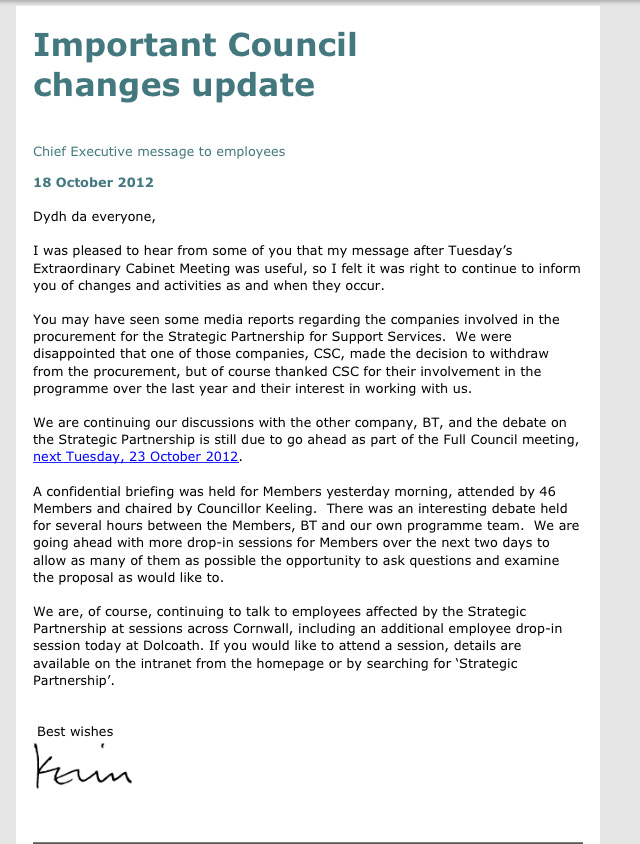
Council CEO Lavery says in his latest letter to all staff that 46 councillors attended a confidential briefing with BT and the programme team on Wednesday.  It lasted several hours.

More briefings were planned to enable councillors to “examine the proposals”. Lavery’s letter to employees (below) is published on the blog of independent Cornwall councillor Andrew Wallis. He  says the letter indicates a “business as usual” approach.

Outsourcing plan a dead duck?

Now that CSC has withdrawn from the bidding leaving only BT some in Cornwall are saying that the outsourcing plans are a dead duck. But perhaps not.

An article on Thisiscornwall.co.uk suggested that councillors might not have ousted Robertson had they received a confidential briefing on the deal before the vote.

BT’s savings pledges

In its briefing BT offers “guaranteed” savings of £60.6m on the core contract in years one to ten, plus  “£89m savings from procurement” – a total of £149.6m.

It is promising “additional forecast savings of £104.4m” plus £25m “anticipated profit share from trading”, which BT describes on a slide as a “cautious” estimate.

BT is further promising “additional procurement savings” of £129.4m, bringing the grand total of promised savings to £279m.

When Andrew Wallis asked at the briefing how the figures stack up if one or more of the other partners such as the Royal Cornwall Hospitals Trust do not enter into the partnership (and it is far from assured that NHS trusts will join the partnership)  he was told the figures would change. At that time BT could not give Wallis the revised figures but said it would send them to him.

A warming to BT?

Liberal Democrat leader Jeremy Rowe says it is possible there may be some merit in shared services and there’s a need to explore that without ruling it out completely.  “I would like to see officers working up a ‘third way’ option and to put all three options in front of the new council.”

Labour councillor Jude Robinson attended the confidential briefing.  Her blog gives a good insight into what happened.

“It was an interesting session and explained a lot. I’ve always said we have to consider this proposal seriously but we need evidence and figures to back up the reassurances and promises we have been given. The great mystery now is why councillors have been excluded for so long from this process. Just look where that has got us..

“Cornwall Council has spent huge amounts of time and a lot of money (£1.8 million) on this JV [joint venture] but the way it has been driven through has created tensions and mistrust that could mean this is rejected. £1.8 million is a lot of money for a dead duck.

“We now have only one company interested in bidding for this venture.  How can Cornwall Council put a tender out to one company and be sure of testing the market and getting the best value? is it even legal according to the constitution?

“To their credit, BT have done a lot of work over the past two years with officers of the council. They are still here but now, at the very end of the process it looks very uncertain. The Council has not even considered other options properly and it would be wrong to go for this just because it is on the table when we don’t know what other alternatives may deliver.

“It would also be politically outrageous to award a contract that commits the next council – after elections – to major change and risk without a democratic mandate.

“Will BT hang around or cut their losses? Will Cornwall lose out what could be a very positive offer because of the way this has been mishandled?”

Comment:

BT’s briefings seem to have had an effect on some councillors; and staff get the impression their jobs are uncertain if they stay with Cornwall council but, if they join BT, they will come under the company’s current policy of no compulsory redundancies. And they’ll get BT broadband for £1 plus other offers.

It’s by no means certain that the full council will vote next week to reject an outsourcing deal.  If it votes in favour of a deal that will be quite a victory for BT, Lavery and some on the council team who appear to believe that BT can cut costs, transform services, make a profit and employ hundreds more people without any downside.

Lavery’s letter as published on Andrew Wallis’s blog:

Cornwall council votes out its leader – a setback for pro-outsourcers?

By Tony Collins

Updated 17 Oct 2012

Cornwall Council has today voted to remove its Conservative leader Alec Robertson, which casts some doubt over a mega-outsourcing deal with CSC or BT.

Robertson and his cabinet colleagues have been ardently in favour of an outsourcing deal that could be worth between £210m and £800m.

He will be replaced as leader by Conservative Jim Currie who had resigned from the cabinet in protest at its push towards the outsourcing deal despite a vote of the full council against the signing of a contract.

Currie’s appointment as the new leader – by 49 votes to 46 – makes an outsourcing deal less likely, though a final decision will be taken by the full council on 23 October. Several pro-outsourcing members of the cabinet resigned a few minutes ago without giving a reason. The suggestion is that they would not serve under Currie because he is opposed to outsourcing.

Standing against Currie for leadership of the council was Neil Burden, an independent councillor and member of the cabinet. In general the pro-outsourcing councillors voted for Burden.

Two independent councillors, Graham Walker and Bob Egerton, had brought the vote of no confidence in Robertson. It was carried by a majority of 14 – 63 in favour and 49 against.  The chair of the council Pat Harvey said she was sorry Robertson had lost the vote.  She thanked Robertson for all he has done for the council. She expressed regret that several cabinet members had resigned over Currie’s appointment as leader.

During the debate on the vote of no confidence in Robertson, most of the arguments in favour of his staying were supportive of him as a person. Most of the arguments against him were about the council’s policies and particularly his cabinet’s strong support for an outsourcing deal.

Several councillors spoke of their dismay that a majority at a full council meeting in September voted against the outsourcing deal but the cabinet has proceeded with negotiations anyway.

Comment:

Robertson lost the vote  but not by a large majority. It may be that his displacement will bring out neutral councillors in sympathy for his mega-outsourcing deal.

The new leader  Jim Currie won the vote in favour of his appointment by a margin of only three.  Though he is against an outsourcing deal, he will find himself up against opposition from some colleagues and particularly some senior officials.

The strength of feeling in some parts of the council for a deal to be signed is remarkable. Could that strength of feeling overcome opposition to the signing of a deal, even with Currie as the new leader?

Refreshing

Continuity of leadership is usually a good thing, but not when the leaders have become too like-minded and lack independent challenge.  Some new faces at the top of Cornwall council will refresh the authority’s outlook even with only a few months to go before local elections.

Currie doesn’t rule out outsourcing deal

In an interview with regional BBC TV news, Currie said he will want to see the facts of the outsourcing proposals, and he urged caution – but did not appear to rule out the signing of a contract.  Doubtless BT and CSC will be working hard to keep the scheme alive. Can they persuade Currie to change his mind – although he was elected in part because of his opposition to the outsourcing scheme?